AMD Radeon RX 9070 GRE Review: A good answer to the memory crisis, or just a stopgap?
Last summer, we imported the Radeon RX 9070 GRE from China, anticipating an international release. Almost a year later, AMD's latest graphics card is indeed launching in the west, making it time for a second review. Can it beat the Geforce RTX 5070?
Test Add as a preferred source on Google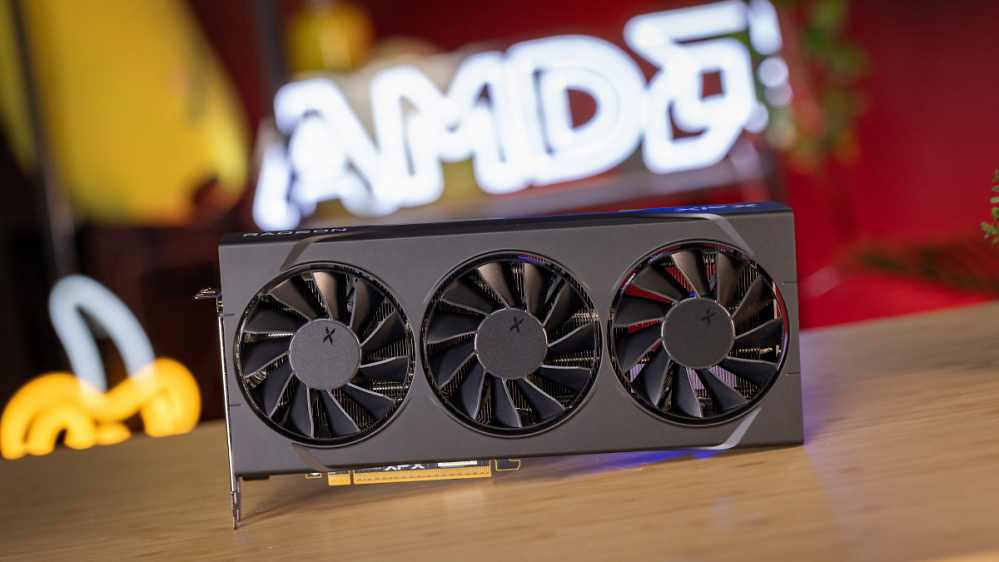
Table of content
- Page 1 Overview and specifications
- Page 2 Game benchmarks and performance index
- Page 3 Ray tracing benchmarks and performance index
- Page 4 Path tracing benchmarks and performance index
- Page 5 Power consumption and efficiency
- Page 6 Price-performance ratio in rasterization & ray tracing, & conclusion
- Page 7 Image gallery
"I love it when a plan comes together!": In the 1980s, those satisfied words echoed from countless television sets whenever the legendary A-Team had successfully completed another mission. Almost 40 years later, the quote fits our stunt with the Radeon RX 9070 GRE perfectly. In the summer of 2025, we imported the China-exclusive graphics card for an in-depth test - not out of boredom, but because we assumed the card would sooner or later make its way to international markets as well. 13 months after China, the Radeon RX 9070 GRE hits western markets - with identical specifications, tougher market conditions, and a higher price tag. In our review of AMD's latest graphics card, we examine whether it is a convincing answer to the memory crisis or a sluggish stopgap.
Radeon RX 9070 GRE: Overview
Loyal PCGH readers have known about the latest "Great Radeon Edition" (GRE) for almost ten months. In essence, everything we wrote about the product in our first review of the Radeon RX 9070 GRE still stands, and yet everything is different. In the meantime, memory prices have skyrocketed in the wake of the AI boom, with noticeable consequences for hardware prices. As a result, we are once again putting the same product through a full review. Pricing plays a key role here, even if hurts.
The short version: In the medium term, no relief regarding DRAM pices is expected. Looking ahead, memory prices are likely to rise further, fuelled by additional geopolitical cost drivers such as the Iran conflict. Attractive graphics cards with 16 GiByte, such as the Radeon RX 9070 (XT), are therefore becoming more expensive. As our colleagues at Igor's Lab explain, price increases of up to 200 euros are expected. This scenario comes into play once existing inventories have been cleared and new stock has to be purchased. So what do manufacturers do when component costs rise? They use fewer components. The Radeon RX 9070 GRE serves precisely that purpose, making even more sense in mid-2026 than it did a year ago.
 Source: PC Games Hardware
AMD Radeon RX 9070 GRE (second) Review: Overview
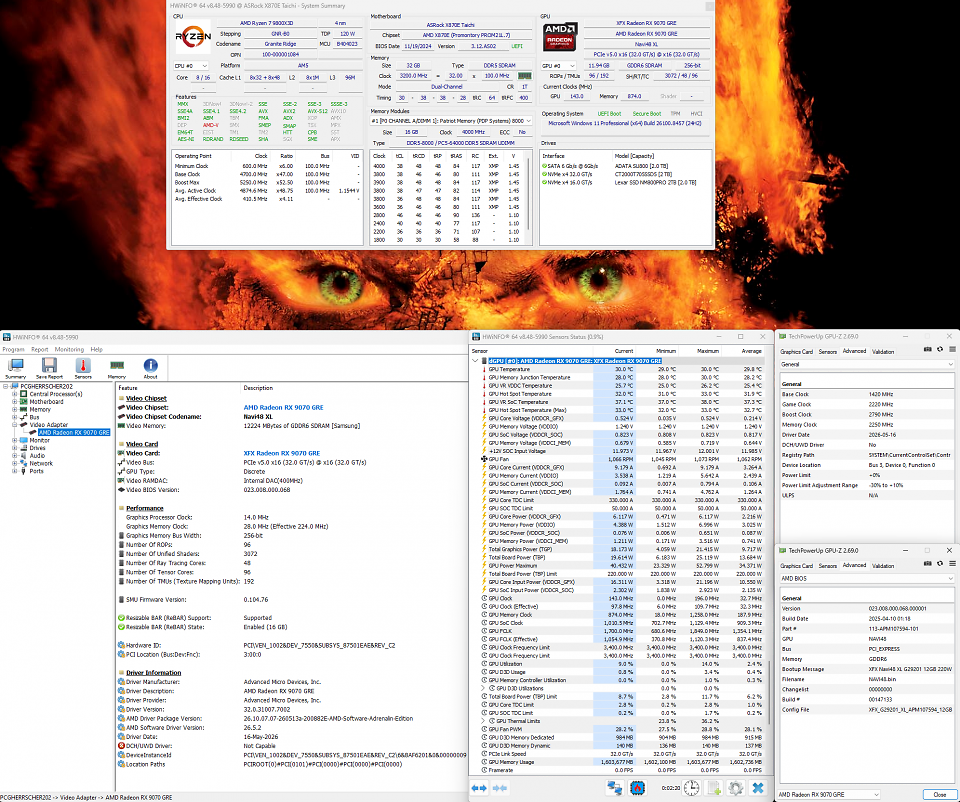
Technically, the Radeon RX 9070 GRE is based on the same GPU as the RX 9070 and RX 9070 XT, but it has to make a number of concessions. The number of active FP32 shader units is reduced to 3,072, while the memory subsystem is cut down even more noticeably: caches, data paths, and memory capacity each shrink by 25 percent, with lower clock speeds on top. Let us take a look at the full specifications of the Radeon RX 9070 GRE. Additional models can be found in our maintained GPU database:
Source: PC Games Hardware
AMD Radeon RX 9070 GRE (second) Review: Overview
Technically, the Radeon RX 9070 GRE is based on the same GPU as the RX 9070 and RX 9070 XT, but it has to make a number of concessions. The number of active FP32 shader units is reduced to 3,072, while the memory subsystem is cut down even more noticeably: caches, data paths, and memory capacity each shrink by 25 percent, with lower clock speeds on top. Let us take a look at the full specifications of the Radeon RX 9070 GRE. Additional models can be found in our maintained GPU database:
| Graphics card | RX 9070 | RX 9070 GRE | RX 9060 XT 16GB | RTX 5070 | RTX 5060 Ti 16GB |
|---|---|---|---|---|---|
| Reference card available? | No | No | No | Yes | No |
| Tested model | Sapphire Pulse | XFX Swift | Sapphire Pulse | Nvidia FE | Palit Infinity 3 |
| Release date | March 6, 2025 | June 2, 2026** | June 5, 2025 | March 5, 2025 | April 16, 2025 |
| Architecture | AMD RDNA 4 | AMD RDNA 4 | AMD RDNA 4 | Nvidia RTX Blackwell | Nvidia RTX Blackwell |
| GPU codename/configuration | Navi 48 XT | Navi 48 XL | Navi 44 XT | GB205-300 | GB206-300 |
| GPU size (die) | 356.5 mm² | 356.5 mm² | 199 mm² | 263 mm² | 181 mm² |
| GPU Transistors (bn) | 53.9 | 53.9 | 29.7 | 31.1 | 21.9 |
| Manufacturing process (foundry) | N4P (TSMC) | N4P (TSMC) | N4P (TSMC) | 4N (TSMC) | 4N (TSMC) |
| FP32 ALUs/TMUs/ROPs | 3,584*/224/128 | 3,072*/192/96 | 2,048*/128/64 | 6,144/192/80 | 4,608/144/48 |
| Ray tracing units | 56 | 48 | 32 | 48 | 36 |
| Matrix units (“AI cores”) | 112 | 96 | 64 | 192 | 144 |
| Level 2 cache (MiB) | 8 | 6 | 4 | 48 | 32 |
| Level 3 cache (MiB) | 64 | 48 | 32 | – | – |
| GPU boost clock in games (MHz) | 2,63 | 2,87 | 3,11 | 2,8 | 2,72 |
| FP32 ALU performance (TFLOPS) | 37.7 | 35.3 | 25.5 | 34.4 | 25.1 |
| Fill rate (Gtex/Gpix per sec.) | 589.1/336.6 | 551.0/275.5 | 398.1/199.0 | 528.0/220.0 | 391.7/130.6 |
| Multi Frame Generation | No | No | No | Yes, up to 5 AI frames | Yes, up to 5 AI frames |
| Frame Generation for all games | Yes, 1 interpolated frame | Yes, 1 interpolated frame | Yes, 1 interpolated frame | Yes, 1 interpolated frame | Yes, 1 interpolated frame |
| Memory bus (bit) | 256 | 192 | 128 | 192 | 128 |
| RAM speed (GT/s/MHz) | 20.1/10,072 | 18.0/9,000 | 20.0/10,008 | 28.0/14,001 | 28.0/14,001 |
| Memory type | GDDR6 | GDDR6 | GDDR6 | GDDR7 | GDDR7 |
| Memory bandwidth (GB/s) | 644 | 432 | 320 | 672 | 448 |
| Memory capacity (MiB) | 16,384 | 12,288 | 16,384 | 12,288 | 16,384 |
| PCI Express interface | 5.0 ×16 | 5.0 ×16 | 5.0 ×16 | 5.0 ×16 | 5.0 ×8 |
| Power connectors | 2× 8-pin | 2× 8-pin | 1× 8-pin | 1× 16-pin/2× 8-pin | 1× 8-pin |
| Power consumption (TBP) | 220 watts | 220 watts | 160 watts | 250 watts | 180 watts |
| Display connectivity | DP 2.1a, HDMI 2.1b | DP 2.1a, HDMI 2.1b | DP 2.1a, HDMI 2.1b | DP 2.1b, HDMI 2.1b | DP 2.1b, HDMI 2.1b |
| Video decoding | VP9/H.264/H.265/AV1 | VP9/H.264/H.265/AV1 | VP9/H.264/H.265/AV1 | H.264/H.265/AV1 | H.264/H.265/AV1 |
| Video encoding | H.264/H.265/AV1 | H.264/H.265/AV1 | H.264/H.265/AV1 | H.264/H.265/AV1 | H.264/H.265/AV1 |
| Price at time of review (euros) | 550 | 559 MSRP | 390 | 570 | 530 |
Performance figures are based on the graphics cards we have tested extensively, using the average GPU boost clock across all benchmarks. The legally safeguarded manufacturer specifications are sometimes significantly lower. *ALUs with dual-issue capability; the figure shown represents the best possible, doubled throughput. **Already released in China on May 8, 2025.
What is interesting is that AMD specifies the Radeon RX 9070 and RX 9070 GRE with the same board power. The generous power budget allows the RX 9070 GRE to boost higher than the RX 9070. Based on the clock speeds actually achieved, the compute performance of the two cards differs only marginally, with a 7 percent advantage for the RX 9070. That shifts attention to the memory subsystem. Here, the cutbacks result in 33 percent less bandwidth and 25 percent less capacity, which clearly affects performance. This makes the Radeon RX 9070 GRE the only 12-GiByte graphics card in AMD's RDNA 4 portfolio, just as the Geforce RTX 5070 is in Nvidia's Blackwell line-up.
For several years now, 12 GiByte has no longer been enough to run demanding games at maximum details without side effects. Even so, this capacity is the only logical configuration for the Radeon RX 9070 GRE. The option of 18 GiByte, as seen with a supposed Geforce RTX 5070 Super, is not viable because GDDR6 is not produced with 1.5 times the capacity. On the following pages, we use more than 40 game benchmarks to determine where the Radeon RX 9070 GRE lands in the 2026 graphics card comparison.
- Page 1 Overview and specifications
- Page 2 Game benchmarks and performance index
- Page 3 Ray tracing benchmarks and performance index
- Page 4 Path tracing benchmarks and performance index
- Page 5 Power consumption and efficiency
- Page 6 Price-performance ratio in rasterization & ray tracing, & conclusion