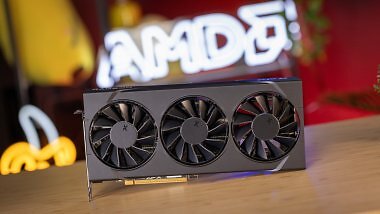
RX 9070 GRE review: Ray tracing benchmarks and performance index
Raytracing gehört längst zum guten Ton - beziehungsweise Bild. Wie die RT-Leistung der Radeon RX 9070 GRE ausfällt, erfahren Sie hier.
Inhaltsverzeichnis
- Page 1 Overview and specifications
- Page 2 Game benchmarks and performance index
- Page 3 Ray tracing benchmarks and performance index
- Page 4 Path tracing benchmarks and performance index
- Page 5 Power consumption and efficiency
- Page 6 Price-performance ratio in rasterization & ray tracing, & conclusion
- Page 7 Image gallery
Visually impressive ray tracing is finding its way into more and more games, so any newly purchased graphics card should be prepared for it. The 15 games in the 2026 ray tracing performance index push graphics cards hard and therefore show how suitable they are. As you can see below, we combine the "who's who" of current ray tracing implementations whose practical value is not in question. The performance of the graphics card determines whether the visual upgrade can actually be used. Since we test with maximum ray tracing complexity, upsampling assists the GPUs in some cases. We test most games at an internal resolution of 67 percent, equivalent to most "Quality" modes. This means image quality is not identical between manufacturers, but this reflects real-world gaming conditions, and we therefore use this practical setting. Frame Generation, Variable Rate Shading, and low-latency options remain consistently disabled in order to create otherwise equal conditions.
Radeon RX 9070 GRE: Raytracing-Benchmarks
The high demands of modern ray tracing implementations require more compromises than mild upscaling on most graphics cards. Let us take a look at how the cut-down Navi 48 handles the ray load across 15 games.
If wanted, you can enable up to 17 additional graphics cards for each game, which we have hidden for the sake of clarity.
You are seeing that correctly: Compared with rasterization, the Radeon RX 9070 GRE has a somewhat harder time competing near the top of the displayed graphics cards, while the RX 9070 is usually represented confidently in the top three. The results in Dragon Age: The Veilguard and Spider-Man 2 are particularly striking. These games allow us to reliably diagnose borderline memory capacity, as most recently shown in our test of the Intel Arc Pro B70. Ray tracing always increases memory requirements, which in the case of 12 GiByte occasionally exceeds the available capacity and makes reduced detail settings necessary. For additional results, including Dragon's Dogma 2, Indiana Jones and the Great Circle, and Ratchet & Clank: Rift Apart, please refer to our first review of the Radeon RX 9070 GRE. Finally, let us take a look at the performance indices resulting from the 15 game benchmarks:
Graphics cards marked with "NA" were tested only in 1080p, which is why only the Full HD performance index is available here. Graphics cards without hardware ray tracing support are omitted entirely.
The overall rating reinforces the interesting individual results: In ray tracing, the Radeon RX 9070 GRE is only 23 percent faster than the Radeon RX 9060 XT 16GB, compared with 31 percent in rasterization. The reason is straightforward: a lack of memory. The Radeon RX 9070 non-XT does not have that problem, allowing it to extend its lead over the GRE to 22 percent, compared with 19 percent in rasterization. But it is not only the Radeon RX 9070 that gains ground; the Geforce RTX 5070 does as well. Thanks to better memory management, Nvidia's card copes well even with high resolutions and also benefits from its ray tracing strength. It is not enough to swap positions, however, with the RX 9070 remaining narrowly ahead. In rasterization, the gap is nine percent. On the next page, we raise the difficulty to level 3 out of 3: Is path tracing usable on the Radeon RX 9070 GRE?
- Page 1 Overview and specifications
- Page 2 Game benchmarks and performance index
- Page 3 Ray tracing benchmarks and performance index
- Page 4 Path tracing benchmarks and performance index
- Page 5 Power consumption and efficiency
- Page 6 Price-performance ratio in rasterization & ray tracing, & conclusion