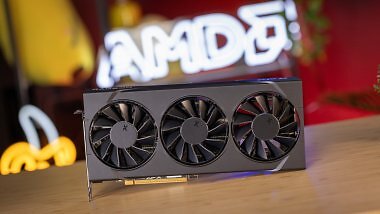
RX 9070 GRE review: Path tracing benchmarks and performance index
How well does path tracing run on the Radeon RX 9070 GRE? We tested it across seven games.
Inhaltsverzeichnis
- Page 1 Overview and specifications
- Page 2 Game benchmarks and performance index
- Page 3 Ray tracing benchmarks and performance index
- Page 4 Path tracing benchmarks and performance index
- Page 5 Power consumption and efficiency
- Page 6 Price-performance ratio in rasterization & ray tracing, & conclusion
- Page 7 Image gallery
Pathtracing Performance Chart
Loyal PCGH readers will not be surprised by this discipline, which has been part of our testing since 2025. After all, we had already mentioned the idea of a path tracing performance index several times. With the release of the Geforce RTX 5090, the time was right to raise the difficulty of our benchmarks by another level and make better use of the new circuitry. So that is exactly what we did: We are proud to present the world's only extensive path tracing performance index. Since the number of games with "full ray tracing," as path tracing is often called, remains limited, the selection is still small, but carefully chosen.
Although the demands of path tracing games vary enormously, they do have one thing in common: Due to the heavy ray load, a CPU limit is nowhere to be found, allowing the fastest graphics cards to show their full potential. Let us take a look at how the latest "Great Radeon Edition" handles that ray load. To avoid overwhelming the GPU mid-range, we switch from WQHD/1440p to Full HD/1080p for this discipline.
If wanted, you can enable up to 15 additional graphics cards for each game, which we have hidden for the sake of clarity.
Path tracing remains a tough test, even in Full HD with upsampling. The Radeon RX 9070 GRE holds its own, but struggles under the heavy load of pixels and GiBytes; even 30 fps is an ambitious target. What is interesting is how close the Radeon RX 9070 GRE and Intel's Arc Pro B70 are to each other, with comparable path tracing performance. Finally, let us take a look at the path tracing performance indices:
What is going on here? You can probably guess: a lack of memory. While 12 GiByte is sufficient in the vast majority of rasterization scenarios, ray tracing causes problems more often. Path tracing increases memory requirements by several hundred additional megabytes, putting the Radeon RX 9070 GRE in a difficult position, as is particularly evident in the Ultra HD result. Its 16-GiByte siblings, the RX 9060 XT 16GB and RX 9070, do not have these issues, which is why they perform better. This leads to the curious outcome that the RX 9070 GRE renders only 13 percent faster than the RX 9060 XT 16GB in path tracing. Despite comparable compute performance, the Radeon RX 9070 pulls far ahead of the GRE at plus 39 percent. And one more model shifts into high gear: Nvidia's Geforce RTX 5070. No AMD model comes anywhere near the path tracing performance of this card. With that, we conclude our look at gaming performance and turn to power consumption and energy efficiency.
- Page 1 Overview and specifications
- Page 2 Game benchmarks and performance index
- Page 3 Ray tracing benchmarks and performance index
- Page 4 Path tracing benchmarks and performance index
- Page 5 Power consumption and efficiency
- Page 6 Price-performance ratio in rasterization & ray tracing, & conclusion