RX 9070 GRE review: Noise levels, power consumption, and efficiency
How much power does the Radeon RX 9070 GRE draw, and how efficient is it? Find out here.
Inhaltsverzeichnis
- Page 1 Overview and specifications
- Page 2 Game benchmarks and performance index
- Page 3 Ray tracing benchmarks and performance index
- Page 4 Path tracing benchmarks and performance index
- Page 5 Power consumption and efficiency
- Page 6 Price-performance ratio in rasterization & ray tracing, & conclusion
- Page 7 Image gallery
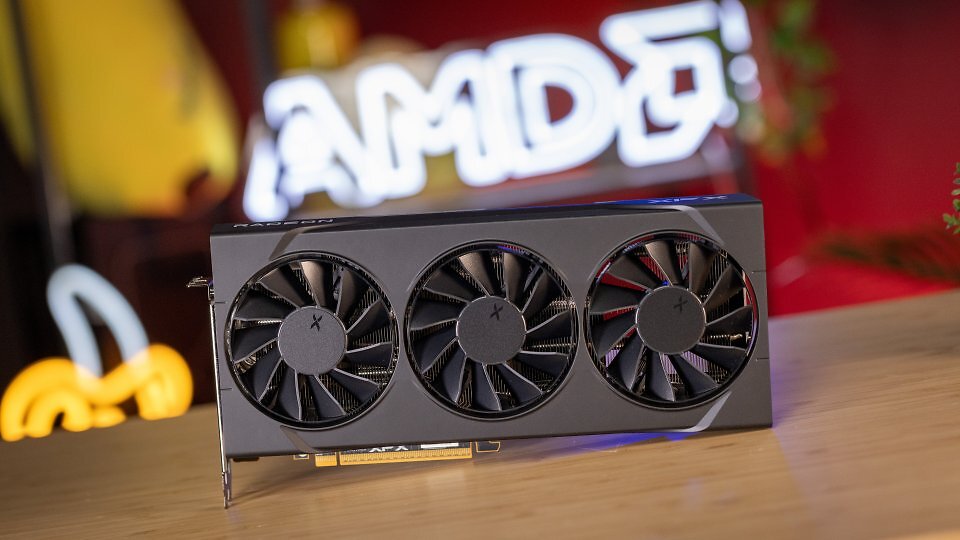
The Radeon RX 9070 GRE is strictly a partner product; AMD is not releasing a "Made by AMD" reference card. For our power consumption measurements and efficiency calculations, we use the same graphics card as in the benchmarks: an XFX Radeon RX 9070 GRE Swift, which operates at 220 watts board power (TBP). This is the baseline specification. AMD's board partners do, however, offer factory-overclocked models that deliver higher performance and higher power consumption. Speaking of which: The Radeon RX 9070 GRE Pulse Metal that we imported in the summer of 2025, with a factory-set 230-watt power limit, remains exclusive to China. In the West, Sapphire is releasing a more compact Pulse model in a black design. We would have liked to show you more of it, but our sample was stuck in customs for several days.
 Source: PC Games Hardware
Radeon RX 9070 GRE Review: AMD's RTX 5070 killer? (3)
Source: PC Games Hardware
Radeon RX 9070 GRE Review: AMD's RTX 5070 killer? (3)
Power delivery and power consumption
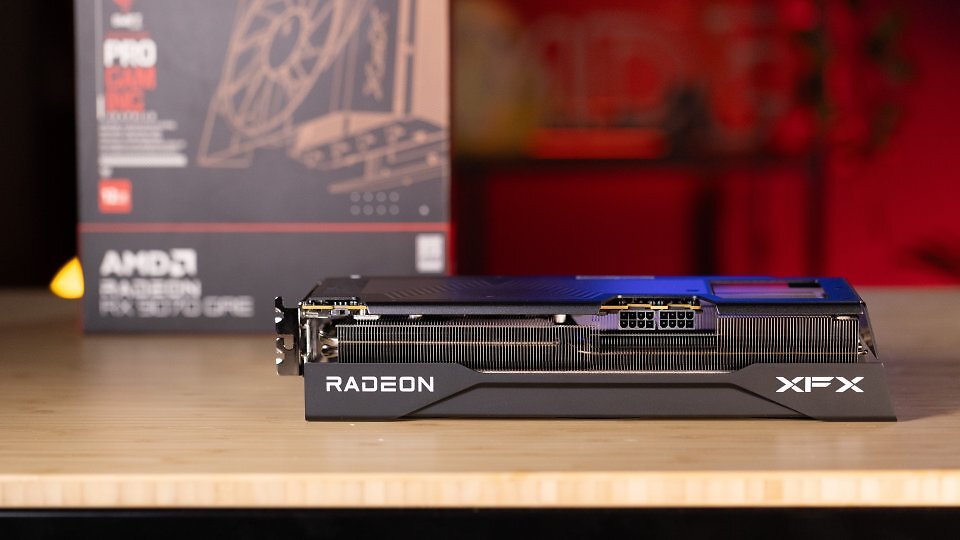
The entry barrier for your power supply is relatively low with a Radeon RX 9070 GRE, and identical to that of the Radeon RX 9070. Required are two conventional 8-pin power connectors and sustained power delivery of at least 220 watts. This wattage level was already established more than ten years ago by high-end graphics cards of the time. The chances are therefore good that your long-serving power supply will cope with a Radeon RX 9070 GRE, Geforce RTX 5070, or a comparable graphics card. The following video provides further guidance and wattage comparisons.
PCGH measures the power consumption of graphics cards using the Power Capture Analysis Tool. As always, the following table shows the maximum values for all graphics cards, with no limiting effect from the surrounding infrastructure. Users with good case ventilation, those who only play in Full HD, or those who prefer using frame limits will see lower power consumption and hear less noise. Let us now turn to the Radeon RX 9070 GRE's figures at idle, under low load, and across a variety of workloads:
| Power consumption | RX 9070 | RX 9070 GRE | RX 9070 GRE (China) | RX 9060 XT 16GB | RTX 5070 | RTX 5060 Ti 16GB |
|---|---|---|---|---|---|---|
| Tested model | Sapphire Pulse | XFX Swift | Sapphire Pulse @ 220W | Sapphire Pulse | Nvidia FE | Zotac Twin Edge |
| Idle (UHD desktop) | 7.5–8.0 watts | 6.5–7.5 watts | 7–8 watts | 6–7 watts | 10–14 watts | 12–13 watts |
| Dual display (UHD + FHD) | 8.0–8.5 watts | 9–10 watts | 8–9 watts | 7.5–9 watts | 14–16 watts | 14–15 watts |
| Ultra HD YouTube video | 20–27 watts | 21–26 watts | 24–29 watts | 16–18 watts | 13.5–15 watts | 15–16 watts |
| Gaming (maximum) | 225 watts | 223 watts | 224 watts | 168 watts | 263 watts | 184 watts |
| Anno 1800 (FHD, 4× MSAA) | 224 watts | 221 watts | 222 watts | 167 watts | 256 watts | 175 watts |
| Control (WQHD, RT) | 223 watts | 220 watts | 222 watts | 167 watts | 229 watts | 166 watts |
| CP2077 (Full HD, Raster) | 223 watts | 221 watts | 223 watts | 167 watts | 231 watts | 180 watts |
| Metro Exodus EE (WQHD, RT) | 223 watts | 222 watts | 222 watts | 167 watts | 262 watts | 183 watts |
| Full HD gaming @ 60 fps limit | 59 watts | 59 watts | 50 watts | 40 watts | 51 watts | 37 watts |
| CS2 (Full HD, 4× MSAA) | – | 221 watts | 222 watts | 166 watts | – | – |
| Dota 2 (FHD, 240 fps limit) | – | 77 watts | 79 watts | 76 watts | – | – |
| Max. power via slot (12V+3.3V) | 1 watt | 9 watts | 9 watts | 40 watts | – | 47 watts |
Power consumption depends on the display, resolution, and refresh rate. The stated range covers 60 to 144 Hertz.
The Radeon RX 9070 and RX 9070 XT ended the long-standing Radeon habit of drawing unnecessarily high power at idle, and the Radeon RX 9070 GRE follows the same path. Once a game is launched, RX 9000 graphics cards do everything they can to boost as high and as long as possible. That is normal behavior, but compared with Nvidia GPUs, AMD chips are noticeably more rigorous and use up their power budget in almost every case. As a result, a Radeon RX 9070 GRE almost always reaches its 220-watt limit even in Full HD/1080p, requiring just as much energy as the faster Radeon RX 9070. Both AMD graphics cards slightly exceed their limit in the most demanding games, with peaks resulting in an average power consumption of just under 225 watts. The power design is configured to draw most of the energy from the power cables, with no more than nine watts supplied through the motherboard slot.
 Source: PC Games Hardware
Radeon RX 9070 GRE review, again: AMD makes a point of advertising the card's use of traditional power connectors.
Source: PC Games Hardware
Radeon RX 9070 GRE review, again: AMD makes a point of advertising the card's use of traditional power connectors.
Energy efficiency
Power is work over time, as most of us learned in physics class. Since we have measured both frame rates in fps and power consumption in watts, we can put the two in relation to calculate energy efficiency. To do so, we created a benchmark that combines the performance index with power consumption. Since both metrics are averages across numerous measurements, the resulting comparison is sufficiently precise. For the strongest possible insight, we performed the calculation separately for rasterization and ray tracing. Let us see how the Radeon RX 9070 GRE compares:
Since both the Radeon RX 9070 and the Radeon RX 9070 GRE operate at 220 watts, the new and slower card falls behind in efficiency. A perfect comparison point is the Geforce RTX 5070, which draws a similar amount of power on average across all game benchmarks. Nvidia's model lands between the Radeon RX 9070 and the GRE variant. All graphics cards from the current Radeon RX 9000 (RDNA 4) and Geforce RTX 5000 (Blackwell) generations deliver excellent energy efficiency, roughly twice as high as graphics cards from 2020. Let us see what this looks like in ray tracing:
The differing wattage figures for some graphics cards are not an error, but a result of the workload. Most models consume a similar amount of power as they do in rasterization, while memory-handicapped 8-GiByte graphics cards have to insert idle cycles and therefore draw less energy. On the next page, we calculate the price-performance ratio of the Radeon RX 9070 GRE and draw our conclusion.
- Page 1 Overview and specifications
- Page 2 Game benchmarks and performance index
- Page 3 Ray tracing benchmarks and performance index
- Page 4 Path tracing benchmarks and performance index
- Page 5 Power consumption and efficiency
- Page 6 Price-performance ratio in rasterization & ray tracing, & conclusion