
Gothic Remake: Graphics Card Benchmarks, Including Linux
How well does the Gothic Remake run on current graphics cards? We ran extensive benchmarks, including on Linux.
Inhaltsverzeichnis
Which graphics card and which processor are best for the Gothic Remake? On this page, we explain which graphics cards can handle the Gothic Remake smoothly. All benchmarks are based on a test scene that comes close to a worst-case scenario. We test in the riverbed near the Old Camp: forest on the left, rain, fog and god rays everywhere, plus shadows cast by torchlight. It is a demanding scene for the whole system and for the GPU in particular. Only the swamp can be even more demanding at times. So the same rule applies here as with PCGH benchmarks in general: graphics cards that deliver smooth performance in this scene are well prepared for the rest of the game — and that is useful to know.
To kick off the GPU benchmarks, we first want to outline the basic performance cost and set the bar. How does the Gothic Remake run in Ultra HD, with every effect maxed out and no upsampling? We tested this using the latest and fastest graphics card currently in the PCGH test lab, a Gigabyte Aorus Geforce RTX 5090 Infinity. We pushed it to a 3 GHz core clock and 34 GT/s memory speed. In the game, we enabled everything available, including DLAA (native DLSS). How many Fps can a graphics card approaching the €4,000 mark achieve, and what becomes possible with Multi Frame Generation? The following benchmark shows the answer.
The heavily overclocked Geforce RTX 5090 makes it clear that the Gothic Remake is extremely demanding on GPUs — at least at maximum details. Frame Generation, in the benchmark above using Nvidia's implementation, helps increase visual smoothness. Given these results, further benchmarks at maximum details without upsampling are off the table.
GPU benchmarks
We tested 40 graphics cards released between 2017 and 2026 across six resolutions, ranging from Full HD to Ultra HD and Dual QHD, or 32:9. The super-ultrawide format already has its share of fans, which is reason enough for us to include this cinematic presentation whenever a game supports it properly. The Gothic Remake is one such title, so we are happy to provide DQHD results as well.
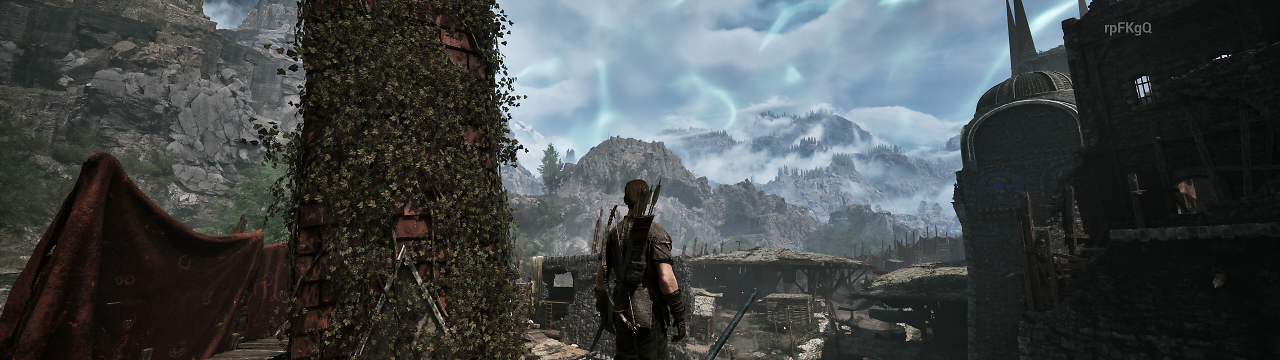
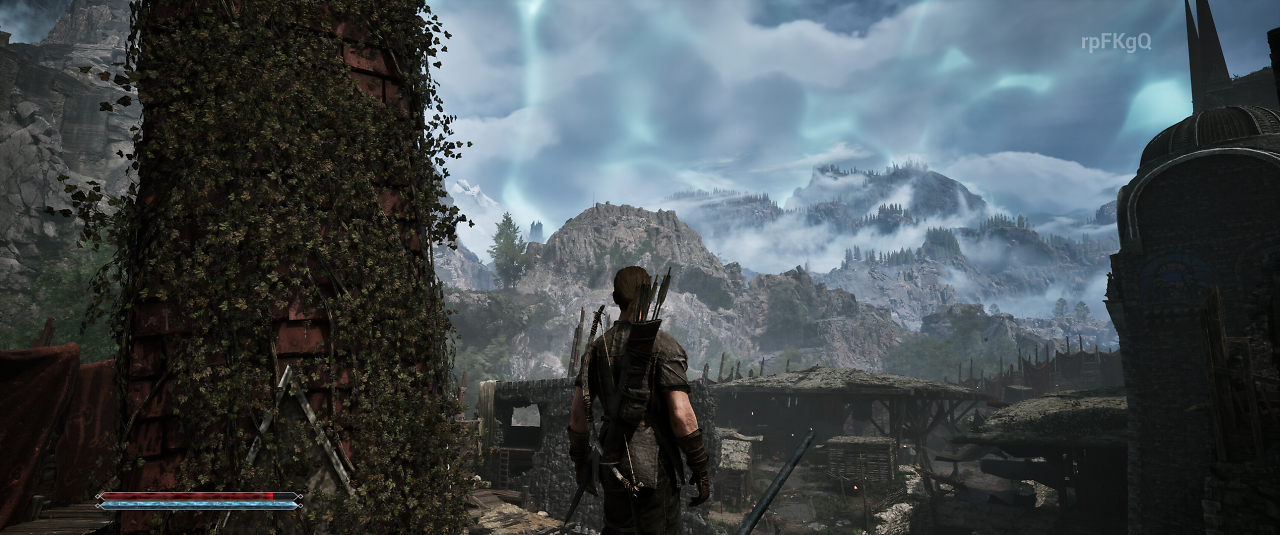
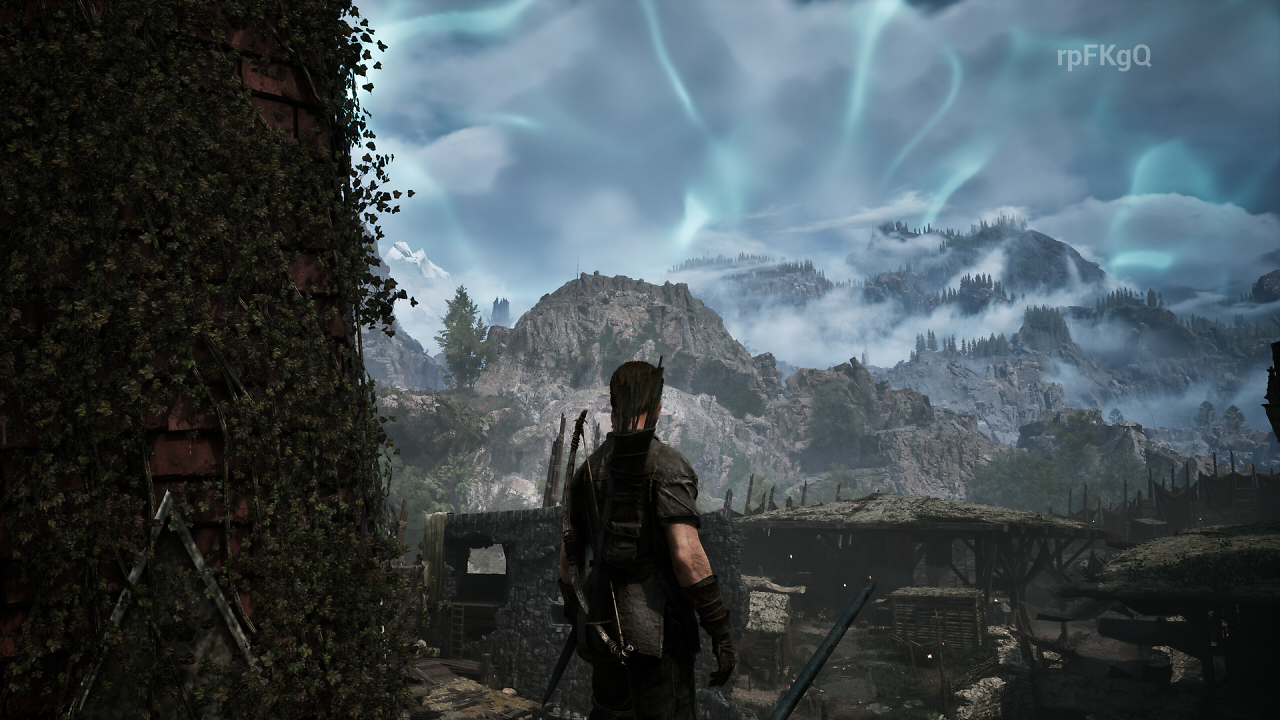
As usual, we record the performance metrics with CapFrameX. For the benchmarks, we calculate the averages from three runs, both for the average fps and the P1 percentile, meaning the average of the lowest one percent of frame times. To make the results as transparent as possible, we also list the average clock speeds recorded during the measurements and show the benchmark scene in the video above. Should you wish to reproduce our benchmarks on your own system, you are very welcome to do so. We can provide our save files for download on request.
GPU Benchmarks at native resolution
Since maximum details without upsampling are extremely demanding, but our readers and viewers also want native benchmarks, we came up with a compromise. For the benchmarks at native resolution, we do not test at maximum details, but instead use the 'Gothic' preset, which corresponds to very high details. In the following benchmarks, every graphics card renders the same image and faces the same workload. Here are the results:
As you can see, the Gothic Remake places high demands on the graphics card, but it also gives plenty back visually. It is particularly pleasing that the game shows decent frame times. The small gap between the percentile values and the average reveals that frame delivery is consistent — and that is by no means standard for UE5 titles.
AMD's success story continues. After strong showings in Forza Horizon 6 and 007 First Light, the Gothic Remake is another playground for Radeon graphics cards. The top RDNA 4 model, the Radeon RX 9070 XT, can compete with the considerably more expensive Geforce RTX 5080, while the RX 9060 XT pulls well ahead of the RTX 5060 Ti, and the new Radeon RX 9070 GRE also puts in an excellent showing.
Anyone who really wants to play without upsampling will need a powerful graphics card even for 30 fps. Full HD/1080p is the easiest task: a Geforce RTX 4060, Radeon RX 7600, Arc B580 or older models such as the Radeon RX 5700 XT or Geforce RTX 2080 suffice here. WQHD/1440p, however, already calls for former high-end hardware, such as a Geforce RTX 3080 or Radeon RX 6800 XT. Those looking to upgrade are best served by a Radeon RX 9060 XT 16GB or Geforce RTX 5060 Ti 16GB. The very highest resolutions, Ultra HD and Ultrawide-5K, can only be driven by the strongest graphics cards on the market. Even so, 60 fps at 4K is only possible on €4,000-class monsters with upsampling — which brings us to the next set of benchmarks.
GPU Benchmarks with Upsampling
In the following benchmarks, we set the details to the absolute maximum, called 'Alkimia Overdose' in the Gothic Remake. These settings are labelled "experimental" because are extremely demanding. To ensure playable frame rates, each GPU is allowed to use its respective in-house upsampling method, always with an internal resolution of 67 percent. Due to the different technologies involved, neither the rendering workload nor the image quality is identical, but these settings reflect common practice. The results:
*Geforce RTX: DLSS 4.5 Quality, Radeon RX 9000: FSR 4.1 Quality, Radeon Vega-RX 7000 and Geforce GTX: FSR 3.1.4 Quality, Arc: XeSS 1.3.1 Ultra Quality
Maximum details hit hard, as the numbers clearly show. Even though the graphics cards have to handle far fewer pixels, frame rates drop significantly compared with the Gothic preset and native TSR. This does little to change the rankings, however: even with Alkimia Overdose, Radeon graphics cards continue to put in a strong showing.
Unfortunately, we once again have bad news for users of older graphics cards. This time it does not affect Radeon users, as it did in 007 First Light, but Geforce owners. As noted in the benchmark annotations, all Geforce generations prior to RTX 2000 show a tendency to crash. At first, we suspected the legacy driver, but GTX 16-series cards also quit to desktop. These GPUs are based on a hybrid architecture between Pascal, used in the GTX 10 series, and Turing, used in the RTX 20 series, and they still receive fresh drivers. However, the Geforce GTX 1660 Super we tested crashed during loading just as often as the GTX 1080 Ti and Titan V. As a workaround, we recommend lowering the details. The Gothic preset did not crash on us even once.
Memory Requirements (VRAM)
A closer look at the numbers already gives a clear indication: 8 GiB of VRAM is not enough for the visual splendour of the Gothic Remake. Let us start at the lower end. Anyone happy with the Gothic preset and Quality upsamling should be able to make their way through the Colony mostly without problems on 8 GiB. Higher resolutions or detail settings, however, lead to the usual problems: minor loading hitches and visibly streaming textures turn into noticeable slowdowns the longer you play. The Alkimia Overdose preset is completely off-limits with 8 GiB; even in Full HD, it causes major issues. From 10 GiB upward, as found on a Geforce RTX 3080 for example, the situation improves. Even so, we strongly recommend 12 GiB VRAM for using maximum details and Frame Generation without side effects. Anyone aiming for Ultra HD is best served by 16 GiB. As a reference point, during our long play sessions with many scene changes, the game allocated no more than 12 GiB in Ultra HD without Frame Generation.
Gothic Remake on Linux
Of course, we also tried the Gothic Remake on Linux. The game launches without issue on CachyOS and showed no bugs compared with Windows during our tests. But how does performance on Linux compare with Windows? For this first test, we selected representative GPUs from both manufacturers. Since large generational differences have already appeared in many other tests, we tested not only the Geforce RTX 5090 from Nvidia, but also an RTX 4080 Super. On the AMD side, a Radeon RX 9070 XT, RX 7900 XTX and RX 6800 XT took part. Measurements were taken using the Gothic preset with native TSR in UHD, WQHD and Full HD. The chart provides a direct comparison with Windows performance. The RTX 4080 is included as a comparison point to the theoretically stronger RTX 4080 Super and does not have a Windows result.
Gothic is an Unreal Engine 5 game, so completely unusual behaviour under Linux would not be expected. Nvidia cards suffer noticeably under CachyOS and lose a significant amount of performance. We also observed some strange behaviour between the RTX 4080 Super and an additionally tested RTX 4080. In UHD and WQHD, the supposedly weaker model achieved higher frame rates than its bigger sibling. The latter also showed a gradual reduction in frame rate over time in UHD after each new save-game load. Since this was not observed at lower resolutions, we suspect an issue with memory handling. We cannot provide more detail. Based on experience, Nvidia cards and their drivers remain unpredictable.
Things look different with AMD. The latest generation, represented by the RX 9070 XT, performs well, but does not yet match its Windows performance. Depending on the resolution, it falls short by three to five percent. The two older generations are much more convincing. The RX 7900 XTX takes the crown as our Linux front-runner and delivers a performance gain, while the even older RX 6800 XT impresses with an even greater uplift under Linux. There is only one minor criticism of AMD's Linux performance, at least on RX 9000 and RX 7000: frametime consistency is currently somewhat worse than under Windows. The lower P1 value suggests slightly less stable frame delivery, which is somewhat noticeable in practice but does not seriously affect the gaming experience.