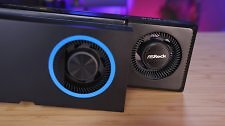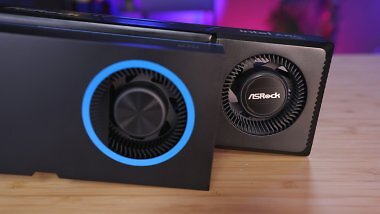
"Arc B780" DIY Project: Conclusion
PCGH's verdict on the "Arc B780".
In this Article
Intel's fastest graphics card had to prove itself once again—this time, not optimized for maximum efficiency, but for maximum performance. After this test, we know what Intel's best graphics card is truly capable of. Does this change our assessment of a potential Arc B770 or "Arc B780"?
Detailed Comparison: B780 vs. B70 vs. B580 vs. A770
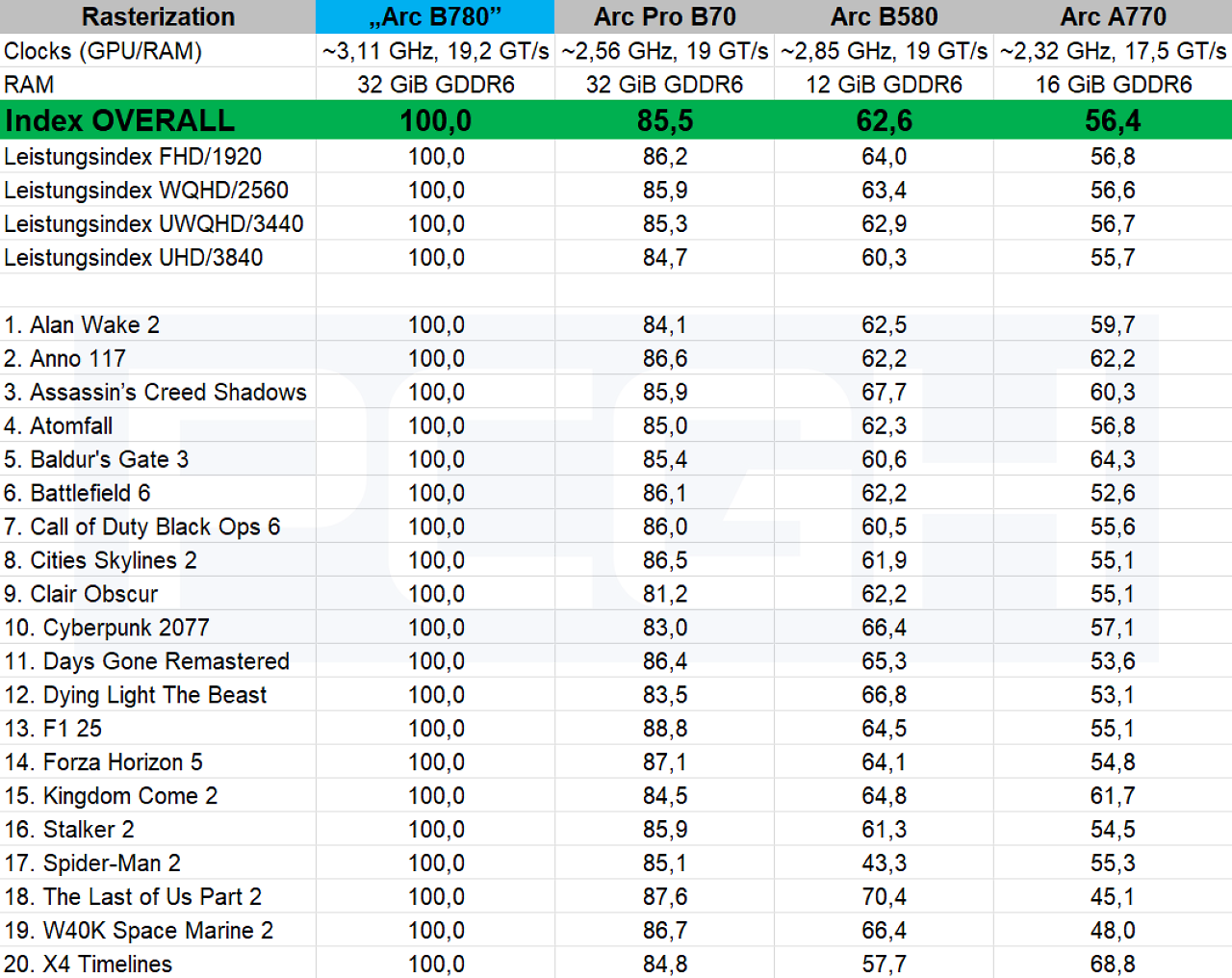
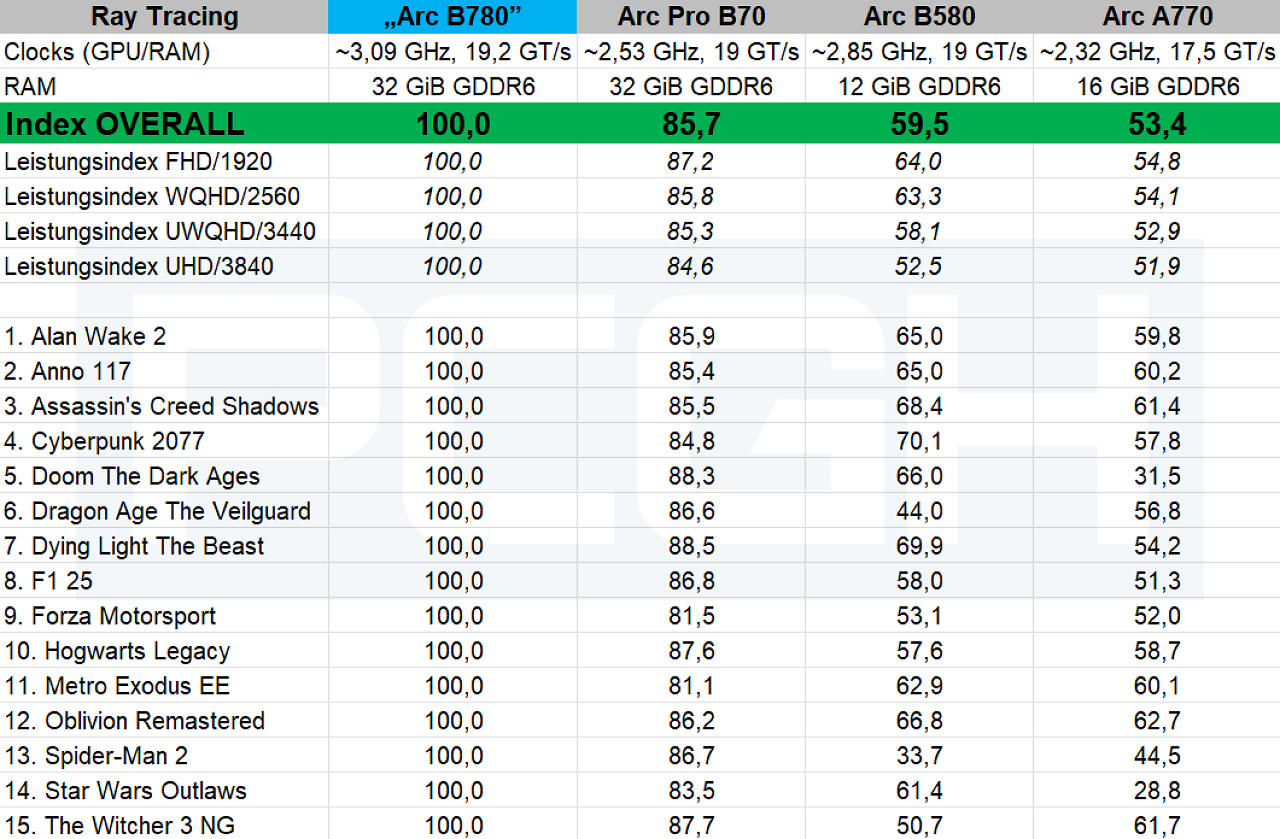
How significant is the performance boost offered by G31-based graphics cards compared to the Arc B580 and Arc A770? In which games does the higher clock speed of the "Arc B780" make the biggest difference compared to the Arc Pro B70? Below you will find the results of the rasterization and ray tracing benchmarks, with the B780 serving as the 100% baseline.
Building the Arc B780: Conclusion
In PCGH's in-depth review of the Arc Pro B70, Intel's powerful Battlemage processor demonstrated that it can hold its own against the GeForce RTX 5060 Ti 16GB and Radeon RX 9060 XT 16GB. However, the reference card's severe power limitations masked the true performance of the BMG-G31 processor, which left us unsatisfied. After testing the fully overclocked Asrock variant, we now know for certain: If Intel were to push it to the absolute limit, it could squeeze up to 20 percent more performance out of the current architecture—and would still fall short of the performance levels of the GeForce RTX 5070 and Radeon RX 9070. While the simulated "Arc B780" does manage to match the aforementioned AMD and Nvidia graphics cards in some cases, this is only at high resolutions and thus at borderline frame rates. Overall, we surpass the performance of older graphics cards, such as the Radeon RX 6800 XT, GeForce RTX 3080, Radeon RX 7800 XT, and GeForce RTX 4070—not a bad, though hardly impressive, level. The only issue is the power consumption required to achieve this: Our test unit draws around 300 watts across all benchmarks, while the faster RTX 5070 and RX 9070 hover in the 220-watt range.
"Arc B780": Impressionen aus dem Test
In conclusion, we'd like to revisit the question of what an official gaming graphics card with the G31 chip might be capable of. Rumors of such an Arc B770 have been circulating for the past year and a half. Our prediction was that, at best, Intel could deliver 15 percent more performance with a 3-GHz graphics card than with the Arc Pro B70. This is exactly the level we saw in our test of the "Arc B780," which we were even able to overclock to 3.1 GHz. We shouldn't expect more—and we don't need to, because with a competitive price under 400 euros (with 16 GB of VRAM), an Arc B770 would be attractive. The chances of Intel releasing such a model are slim. Die-hard Arc fans and enthusiastic hobbyists don't have to wait; an Arc Pro B70 works perfectly with the gaming drivers. Anyone who opts for an Asrock Arc Pro B70 Creator and manually pushes it to peak performance will get the ultimate Intel graphics card, delivering 60 to 90 percent more performance than an Arc B580.
What do you think of our experiment? You're welcome to follow us on Whatsapp and X for the latest news from the world of hardware and our exclusive content. You can find our video content (often spiced up with a dash of humor) on Youtube, Instagram, and Tiktok.