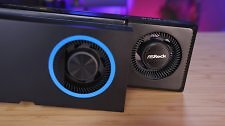
"Arc B780" DIY Build: Can We Beat the RTX 5070 and RX 9070 at 3.1 GHz?
In PCGH's review of the Arc Pro B70, Intel's largest and most powerful graphics chip recently demonstrated its potential. But there was one thing the heavily power-limited card didn't reveal: what the BMG-G31 is truly capable of. This article provides the answer through extreme overclocking.
Test Add as a preferred source on Google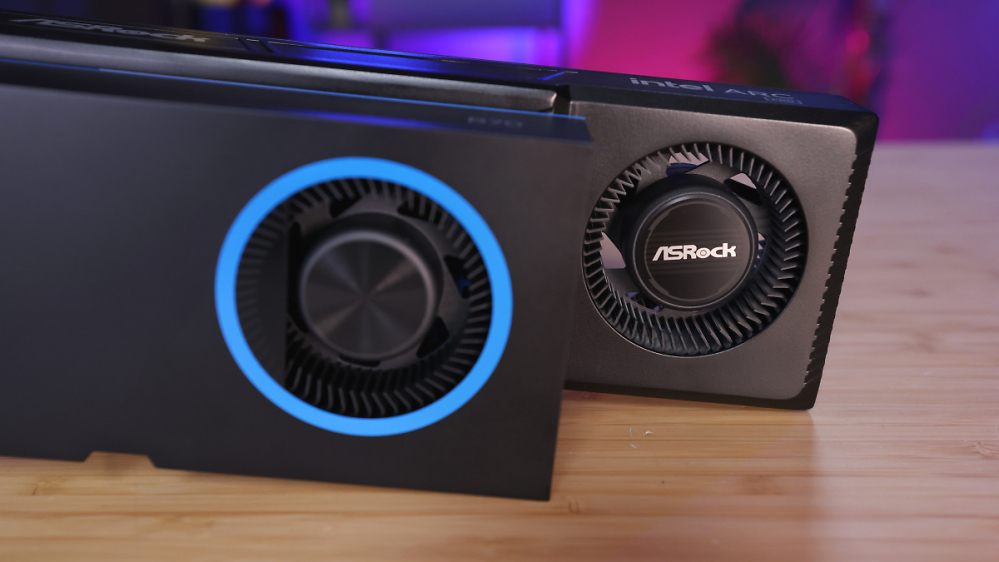
Inhaltsverzeichnis
In our review of the Intel Arc Pro B70, we were able to determine just what the highly anticipated "Big Battlemage" is capable of. Intel's most powerful graphics chip will likely remain reserved for professional graphics cards forever. That doesn't stop us from putting the Arc Pro B70 through its paces once again—after all, it's a formidable gaming card. For this test, we're not using the efficiency-optimized Intel reference card, but rather an Asrock Arc Pro B70 Creator, which can draw up to 330 watts and is thus a minor overclocking marvel. The stated goal: to close the gap on the GeForce RTX 5070 and Radeon RX 9070. Read on to find out if we succeeded in this attempt.
Building Your Own Arc B780: Overview
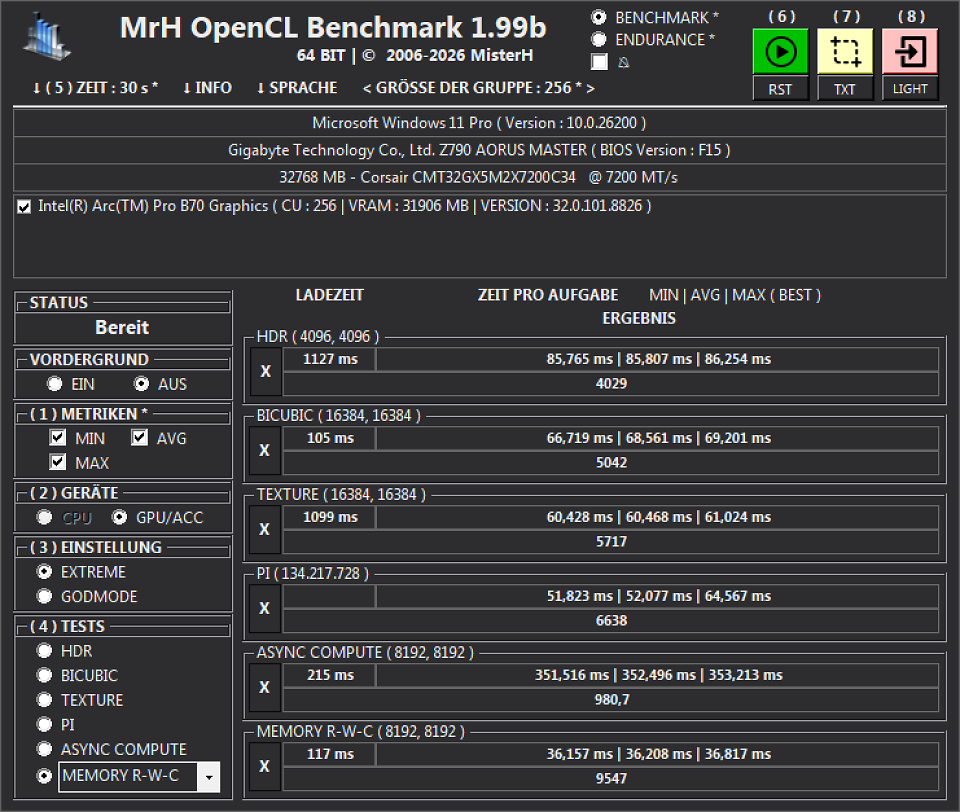
While the reference card comes directly from Intel, this test is "powered by the community": PCGHX member MisterH kindly provided us with his Asrock Arc Pro B70 Creator —many thanks for lending it to us! MisterH is no stranger to us; he's an enthusiast active in various forums who has even written his own benchmarking and tuning tool —feel free to check it out and put your CPU or GPU to the test.
 Source: PC Games Hardware
MisterH OpenGL Benchmark 1.99b with "Arc B780": Results
For this test, we are specifically capitalizing on the strengths of the Asrock graphics card, as it offers extensive tuning options. With the reference card, Intel locks the tuning menu in the graphics driver, while Asrock unlocks all the controls for board power, clock speeds, voltages, and fan speeds. This is a valuable feature, because unlike AMD and Nvidia graphics cards, Arc is still not supported by the usual overclocking tools, most notably MSI Afterburner. The procedure for this test is simple: We overclock the graphics card as much as possible and attempt to reach new performance levels. Let's take a look at the raw data the heavily overclocked Arc B70 delivers compared to the base model; you can find additional comparison models in our comprehensive GPU database:
Source: PC Games Hardware
MisterH OpenGL Benchmark 1.99b with "Arc B780": Results
For this test, we are specifically capitalizing on the strengths of the Asrock graphics card, as it offers extensive tuning options. With the reference card, Intel locks the tuning menu in the graphics driver, while Asrock unlocks all the controls for board power, clock speeds, voltages, and fan speeds. This is a valuable feature, because unlike AMD and Nvidia graphics cards, Arc is still not supported by the usual overclocking tools, most notably MSI Afterburner. The procedure for this test is simple: We overclock the graphics card as much as possible and attempt to reach new performance levels. Let's take a look at the raw data the heavily overclocked Arc B70 delivers compared to the base model; you can find additional comparison models in our comprehensive GPU database:
| Grafikkarten | „Arc B780” | Arc Pro B70 | Radeon RX 9060 XT 16GB | Geforce RTX 5060 Ti 16GB |
|---|---|---|---|---|
| Getestetes Modell | Asrock Creator MAX-OC | Intel-Referenz | Sapphire Pulse | Zotac Twin Edge |
| Architektur | Xe 2 (BMG) | Xe 2 (BMG) | RDNA 4 | RTX Blackwell |
| GPU-Codename/Konfektion | BMG-G31 | BMG-G31 | Navi 44 XT | GB206-300 |
| Chipgröße (Die) | 368 mm² | 368 mm² | 199 mm² | 181 mm² |
| Transistoren Grafikchip (Mrd.) | 27,7 | 27,7 | 29,7 | 21,9 |
| Fertigungsverfahren (Foundry) | N5 (TSMC) | N5 (TSMC) | N4P (TSMC) | 4N (TSMC) |
| FP32-ALUs/TMUs/ROPs | 4.096/256/128 | 4.096/256/128 | 2.048*/128/64 | 4.608/144/48 |
| Raytracing-Einheiten | 32 | 32 | 32 | 36 |
| Matrix-Einheiten („AI-Cores”) | 256 | 256 | 64 | 144 |
| Level-2-Cache (MiB) | 24 | 24 | 4 | 32 |
| Level-3-Cache (MiB) | – | – | 32 | – |
| Typ. GPU-Boost-Takt (MHz) | 3.100 | 2.560 | 3.110 | 2.720 |
| INT8-Dense-Leistung (TOPS, Peak) | 406 | 367 | 205 | 190 |
| FP16-Leistung ALUs (TFLOPS) | 25,4 | 21,0 | 51,0 | 25,1 |
| FP32-Leistung ALUs (TFLOPS) | 25,4 | 21,0 | 25,5 | 25,1 |
| FP64-Leistung ALUs (TFLOPS) | 1,6 | 1,3 | 0,4 | 0,4 |
| Füllrate (Gtex/Gpix pro Sek.) | 793,6/396,8 | 655,4/327,7 | 398,1/199,0 | 391,7/130,6 |
| Multi Frame Generation | Ja (bis zu 3 KI-Bilder) | Ja (bis zu 3 KI-Bilder) | Nein | Ja (bis zu 5 KI-Bilder) |
| Treiber-Frame-Generation | Nein | Nein | Ja (1 Zwischenbild) | Ja (1 Zwischenbild) |
| Speicheranbindung (Bit) | 256 | 256 | 128 | 128 |
| Geschwindigkeit RAM (GTs/MHz) | 19,2/9.600 | 19,0/9.500 | 20,0/10.008 | 28,0/14.001 |
| Speichertyp | GDDR6 | GDDR6 | GDDR6 | GDDR7 |
| Transferrate Speicher (GB/s) | 614 | 608 | 320 | 448 |
| Speicherkapazität (MiB) | 32.768 | 32.768 | 16.384 | 16.384 |
| PCI-Express-Anbindung | 5.0 ×16 | 5.0 ×16 | 5.0 ×16 | 5.0 ×8 |
| Stromanschlüsse | 1× 16-Pol | 1× 8-Pol | 1× 8-Pol | 1× 8-Pol |
| Leistungsaufnahme (TBP) | 330 Watt | 230 Watt | 160 Watt | 180 Watt |
| Display-Konnektivität | 4× DP 2.1 (UHBR13.5) | 4× DP 2.1 (UHBR13.5) | DP 2.1a (UHBR13.5), HDMI 2.1b | DP 2.1b (UHBR20), HDMI 2.1b |
| Video-Decoding | VP9/H.264/H.265/AV1 | VP9/H.264/H.265/AV1 | VP9/H.264/H.265/AV1 | H.264/H.265/AV1 |
| Video-Encoding | VP9/H.264/H.265/AV1 | VP9/H.264/H.265/AV1 | H.264/H.265/AV1 | H.264/H.265/AV1 |
Performance figures based on graphics cards we have thoroughly tested (average GPU boost across all benchmarks)—the legally binding manufacturer specifications are, in some cases, significantly lower. *ALUs with dual-issue capability; the best possible (double) throughput is listed.
The Intel reference card cannot reach its full potential due to its moderately selected operating point ("sweet spot"); in addition to cooling, it is primarily limited by the board's power supply. The Asrock Creator operates at 275 watts instead of 230 watts out of the box and can thus maintain its maximum boost of 2.8 GHz in the vast majority of cases, while the Intel card has to throttle down to an average of 2.56 GHz. Since 2.8 GHz does not represent a new performance class, we manually push the card to its maximum performance.
With a 20% increase in board power, resulting in 330 watts, along with a carefully balanced mix of clock offsets and enhanced cooling, we achieve peak clock speeds of 3.2 GHz. This level is not stable across all benchmarks, partly because we cannot use a custom voltage/frequency curve. While the Intel driver does offer this functionality, it rarely sets the clock and voltage points in a way that's easy to understand. Furthermore, it's not possible to save the overclocking settings using profiles. To make matters worse, a crash on Arc graphics cards causes the entire system to freeze, which can only be resolved by resetting the system. Tuning is thus significantly more difficult than with Radeon and GeForce, which is why we have to forgo that last bit of performance. Nevertheless: At 3.1 GHz, we easily break the psychologically significant barrier and increase the average clock speed by a solid 21 percent. When it comes to memory, however, we're out of luck: The Asrock card only manages to go a few MHz beyond the 19.2 GT/s mark.
Nevertheless, we've decided to call this fictional graphics card the "Arc B780." Why not B770? Because we're still dealing with a 32-GB model. Enough with the preamble—on the following pages, we'll use more than 40 benchmarks to determine how much of that impressive overclocking translates to actual gaming performance. Can we catch up to the GeForce RTX 5070 and Radeon RX 9070?