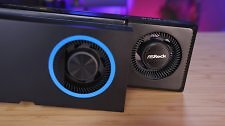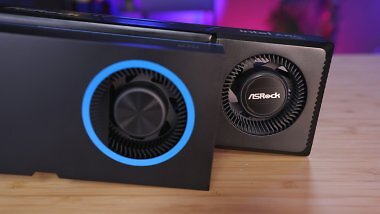
"Arc B780" DIY Build: Path Tracing Benchmarks and Performance Index
How well does path tracing perform on the overclocked Intel graphics chip? We put it to the test using seven games.
Inhaltsverzeichnis
Path Tracing Performance Chart
Loyal PCGH readers won't be surprised by this new category, which has been in the works since 2025—after all, we've mentioned the idea of a pathtracing performance index on several occasions. With the release of the GeForce RTX 5090, the time was right to ramp up the difficulty of our benchmarks and fully leverage the capabilities of these new chips. No sooner said than done—we proudly present the world's only comprehensive path tracing performance index. Since the number of games featuring "full ray tracing"—as path tracing is often called—remains limited, the selection is still small but excellent.
Although the demands of ray-tracing games vary enormously, they do have one thing in common: due to the high ray load, you won't find any CPU bottlenecks here, allowing the fastest graphics cards to truly shine. Let's see how the overclocked BMG-G31 processor handles the ray load. To avoid overtaxing the graphics cards under review, we're switching from WQHD/1440p to Full HD/1080p for this test.
Half-Life 2 RTX does not run on Arc graphics cards with the current software version, so we have excluded the game from this test.
Let's cut to the chase: Overclocking the Arc Pro B70 delivers impressive gains in path tracing as well, but very few games run smoothly. The latter applies to most graphics cards; full ray tracing is and remains a litmus test—one that Nvidia currently masters best. The "Arc B780" performs admirably and can at least occasionally hold its own against the GeForce RTX 5060 Ti 16GB, while the Radeon RX 9060 XT 16GB usually lags far behind. The Radeon RX 9070 GRE also falls behind, as it suffers from memory shortages even more frequently than it does with ray tracing. Finally, let's take a look at the path tracing performance indices:
If you're wondering about the clock speed: Our overclocked card actually manages to maintain its highest average clock speed during path tracing because it isn't consistently maxed out—thanks to Quake 2 RTX, which runs terribly on Battlemage. That wraps up our look at gaming performance; now we'll turn our attention to power consumption and energy efficiency.