Witcher 3: Interview (englisch)
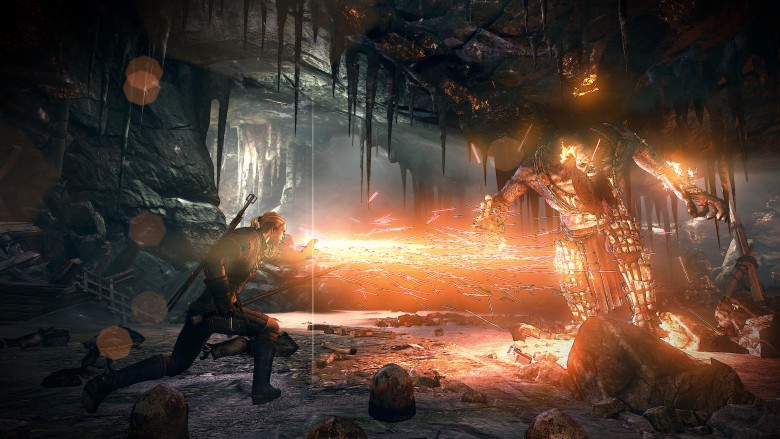
The Witcher 3: The Wild Hunt sieht schon im jetzigen Entwicklungsstadium atemberaubend aus. Wir haben uns mit Balázs Török, dem Lead-Engine-Entwickler von CD Projekt, über die Technik unterhalten. Das Open-World-Rollenspiel nutzt von der GPU berechnete Physik-Effekte für Haar und Fell, Tessellation für die Landschaftsdarstellung sowie Wasserberechnung und ist konsequent auf moderne CPU-Architekturen ausgelegt.
PCGH: As far as we know , is The Witcher 3 part of Nvidia's The Way - it's - Meant -to-be - played program and uses tessellation , an enhanced version of Nvidia's Horizon -based Ambient Occlusion in the form of HBAO + .
Balázs Török: That's right.
PCGH: Do you use Nvidia's Temporal anti-aliasing TXAA?
Balázs Török: No, at least not currently. We are still in the development phase and are not yet sure whether we will eventually use TXAA or not. If we should use it, we'll probably use it only for the PC-version.
PCGH: Your engine uses tessellation and GPU-Compute for the rendering of the landscape and water?
Balázs Török: Yes, we're currently using tessellation in our rendering pipeline to render landscape and water. We have made some tests in which we used tessellation to other assets, but that has not brought the desired result. And indeed, tesselation is not really needed for our other assets. This only increases the overhead, so we're using tessellation only for the scenery and the water where it's beneficial.
PCGH: Yes, we have already established in some other games that tessellation, in the representation of characters for example, does not leave the best impression and also requires a lot of power.
Balázs Török: Yes, exactly. And there are indeed many problems with tessellation. It is very rarely spoken of. Only a few publications revolve around the issue of transferring Tessellation on meshes, but it is very problematic. So it is better to use it only if it really does bring a great advantage or makes a clearly visible difference.
PCGH: The Witcher 2 probably is still the most beautiful RPG. The Witcher 3 will certainly be so again. Can you give us some information on how it is achieved in terms of polygon density and texture resolution?
Balázs Török : (laughs ) Thank you. In the regards of texture resolution we will not go completely crazy. The screenshot and scenes you have seen are already using textures with an increased resolution, and we obviously have a much higher budget for texturing. But we don't use this possibility to increase the resolution when there are no visible optical gains. We don't use extremely high resolution textures like 4K by 4K because there's not much of an increased fidelity. We did raise the polygon count, even if our meshes were already very, very detailed.
That's why The Witcher 3 already looks so great. Obviously, we'll increase the level of detail, but for now we are mostly using shaders to enhance optical fidelity, rather than giving the models more details by triangles, since the models do not solely gain a high level of detail simply by adding more polygons. We experiment here with different approaches, rather than just increasing the resolution of the wireframe model.
PCGH: You and Nvidia announced together that The Witcher 3 will use GPU accelerated physics. This includes the hair and fur in The Witcher 3 Can you to give us some information?
Balázs Török: The system for the simulation of hair and fur is actually running on the GPU, so there is no CPU simulation. We use this currently only on the PC and do not yet know whether we will support it on the consoles.
PCGH: Will the hair and fur simulation run on Radeon GPUs?
Balázs Török: Yes, yes it should. At the moment it works, but if it will work in the end, is the decision of Nvidia, the direction in which they continue to develop the technology and whether and what barriers they implement. But I think it will also run on Radeon cards.
PCGH: Good to hear. In Call of Duty: Ghosts, we were also able to activate the effect on AMD GPUs.
Balázs Török: Yes, true. But what the developers of Ghosts have used was a much earlier version than the one that is used in The Witcher 3. We have of course a lot more time, or Nvidia has more time to develop the effect. So we will use a more advanced, sophiticated version. I think it will look even prettier. And we will probably not be using Fur for only a single dog (laughs).
PCGH: Some games with GPU PhysX support also support the rendering of the effects on the CPU. This of course costs a lot of performance, but it actually works quite well on powerful processors, at least in medium settings. Will this also be possible in The Witcher 3?
Balázs Török: Yes. The default behavior of the PhysX simulations APEX Cloth, Destruction is to render the effects on the CPU. So this will also work in The Witcher 3 without PhysX GPU. Indeed, for the developer it is even more work if he wants to calculate the effects of the GPU. GPU PhysX only increases the level of detail or density, so therefore more particles can be rendered. But as default PhysX uses the CPU.
PCGH: So unlike, for example, the smoke in Assassins Creed 4, which can be activated only on Nvidia cards and even then requires a lot of power.
Balázs Török: The problem with the smoke effect using APEX Turbulence is that the effect can be solely rendered by the GPU. Turbulence is one of the modules, which can only be calculated on the GPU and only works - at least at this moment - with Nvidia graphics cards. We are thinking to implement it, but that decision is to be honest less on the programmer's side and more a Buissness decision. And it is not an effect that necessarily results in an advantage for the gameplay or the immersion of the player.
PCGH: Your water simulation looks very impressive. Do you use Nvidia Fluid or did you develop your own system to render the water?
Balázs Török : We have started to design a water simulation. Then we sat down with Nvidia and they have shared some insights with us. But we use our own simulation and do not use Nvidia's.
PCGH: open-world games tend be very CPU-heavy. Since The Witcher 3 will appear only for PC and next-gen consoles, so do not have to take on Xbox360 and PS3 in consideration, can you use the full potential of modern multi-core processors and large amounts of memory of current systems?
Balázs Török: Yes, at the very start of the project we had multi-core CPUs as a goal of our development. Where the 360 had three cores with six threads that we already fully utilized with the Xbox version of The Witcher 2, we now can address even more cores with our new edition of the Red Engine. And on the consoles we naturally try extracting every last bit of performance. And obviously, we try to use all of the memory there is. On the PC, that is much more difficult. The reason for that is that many PC gamers tent to have less memory in their systems. But on the consoles we will definitely try to go to the limit.
PCGH: Taking the limitations of the hardware of the Xbox 360 into consideration, The Witcher 2 looks astounding on the Microsoft console. Obviously you let a lot of optimization flow into the port. That was probably a lot of work. How does this compare to the new consoles and their PC-like hardware? Is the development for next- gen consoles easier than for the last generation?
Balázs Török : Yes, but here there are two aspects to consider : When we brought The Witcher 2 on the Xbox 360 up and running, the architecture already possessed a certain maturity. The developers had a lot of experience with the console and the tools for development were really very, very good. The problem was that the hardware architecture differed greatly from that of a PC, also a lot slower and had less memory. But we just had very good tools to squeeze all into a smaller box, metaphorically speaking.
Now it's the other way: We have new, barely tested tools that are naturally not as mature as those of the XBox360 at the time when we ported The Witcher 2. We have a lot more options through increased performance of the new consoles, though. And the architectures are almost identical to that of a PC. Therefore, we can also use the tools we used previously on the PC. When we develop new tools, we optimize them as best as we can for the PC. A majority of the tools and optimizations can be ported as they are to the consoles.
PCGH: So it's easier to bring a PC game on the new consoles, and vice-versa, while during the last generation major adjustments to the respective hardware were needed?
Balázs Török : Yes, that's exactly the point. And as a developer, if you come from PC, like us, one finds the programming of the new consoles much easier. If you come from the old consoles, you have to get used to that first.
PCGH: What do you think of AMD's Mantle technology? If you consider that open-world games tend to be heavy on the CPU, would a technique such as Mantle not be helpful in terms of framerates?
Balázs Török : Well, I think Mantle is a very interesting idea. Mantle shows that finally something moves with respect to APIs . There were many problems in Direct X 9 with the CPU usage and not much has happened since then. Now something is finally happening, although I'm not sure Mantle will solve all the problems. Of course, we would be much more pleased if it would be an API that works for all manufacturers, such as OpenGL or Direct X. But Mantle shows that there is a huge demand for such APIs in the developer scene. And I really hope that Microsoft and the Khronos Group (Note: Developers of OpenGL , OpenCL ) perceive this, see that the demand exists and finally develop their APIs further.
PCGH: For all of us image quality enthusiasts: Will Ubersampling find its way back into The Witcher 3?
Balázs Török : Well, that is a somewhat controversial topic . Many users would like to max all settings on their computers and some people had problems with the fact that at the time of The Witcher 2 not even the most powerful PCs were fast enough to use Ubersampling. And we got ¬let's say: fire and ice as feedback from the community. But I think we will continue to keep features for you graphics enthusiasts in mind, even if you will not immediately be able to use them but rather in two years in the future or so. And even then will make the game look really good in comparison. So I cannot guarantee with 100 % that Ubersampling will be included in The Witcher 3, but I think we will try to implement it. Or maybe deliver it somewhat later with a patch.
PCGH: Maybe you can hide the option somewhat or let us enable it with a console command. So too inexperienced players do not complain about poor frame rates when they absolutely have to put all options on the maximum.
Balázs Török: (laughs) That is indeed part of the problem. Maybe; we like to give players such features that make it possible to enjoy the game, even years after the release.
PCGH: Can you just us a rough estimate about the hardware requirements of The Witcher 3?
Balázs Török : No, that is unfortunately not yet possible .
PCGH: Thank you for the interview.

 Ob das so effizient ist?!








Siehe DarkSouls...
Du brauchst Hilfe bei einem Boss abseits von einem hirnlosen Tank?
Du willst Hinweise ingame?
Dann Spiel online.
Funktioniert denk ich ziemlich gut.
Das mit dem "Übersampling" stimmt: Viele wussten gar nicht, was genau das bedeutet und waren anschließend verärgert, dass das Game nicht mehr flüssig lief ... Das habe ich dieses Wochenende bei Wildstar erlebt: Dort heißt es "Render Target Scale" und massenweise Leute beschwerten sich, wie "unoptimiert" das Spiel doch sei und wie sich schnell herausstellte, hatten sie alle den Slider auf 2, wodurch aus 1920x1080 mal eben 3840x2160 wird.
Ganz am Anfang vom Vid: Haiste Füll ?
echt ein hammer Game. wird sehr bestimmt ein Blockbuster.