I'm getting old and grumpy: Palworld 1.0 has a problem, and I'm tired of turning a blind eye
Editor Richard Engel looks back at Palworld's Early Access launch. What was still technically excusable back then is much harder to dismiss in version 1.0 when it comes to draw distance and level of detail. A commentary.
Special Add as a preferred source on Google 20,29 €
Inhaltsverzeichnis
What the hell is Palworld?
For readers unfamiliar with the genre, here is the short version: At its core, Palworld is an open-world survival game with base building, crafting, and collectible creatures whose designs are reminiscent of Pokémon, Digimon, or Temtem. Except that here, they do not just look cute. They also toil away on production lines and, in a satirical twist, can even wield firearms. This wild combination made Palworld an astonishing success when it entered Early Access in January 2024. Within a month, the game had reached 25 million players, including 15 million buyers on Steam. At its all-time peak, 2.1 million players were active on Steam at the same time, an achievement unlike anything seen before.
What makes this even more remarkable is that the surprise hit was developed by a small Japanese team. Pocketpair grew from an initial three or four people to around 40 to 60 employees. It is hardly surprising, then, that the studio quickly won over a great many players. The contrast was all the sharper when Nintendo and The Pokémon Company took legal action against Pocketpair in September 2024, with mercifully limited "success" so far from a consumer perspective.
Despite all the crises and drama, Palworld has now made it to its full 1.0 release in July 2026. The story, progression, and overall scope have grown considerably. The basic concept, however, remains largely unchanged. To Pocketpair's credit, the studio did not raise the price. There is also a 30 percent discount until July 23, bringing the game down to a very fair €20 on Steam.
The full release adds 72 new Pals, additional islands, the World Tree, and a reworked progression system, among other things. Players are clearly pleased. Nearly 900,000 people jumped into the update simultaneously on Steam, while 93 percent of the roughly 8,800 most recent Steam reviews are positive. Palworld is alive and well, and people still love it. I have also had quite a bit of fun during my time with version 1.0. The gameplay is not perfect, but it is entertaining. So far, so good.
Tech Foundation in a Nutshell
PC Games Hardware had already taken a technical look at Palworld when it launched in Early Access two and a half years ago, though only in German at the time. Aside from the new content, not all that much has changed. Under the hood, Palworld 1.0 still uses Unreal Engine 5.1 as its main branch, with DirectX 11 as the default API. Its technical foundation therefore dates back to late 2022.
For indirect lighting, Pocketpair uses Lumen's software ray-tracing path. The more granular, global Nanite system is explicitly not used due to the game's older technical foundation, which means rocks, trees, and buildings are still simplified through traditional LOD stages. The problem is not the technology itself, or even the decision to use traditional LODs, since Nanite comes with performance drawbacks of its own. The problem is how Pocketpair has implemented those LODs. What I was still willing to excuse in 2024 because of the Early Access status, namely the limited draw distance, crude LOD transitions, and visibly loading vegetation, is still right in front of me in 2026. Only now, it has version 1.0 on the label.
 Source: PC Games Hardware
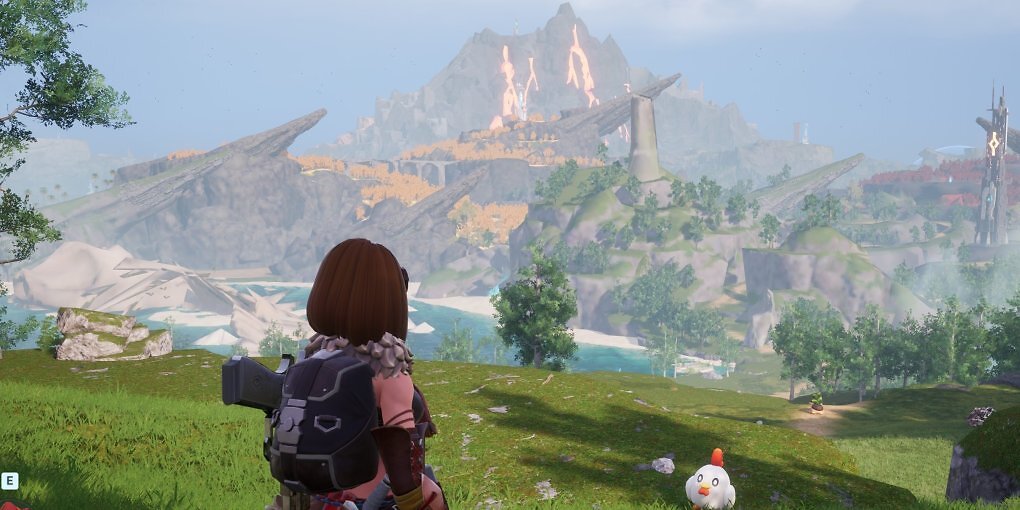
A cohesive art style matters more than photorealism, and Palworld's cartoon look works. The technical execution, however, repeatedly pulls that coherent image apart. On the left, the giant skeleton has been reduced to little more than a chunky "PS2" block, while the more distant "Lion King" cliffs remain comparatively detailed in the background. It becomes even more distracting in motion. Even at the Ultra preset, as shown here, objects visibly pop in, details load late, and the world looks as though it cannot settle on a consistent level of detail. This affects both level-of-detail models, or LODs, and, in some cases, textures. Consoles are affected even more severely.
Source: PC Games Hardware
A cohesive art style matters more than photorealism, and Palworld's cartoon look works. The technical execution, however, repeatedly pulls that coherent image apart. On the left, the giant skeleton has been reduced to little more than a chunky "PS2" block, while the more distant "Lion King" cliffs remain comparatively detailed in the background. It becomes even more distracting in motion. Even at the Ultra preset, as shown here, objects visibly pop in, details load late, and the world looks as though it cannot settle on a consistent level of detail. This affects both level-of-detail models, or LODs, and, in some cases, textures. Consoles are affected even more severely.
The Early Access grace period is over. On the next page, we take a closer look at Palworld's most visible technical weakness: its uneven long-distance rendering, crude LOD stages, and details that visibly load in even at the Ultra preset. On the horizon, the world unfortunately falls apart into its compromises.