Halo: Combat Evolved: Did you know how (poorly) Bungie's shooter ran at its 2003 PC launch?
Halo: Combat Evolved is one of the most influential shooters ever made. A remake, Halo: Campaign Evolved, launches in just a few days. That is reason enough to take a closer look at the 25-year-old original and its fascinating history, including contemporary benchmarks.
Special Add as a preferred source on Google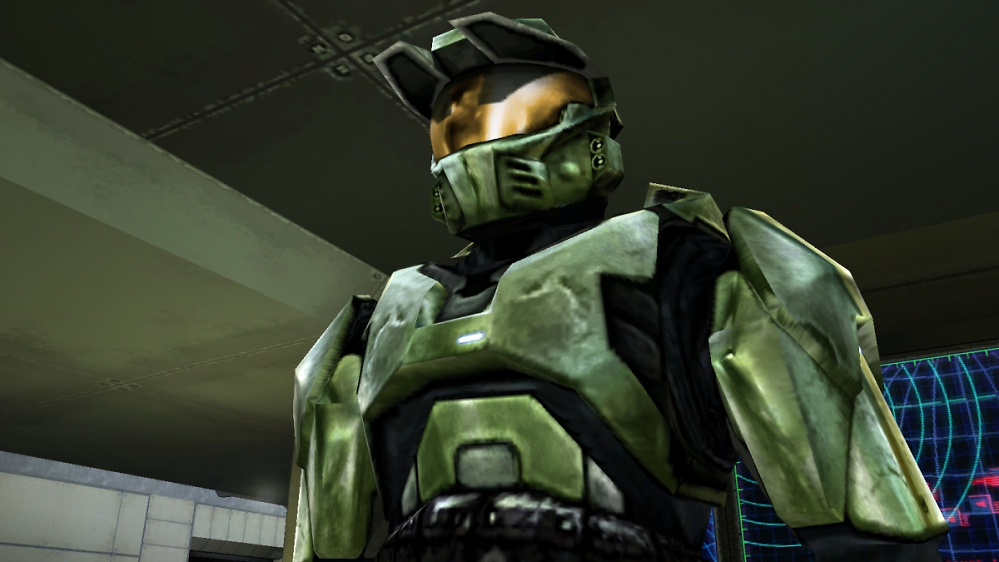
You read that correctly: Halo: Combat Evolved celebrates its 25th anniversary this year. If that makes the game seem too old, you may be remembering the much later PC port, which did not arrive until fall 2003. Halo: Campaign Evolved, a remake built with Unreal Engine 5, launches on July 28th. Before putting it through a technical analysis, we would like to take you on a brief journey back to a time when pixel shading was still uncharted territory, large environments could not yet be explored in vehicles, and a regenerating shield was little more than science fiction. Halo changed all of that and ushered in a new era for first-person shooters.
Halo: Apple, Xbox, PC
Halo: Combat Evolved began life at developer Bungie in the late 1990s as a third-person action game for Mac and PC. It was unveiled at Macworld on 21 July 1999 by former Apple mastermind Steve Jobs. The following video may raise a smile (or an eyebrow) today, but 27 years ago its expansive environments, the physics of the vehicle known as the "Warthog", its shadow maps, and enemy models deeply impressed everyone who saw it. Microsoft's management was equally taken with the project. At the time, the company was looking for flagship titles for its own console venture, so it promptly acquired Bungie and turned Halo into a launch title for the original Xbox. PC players were left disappointed, with one particularly interesting footnote: the Voodoo 5 5500 boxes printed by 3dfx in early 2000 featured a screenshot from Halo alongside the words "the next generation of PC games". As we now know, that never came to pass.
Released in November 2001, Halo: Combat Evolved became both a major commercial success and a landmark title for the genre, contributing substantially to the successful launch of the Xbox. Its combination of expansive levels and vehicles, intelligent enemy AI and, not least, outstanding graphics set new standards. For many gaming veterans, Halo may have been their first encounter with programmable pixel effects. The original Xbox was based on Nvidia's Geforce 3 and therefore supported first-generation pixel and vertex shaders.
Halo PC: Advanced yet behind the times
It took until fall 2003 for Halo to finally reach the PC. Bungie commissioned the then-small studio Gearbox to handle the port—with mixed results. The long-awaited PC version offered advanced DirectX 9 pixel shading, including Pixel Shader 2.0 support, but several effects were later found to have been downgraded compared with the Xbox version. This was not intentional, but the result of a bug in the shader code. It was only fixed five years ago (!) as part of the Master Chief Collection, as our colleagues at Digital Foundry and others have explained.
Even so, Halo remained a visual showcase in 2003 and was also capable of bringing graphics cards to their knees. Its most important rendering features included:
- Pixel Shader 2.0: Improved lighting and material rendering.
- Bump Mapping: Adds depth to surfaces such as metal, stone and walls.
- Specular Highlights: Glossy materials reflect light.
- Environment Mapping: Water and metal surfaces display reflections.
Overall, Halo: Combat Evolved was one of the early games to make extensive use of programmable vertex and pixel shaders to improve lighting and material rendering. However, it also included fallback paths for older GPUs that were still widespread at the time, including the Geforce 4 with PS1.3 support and the Radeon 8500 with PS1.4. There was even a fixed-function fallback without pixel shading, allowing older GPUs such as the original Geforce and Radeon generations to run the game. Only graphics cards whose boxes had once featured Halo required additional workarounds ...
Stuttering Evolved?
Halo successfully showcased the capabilities of the Xbox, but its visual quality came with a compromise: the game ran at no more than 30 Fps, with frequent slowdowns below that mark. Furthermore, Halo arrived at a time when analogue television standards still dominated. European players had to cope with the PAL version and a maximum of 25 Fps. The 2003 PC release supported much higher resolutions and uncapped frame rates, although its animations remained limited to an update rate of 30 Fps.
The extensive use of pixel shading placed considerable strain on mainstream graphics cards, and even the high-end models available at launch, namely the ATI Radeon 9800 Pro and Nvidia Geforce FX 5900 Ultra, struggled badly. Geforce owners in particular had to make compromises because the CineFX architecture suffered from a weakness in Pixel Shader 2.0 workloads. But what frame rates are we actually talking about? We searched through benchmark archives and found contemporary examples. The following benchmark was recorded at 1,024 × 768 pixels with maximum details and without anti-aliasing, as the original Halo did not support it.
The fastest graphics cards available when Halo: Combat Evolved launched achieved around 50 Fps. By 2003, however, 1,024 × 768 was no longer considered a desirable resolution, as the CRT monitors commonly used at the time supported up to 2,048 × 1,536 pixels. Smooth gameplay at that resolution, or even at 1,600 × 1,200, was initially unreachable. The graphics cards highlighted in blue belong to the next GPU generation, which launched in 2004 and 2005 and therefore after Halo. As the results show, both the resolutions and frame rate expectations were very different at the time.
Halo PC (2003): Impressions at maximum detail settings
In just a few days, Halo: Campaign Evolved will use Unreal Engine 5 to take the game's polygons and pixels to a new level. Expect a detailed technical analysis from PCGH! Until then, you can enjoy images from the original, captured for the occasion at 1,600 × 1,200 using the 2003 release on a Geforce RTX 5090 (which is bored to death with vanilla Halo's workload).
When did you experience Halo for the first time? Use the Reddit post to share your thoughts with us! You're also welcome to follow us on Whatsapp and X for the latest news from the world of hardware and our exclusive content. You can find our video content (often spiced up with a dash of humor) on Youtube , Instagram , and Tiktok .