Can You Fake a CPU Review? We Built Our Own Ryzen 7 7700X3D
How do you test a CPU you do not actually have? We show how to simulate a processor review—and why the method works surprisingly well in this particular case.
Test Add as a preferred source on Google
In this article
This is not something that happens every day: AMD's new Ryzen 7 7700X3D launches today, but PCGH did not receive an official review sample. We still wanted to find out how the processor performs, so we came up with a workaround. We simply took a Ryzen 7 7800X3D and configured it to match the known specifications of the Ryzen 7 7700X3D. Both processors have eight cores, the same amount of L3 cache and the same TDP class, so the only real difference is the boost clock. With a small configuration trick, we were able to adjust the clock speed and effectively test the Ryzen 7 7700X3D without an official sample—cue the evil laughter. In this review, we explain how the simulation works and what conclusions can reasonably be drawn from it.
AMD Ryzen 7 7700X3D: Specifications
 Source: AMD
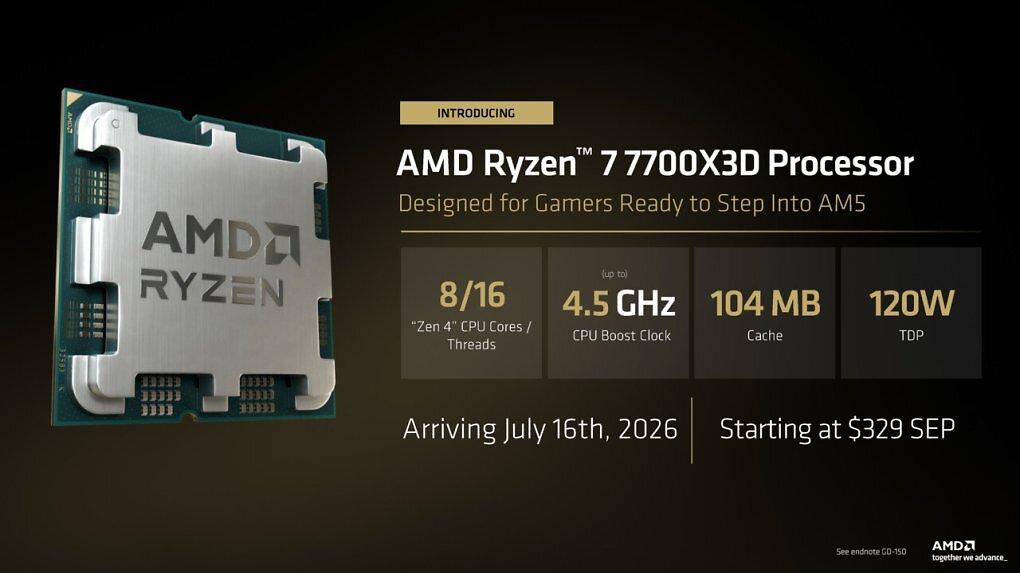
AMD unveiled the Ryzen 7 7700X3D at this year's Computex as part of its AM4 anniversary celebrations. The CPU launches on July 16, 2026, at a pre-tax price of $329. This makes it more expensive at launch than a Ryzen 7 7800X3D at current retail prices.
With eight cores, 16 threads and a maximum boost clock of 4.50 GHz, the Ryzen 7 7700X3D may not appear particularly exciting at first glance. However, it features the same L3-cache configuration and first-generation 3D V-Cache as the Ryzen 7 7800X3D, giving it similar advantages in games.
Source: AMD
AMD unveiled the Ryzen 7 7700X3D at this year's Computex as part of its AM4 anniversary celebrations. The CPU launches on July 16, 2026, at a pre-tax price of $329. This makes it more expensive at launch than a Ryzen 7 7800X3D at current retail prices.
With eight cores, 16 threads and a maximum boost clock of 4.50 GHz, the Ryzen 7 7700X3D may not appear particularly exciting at first glance. However, it features the same L3-cache configuration and first-generation 3D V-Cache as the Ryzen 7 7800X3D, giving it similar advantages in games.
It remains to be seen whether AMD intends to position the Ryzen 7 7700X3D as the successor to the Ryzen 7 7800X3D. On paper, the only significant difference between the two models is a 500 MHz reduction in maximum boost clock. AMD followed a similar strategy with Zen 3: the Ryzen 7 5800X3D was followed by the Ryzen 7 5700X3D, which initially replaced its larger sibling at retail. The 5800X3D has since returned, while the 5700X3D has largely disappeared from store shelves.
While this product strategy may be interesting to follow, it creates unnecessary uncertainty for buyers. It remains unclear how long the excellent Ryzen 7 7800X3D will remain widely available, particularly as the higher-end model is currently cheaper than the new Ryzen 7 7700X3D.
How the Simulation Works
AMD specifies a maximum boost clock of up to 5.05 GHz for the Ryzen 7 7800X3D. The words "up to" are important, as the processor does not sustain this frequency under every workload. By contrast, the base clock should be sustainable when the processor is used with cooling that meets AMD's specifications.
Boost frequency under load depends on several factors, most notably the maximum operating temperature, or Tjmax, which is 89 degrees Celsius for Zen 4 X3D processors. Even before reaching this limit, the boost algorithm gradually lowers the maximum attainable clock speed to remain within the thermal specifications.
AMD uses a finely tuned voltage/frequency curve for this purpose. If the frequency of individual cores drops slightly, the required voltage can be reduced accordingly. This lowers power consumption and therefore the amount of heat generated. Enthusiasts often take advantage of this behaviour to improve efficiency through undervolting or curve optimisation. For our purposes, however, it mainly explains why the Ryzen 7 7800X3D cannot maintain its maximum boost frequency continuously.
 Source: PCGH
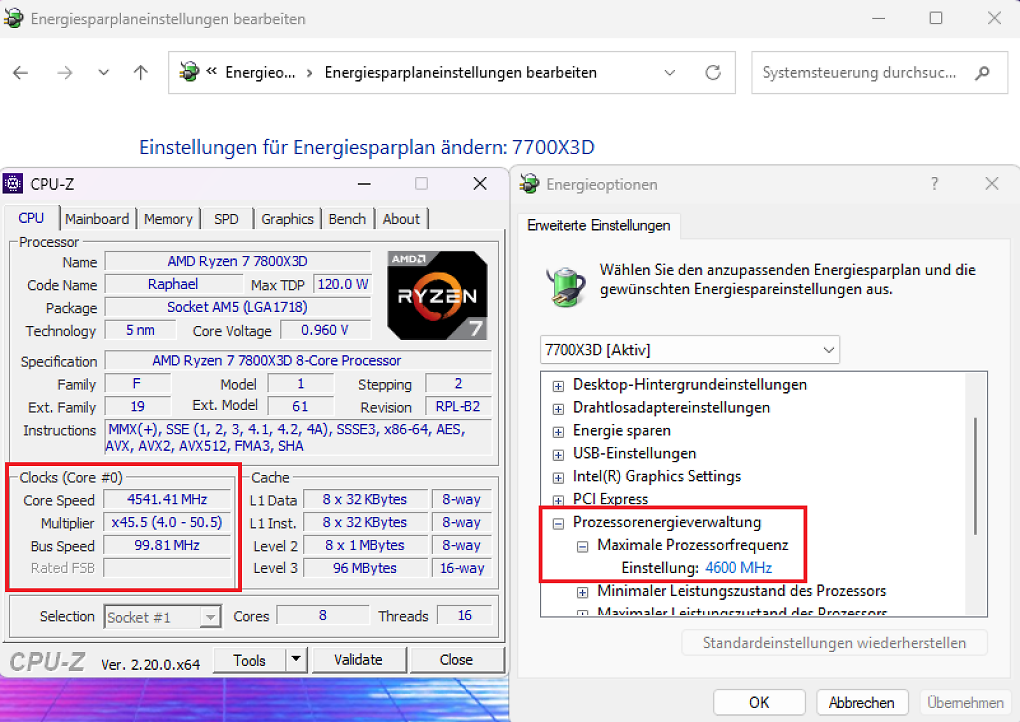
By enabling the maximum processor frequency setting, we can limit the peak clock speed without disabling the remaining boost logic or its built-in protection mechanisms. A look at CPU-Z confirms the clock speed of our "7700X3D." Since the remaining specifications are identical to those of the 7800X3D, the simulation can be achieved by adjusting the frequency alone.
Source: PCGH
By enabling the maximum processor frequency setting, we can limit the peak clock speed without disabling the remaining boost logic or its built-in protection mechanisms. A look at CPU-Z confirms the clock speed of our "7700X3D." Since the remaining specifications are identical to those of the 7800X3D, the simulation can be achieved by adjusting the frequency alone.
There is one obstacle to configuring a Ryzen 7 7800X3D to behave like a Ryzen 7 7700X3D: unlike Ryzen 9000X3D, the older processor does not have an unlocked multiplier. So how do we lower its clock speed?
The solution is a hidden processor power-management setting in Windows 10 and Windows 11. PowerSettingsExplorer can be used to expose these concealed settings. We do not recommend using this tool casually. It exposes numerous advanced settings and should therefore be handled only by experienced users.
One of its functions allows us to influence the processor's maximum clock speed. The configured value establishes the maximum boost frequency, but it does not disable protection against overheating or exceeding power limits. Those safeguards remain unaffected, which is all we need: our goal is simply to limit the 7800X3D to roughly 4,550 MHz. That is essentially the entire trick. Based on the known specifications, clock speed is the only relevant difference between the two processors.
AMD Ryzen 7 7800X3D ausreizen: OC, DDR5-Tuning, Effizienz-Optimierung
Der 8-Kerner Ryzen 7 7800X3D für den Sockel AM5 mausert sich zum Liebling der PCGH-Leser. Doch wie kann man den Gaming-Boliden richtig ausreizen? Ein PCGH-Plus-Guide aus drei Einzelartikeln.
mehr ...
The next page gets to the heart of the matter: How fast is our simulation of AMD's new Ryzen 7 7700X3D in PCGH's extensive CPU benchmark suite, and does the lower boost clock also improve efficiency? We examine these questions and more over the following pages.