Conclusion
In this article
Now that we've taken a close look at the Intel Arc Pro B70, we still have some time left for further analysis. Below, we'll not only break down the performance of the BMG-G31 compared to the BMG-G21 and ACM-G10 but also explore what a still-possible "Arc B770" might be capable of.
G31 vs. G21 vs. G10
The Alchemist-G10, better known as the Arc A770, will turn four this fall. Intel's first-generation chip delivers respectable performance both now and then but suffers from poor utilization in some engines—an issue that Intel's driver work hasn't been able to resolve. Like any first attempt, the architecture still has some shortcomings. The Battlemage-G21, better known as the Arc B580, has been demonstrating since late 2024 how to achieve higher performance with fewer processing units. With the Arc Pro B70, the Battlemage-G31 has now also been released, the "full version" of the Xe-2 microarchitecture. We've seen so many bars and numbers on the previous pages that it's easy to lose track. Below, we've isolated the G10, G21, and G31 to illustrate the performance jumps in a compact format. Here you can see the three Arc GPUs on their own. The numbers below the index values show the relative performance per game.
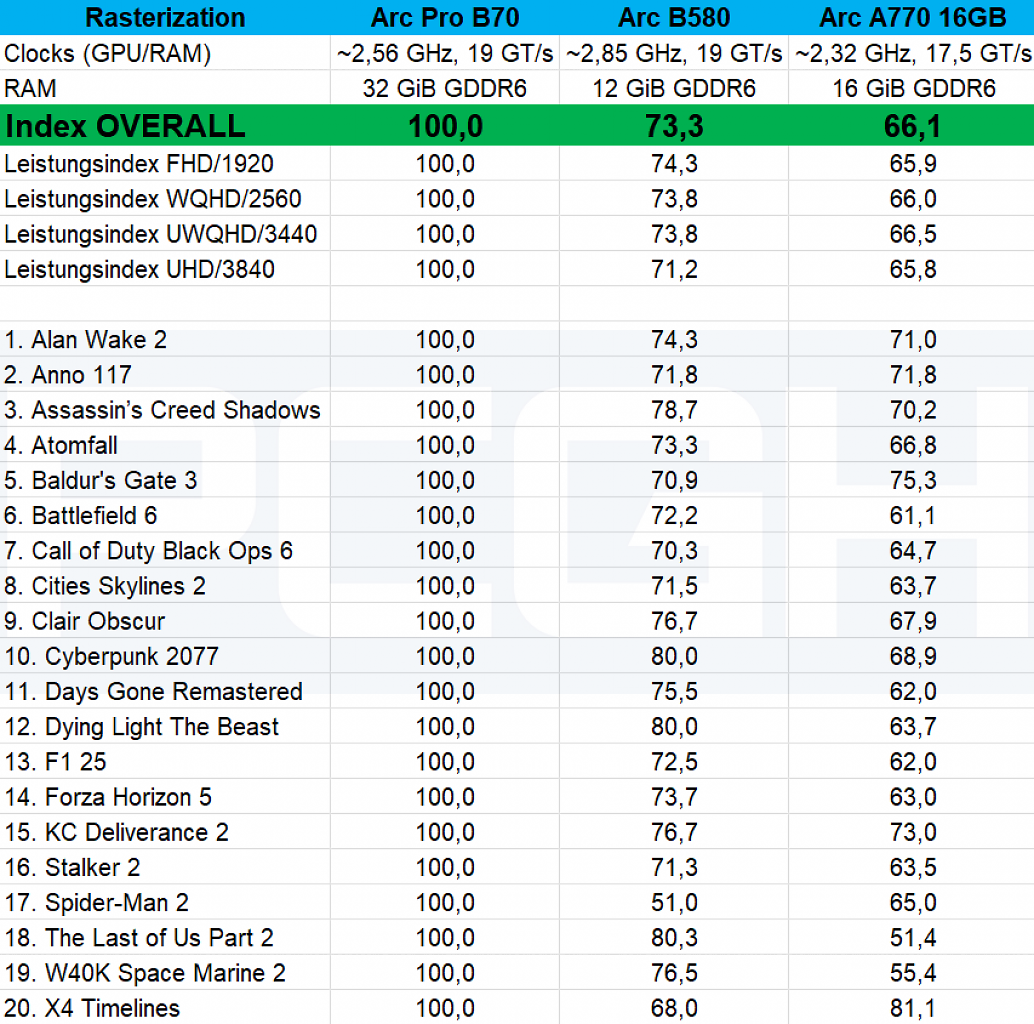
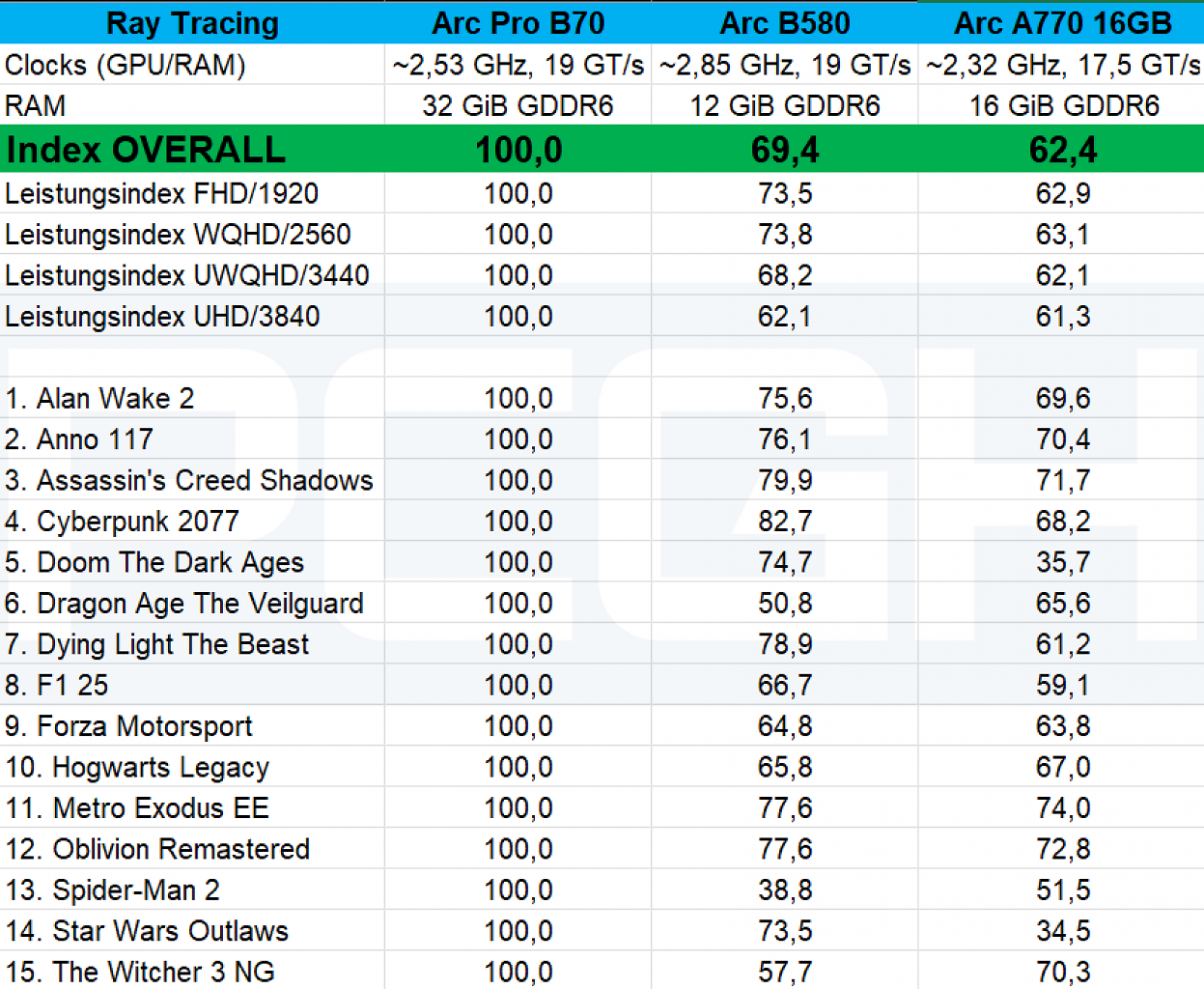
The comparison between the G10 and G31—both graphics chips with 4,096 FP32 ALUs—highlights Intel's tremendous progress from Xe/Alchemist to Xe 2/Battlemage.
Intel Arc Pro B70: Conclusion
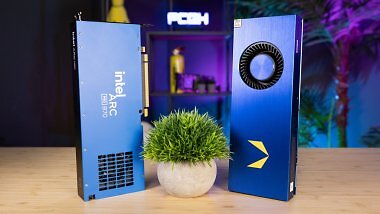
With the BMG-G31, Intel has a powerful alternative to the Radeon RX 9060 XT and Geforce RTX 5060 Ti up its sleeve, but it isn't releasing a gaming graphics card featuring the largest Battlemage GPU. The cause is believed to be the memory crisis, which is driving Intel toward the higher-margin professional segment. There, the Arc Pro B70 is an attractive device for creatives, developers, and especially users of large AI language models, such as Qwen3.5-27B. With its high inference performance and a whopping 32 GiB of memory, the B70 outperforms various competitor graphics cards, as evidenced by workstation benchmarks and enthusiastic users (such as on the Level1techs forum). Our own tests with the UL Procyon confirm that the Intel Arc Pro B70 delivers tremendous value for the money, even if this is difficult to fathom from a PC gamer's perspective.
Intel Arc Pro B70: Impressionen aus dem Test
But let's get back to our gaming adventure, which is the focus of this article. Despite its primary positioning as a workstation graphics card, gaming isn't a contradiction or a problem. With the official driver, the Intel Arc Pro B70 is a wonderful gaming machine. Everything an Arc B580 can do, a B70 can do too—but significantly faster. With an average performance increase of 36 percent in rasterization and 45 percent in ray tracing, Intel's B70 is every Arc fan's dream. With this performance, it consistently outperforms the Radeon RX 9060 XT 16GB, while the Geforce RTX 5060 Ti 16GB holds an advantage, at least in ray and path tracing.
Intel's B70 reference design operates at a reasonable 230 watts, sacrificing the last few percentage points of performance in favor of energy efficiency. The maximum boost of 2.8 GHz can only be sustained in the rarest of cases; on average, it hovers just below 2.6 GHz. This means the Arc Pro B70 achieves the same energy efficiency as the Arc B580—that's good, but it falls short of AMD's and Nvidia's current models. This brings us to the final open question: Does an "Arc B770" still make sense?
Arc B770 still viable in 2026?
It's an open secret that the Arc B770 was once on Intel's roadmap but was later canceled. Nevertheless, this product still makes sense, as there's plenty of room for a more powerful model above the Arc B580 (around $300). The Arc Pro B70 has just proven that it can compete with both the Radeon RX 9060 XT 16GB and Geforce RTX 5060 Ti 16GB. For an Arc B770, Intel would only need to tweak a couple of settings and could deliver a powerful alternative. The most important point is the move to 16 GiB of memory. This saves a bit of power, which benefits the GPU boost, and is ideal even for the most demanding PC games. Other possible tweaks would include switching to faster 20 GT/s memory and a higher maximum clock speed. Based on our current measurements, we estimate that such an Arc B770 16GB would be, at best, 15 percent faster than an Arc Pro B70. If, on the other hand, Intel sticks to the current clock speeds and only increases the board power, a gain of 6-7 percent is realistic at most by maintaining the 2.8 GHz boost.
| Intel Graphics Cards | „Arc B770” (Best-Case) | Arc Pro B70 | Arc B580 | Arc A770 |
|---|---|---|---|---|
| Release Date | Uncertain | 25.03.2026 | 13.12.2024 | 12.10.2022 |
| Architecture | Xe 2 (BMG) | Xe 2 (BMG) | Xe 2 (BMG) | Xe (ACM) |
| GPU Codename | BMG-G31 | BMG-G31 | BMG-G21 | ACM-G10 |
| Manufacturing Process (Foundry) | N5 (TSMC) | N5 (TSMC) | N5 (TSMC) | N6 (TSMC) |
| FP32 ALUs/TMUs/ROPs | 4.096/256/128 | 4.096/256/128 | 2.560/160/80 | 4.096/256/128 |
| Ray Tracing Units | 32 | 32 | 20 | 32 |
| Matrix Units (“AI Cores”) | 256 | 256 | 160 | 256 |
| Typical GPU Clock (MHz) | 3.000 | 2.560 | 2.850 | 2.320 |
| FP32 Perf. ALUs (TFLOPS) | 24,6 | 21,0 | 14,6 | 19,0 |
| Fill rate (Gtex/Gpix per sec.) | 768,0/384,0 | 655,4/327,7 | 456,0/228,0 | 593,9/297,0 |
| Memory interface (bits) | 256 | 256 | 192 | 256 |
| RAM speed (GTs/MHz) | 20,0/10.000 | 19,0/9.500 | 19,0/9.500 | 17,5/8.750 |
| Memory type | GDDR6 | GDDR6 | GDDR6 | GDDR6 |
| Memory transfer rate (GB/s) | 640 | 608 | 456 | 560 |
| Memory capacity (MiB) | 16.384 | 32.768 | 12.288 | 16.384 |
| PCI Express interface | 5.0 ×16 | 5.0 ×16 | 4.0 ×8 | 4.0 ×16 |
| Power connectors | 2× 8-Pin | 1× 8-Pin | 1× 8-Pin | 1× 8/1× 6- Pin |
| Power consumption (TBP) | 300 Watts | 230 Watts | 190 Watts | 225 Watts |
What do you think of the Intel Arc Pro B70? Would you prefer an Arc B770? Use the comments section to share your thoughts with us! Please be sure to follow the forum rules when commenting. You're also welcome to follow us on WhatsApp and X for the latest news from the hardware world or our exclusive content. You can find our video content (often spiced up with a dash of humor) on YouTube, Instagram, and TikTok. Translated with the help of DeepL.