Arc Pro B70 Review with 40+ gaming benchmarks: The best graphics card Intel has to offer
While gamers continue to wait for the Arc B770, Intel's biggest Battlemage GPU is already being used in the Arc Pro B70. Until now, it was unclear how well the BMG-G31 performs in games - time for a comprehensive gaming test covering rasterization, ray tracing, and path tracing.
Test Add as a preferred source on Google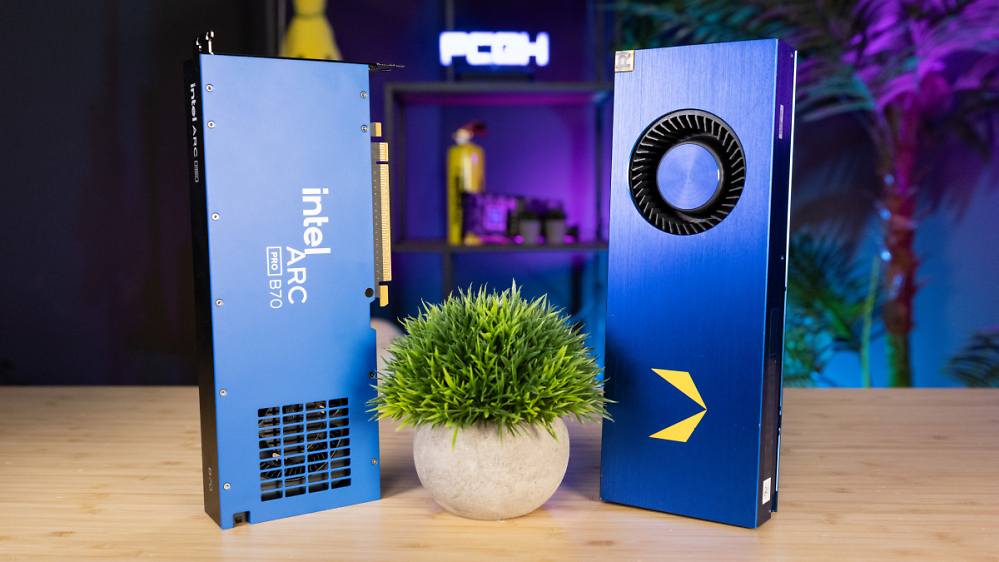
Content
In late 2024, Intel impressed with the Arc B580, an efficient and attractively priced graphics card based on the BMG-G21 GPU. In 2025, all eyes were eagerly turned toward its big brother, the BMG-G31 also known as "Arc B770". But it didn't happen. For several weeks now—and thus a good year late—the G31 has finally become available, though only on the professional graphics cards Arc Pro B70 and Arc Pro B65. Today, we're finally going to answer that burning question: What is "Big Battlemage" capable of? We'll find out in our in-depth review of the Intel Arc Pro B70. In addition to the long-awaited gaming benchmarks covering rasterization, ray tracing, and path tracing, we'll also examine power consumption, efficiency, and noise levels. Should AMD and Nvidia be worried?
 Source: PC Games Hardware
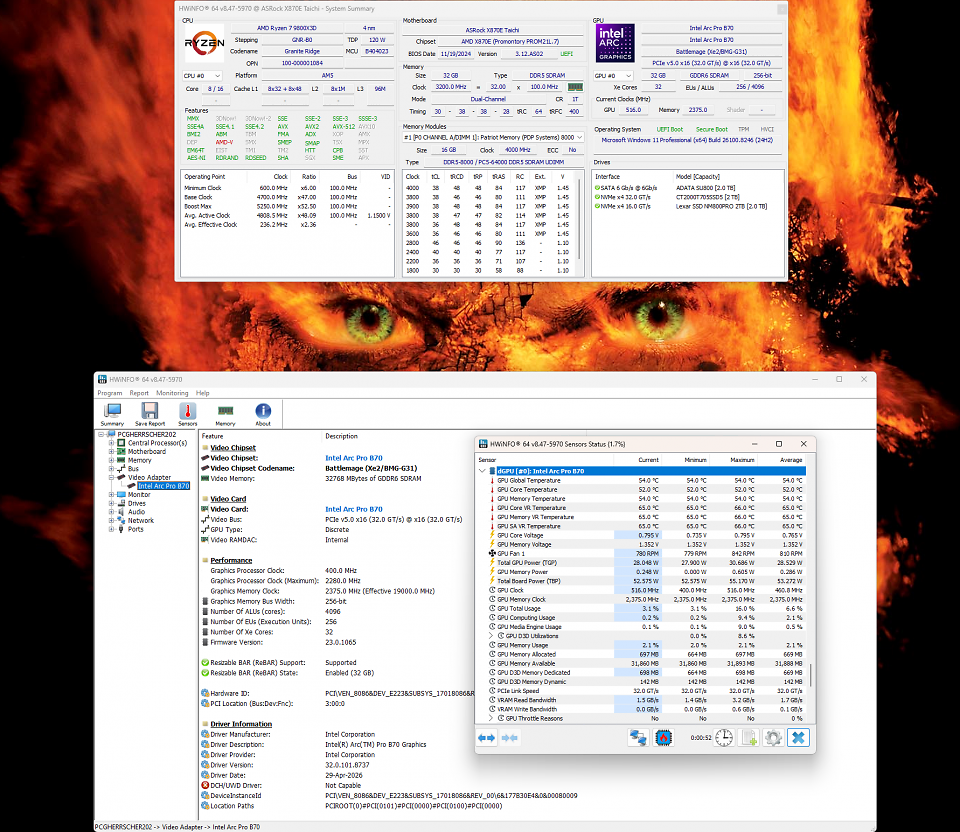
Intel Arc Pro B70 Full Review: Hardware Overview (Hwinfo)
Source: PC Games Hardware
Intel Arc Pro B70 Full Review: Hardware Overview (Hwinfo)
Arc Pro B70: Overview
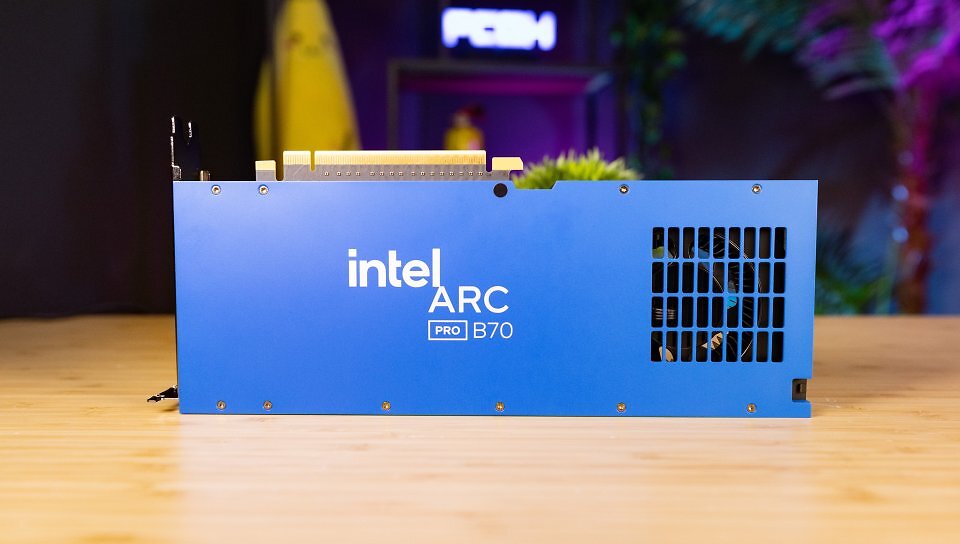
You might be wondering why Intel is positioning the Arc Pro B70 and B65 as workstation products and ignoring the gaming segment. The reason, unsurprisingly, is the recent memory crisis. Much like Nvidia with the RTX 5000 Super refresh, Intel has likely run the numbers—with the unfortunate result that new gaming graphics cards aren't worth it at current DRAM prices. The situation is different in the professional segment, as customers there are accustomed to high prices and willing to pay for the corresponding hardware features and technical support. This is why the Arc Pro B70 and Arc Pro B65 make sense despite the expensive 32 GiB of GDDR6, while an "Arc B770" with 16 GiB would hardly be economical for less than half the price. Anyone looking to get their hands on Intel's best GPU, the Battlemage BMG-G31, will therefore have to dig deeper into their pockets-the Intel Arc Pro B70 reference card costs $949 USD (MSRP).
 Source: PC Games Hardware
Arc Pro B70 Review: The best graphics card Intel has to offer
Intel explicitly places the Arc Pro B70 as a workstation product. Large language models (LLMs) and memory-intensive workloads are the intended use cases. To best serve this purpose, the B70 boasts an impressive 32 GiB of memory—the same amount as a GeForce RTX 5090 or Radeon AI Pro R9700. But! Anyone who buys one of these graphics cards can use it for gaming. The professional models may be optimized for Pro mode, with special support from AMD, Intel, and Nvidia. However, gaming is still possible with the appropriate drivers. Thus, PC gamers can use a Pro B70 as the ultimate Arc gaming graphics card. But is it worth it? We'll find out right away. To get things started, let's take a look at the full specifications of the Arc Pro B70 alongside its siblings; you can find additional comparison models in our comprehensive GPU database:
Source: PC Games Hardware
Arc Pro B70 Review: The best graphics card Intel has to offer
Intel explicitly places the Arc Pro B70 as a workstation product. Large language models (LLMs) and memory-intensive workloads are the intended use cases. To best serve this purpose, the B70 boasts an impressive 32 GiB of memory—the same amount as a GeForce RTX 5090 or Radeon AI Pro R9700. But! Anyone who buys one of these graphics cards can use it for gaming. The professional models may be optimized for Pro mode, with special support from AMD, Intel, and Nvidia. However, gaming is still possible with the appropriate drivers. Thus, PC gamers can use a Pro B70 as the ultimate Arc gaming graphics card. But is it worth it? We'll find out right away. To get things started, let's take a look at the full specifications of the Arc Pro B70 alongside its siblings; you can find additional comparison models in our comprehensive GPU database:
| Graphics Cards | Arc Pro B70 | Arc B580 | Radeon RX 9060 XT 16GB | Geforce RTX 5060 Ti 16GB |
|---|---|---|---|---|
| Model used for testing | Intel Reference | Intel Limited Edition | Sapphire Pulse | Zotac Twin Edge |
| Release Date | 03/25/2026 | 12/13/2024 | 06/05/2025 | 04/16/2025 |
| Architecture | Xe 2 (BMG) | Xe 2 (BMG) | RDNA 4 | RTX Blackwell |
| GPU Codename | BMG-G31 | BMG-G21 | Navi 44 XT | GB206-300 |
| Die Size | 368 mm² | 272 mm² | 199 mm² | 181 mm² |
| GPU Transistors (Billion) | 27,7 | 19,6 | 29,7 | 21,9 |
| Manufacturing Process (Foundry) | N5 (TSMC) | N5 (TSMC) | N4P (TSMC) | 4N (TSMC) |
| FP32 ALUs/TMUs/ROPs | 4.096/256/128 | 2.560/160/80 | 2.048**/128/64 | 4.608/144/48 |
| Ray Tracing Units | 32 | 20 | 32 | 36 |
| Matrix Units (“AI Cores”) | 256 | 160 | 64 | 144 |
| Level 2 Cache (MiB) | 24 | 18 | 4 | 32 |
| Level 3 Cache (MiB) | – | – | 32 | – |
| Typical GPU Boost (MHz) | 2.560 | 2.850 | 3.110 | 2.720 |
| INT8 Perf. Dense (TOPS, Peak) | 367 | 233 | 205 | 190 |
| FP16 Perf. ALUs (TFLOPS) | 21,0 | 14,6 | 51,0 | 25,1 |
| FP32 Perf. ALUs (TFLOPS) | 21,0 | 14,6 | 25,5 | 25,1 |
| FP64 Perf. ALUs (TFLOPS) | 1,3 | 0,9 | 0,4 | 0,4 |
| Fill Rate (Gtex/Gpix per sec.) | 655,4/327,7 | 456,0/228,0 | 398,1/199,0 | 391,7/130,6 |
| Multi-Frame Generation | Yes (up to 3 AI frames) | Yes (up to 3 AI frames) | No | Yes (up to 5 AI frames) |
| Driver Frame Generation | No | No | Yes (1 Frame) | Yes (1 Frame) |
| Memory Interface (bits) | 256 | 192 | 128 | 128 |
| RAM Speed (GTs/MHz) | 19,0/9.500 | 19,0/9.500 | 20,0/10.008 | 28,0/14.001 |
| Memory Type | GDDR6 | GDDR6 | GDDR6 | GDDR7 |
| ECC Support | Yes | No | No | No |
| Memory Transfer Rate (GB/s) | 608 | 456 | 320 | 448 |
| Memory Capacity (MiB) | 32.768 | 12.288 | 16.384 | 16.384 |
| PCI Express Interface | 5.0 ×16 | 4.0 ×8 | 5.0 ×16 | 5.0 ×8 |
| Power Connectors | 1× 8-Pin* | 1× 8-Pin | 1× 8-Pin | 1× 8-Pin |
| Power Consumption | 230 Watts* | 190 Watts | 160 Watts | 180 Watts |
| Display Connectivity | 4× DP 2.1 (UHBR13.5) | DP 2.1 (UHBR13.5), HDMI 2.1 | DP 2.1a (UHBR13.5), HDMI 2.1b | DP 2.1b (UHBR20), HDMI 2.1b |
| Video Decoding | VP9/H.264/H.265/AV1 | VP9/H.264/H.265/AV1 | VP9/H.264/H.265/AV1 | H.264/H.265/AV1 |
| Video Encoding | VP9/H.264/H.265/AV1 | VP9/H.264/H.265/AV1 | H.264/H.265/AV1 | H.264/H.265/AV1 |
Performance figures based on graphics cards we have thoroughly tested (average GPU boost across all benchmarks)—the official numbers are, in some cases, significantly lower. *Specifications for the Intel-branded card. Board partner models may be rated between 160 and 330 watts.
Compared to Intel's fastest graphics card to date, the Arc B580, the Arc Pro B70 delivers a significant performance boost thanks to its larger GPU. Based on the actual GPU clock speeds achieved, the card achieves 44 percent more computational performance and a 33 percent higher memory throughput. Before we dive into the benchmarks, let's take a look at the AMD and Nvidia graphics cards we're comparing it to. The Radeon RX 9060 XT 16GB and GeForce RTX 5060 Ti 16GB are valid and powerful contenders for the Arc Pro B70, each with their own pros and cons. It's interesting to see how differently the architectures handle certain tasks. Intel has the broadest architecture in most respects, with advantages at both very low and maximum precision, as evidenced by the INT8 and FP64 throughput rates. These are irrelevant for gaming but provide massive benefits for productivity applications.
PCI-Express 5.0 without compromise
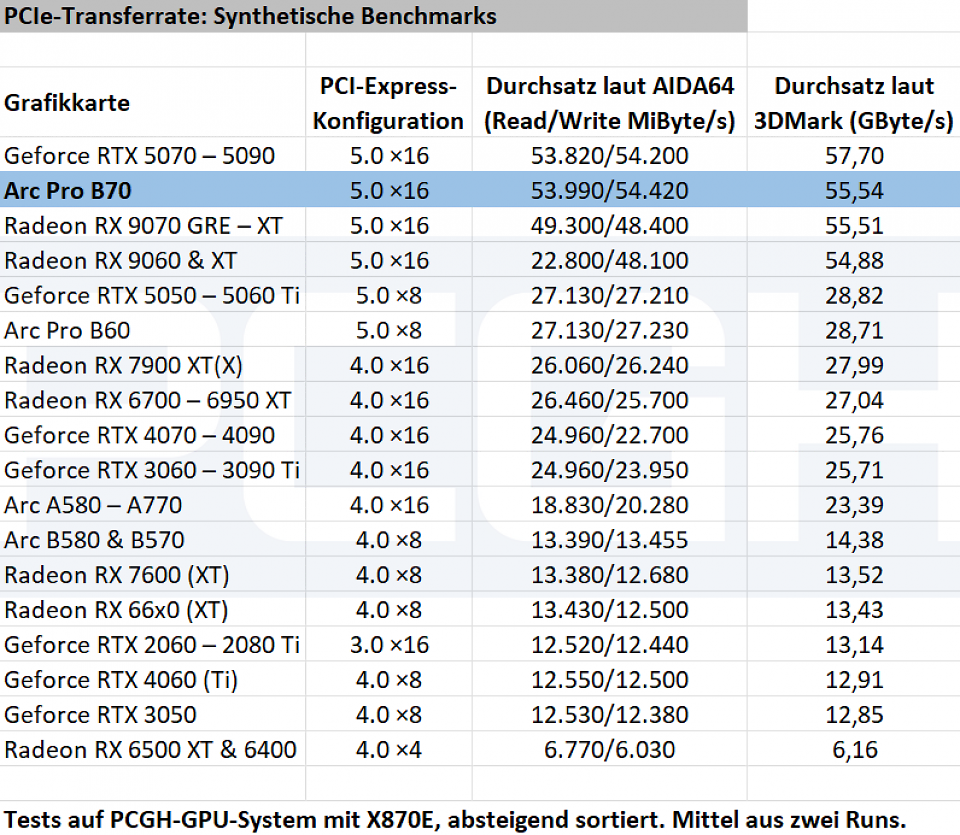
In addition to memory capacity, there is another difference between Intel's consumer and professional lines: current Arc Pro models support PCI Express 5.0, while the B580 and B570 are limited to PCI Express 4.0. There are no technical reasons for this; we suspect it's simply a matter of product strategy and cost savings. As a result, the PCI Express throughput doubles with each step from the Arc B580 to the Arc Pro B60 and ultimately the Arc Pro B70. Let's have a look at some synthies:
 Source: PC Games Hardware
Intel Arc Pro B70: PCI Express Throughput
In the rare event that the 32 GiB of local memory is exceeded, the Intel Arc Pro B70 can offload data to main memory at maximum speed. Synthetic benchmarks confirm that this professional graphics card consistently delivers high performance. On the following page, we use more than 40 gaming benchmarks and specialized tests to determine how these superlatives translate to real-world performance. Can Intel beat the Geforce RTX 5060 Ti and Radeon RX 9060 XT?
Source: PC Games Hardware
Intel Arc Pro B70: PCI Express Throughput
In the rare event that the 32 GiB of local memory is exceeded, the Intel Arc Pro B70 can offload data to main memory at maximum speed. Synthetic benchmarks confirm that this professional graphics card consistently delivers high performance. On the following page, we use more than 40 gaming benchmarks and specialized tests to determine how these superlatives translate to real-world performance. Can Intel beat the Geforce RTX 5060 Ti and Radeon RX 9060 XT?