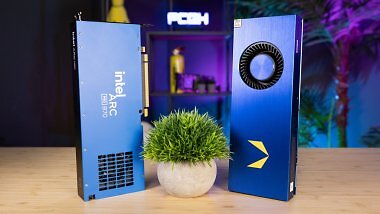
Arc Pro B70 Review: Ray Tracing Benchmarks and Performance Index
Inhaltsverzeichnis
Ray tracing is making its way into more and more games, so a newly purchased graphics card should be ready for it. The 15 games in the 2026 Ray Tracing Performance Index push graphics cards to their limits, thereby demonstrating their capabilities. As you'll see below, we've compiled the "who's who" of current ray tracing implementations. Since we test with maximum ray tracing complexity, upscaling comes to the GPUs' aid in some cases. We test the majority of games at an internal resolution of 67 percent (equivalent to most "quality" modes). While this means image quality isn't identical across manufacturers, this reflects real-world gaming conditions. Frame generation, variable rate shading, and low-latency options remain consistently disabled to ensure otherwise equal conditions.
Arc Pro B70 vs. Arc B580: Ray Tracing Benchmarks
The high demands of modern ray tracing implementations require more than just mild upscaling on most graphics cards. Let's see how Intel's most powerful graphics processor handles the ray tracing load in 15 games.
If you wish, you can display up to 15 additional graphics cards for each game; we have hidden them for the sake of clarity.
Once again, Anno 117 throws a wrench in the works for Arc graphics cards—the utilization of the Intel GPU doesn't improve even with ray tracing and XeSS upsampling. Overall, however, ray tracing makes a noticeable difference compared to rasterization. The first difference is the gap between the Arc Pro B70 and the Arc B580, which has widened significantly in some cases. The B70 doesn't owe this to its computational prowess, but rather to driver issues: As you can see from the figures, the Arc B580 achieves poor results in Dragon Age: The Veilguard and Marvel's Spider-Man 2 because VRAM is managed inefficiently—Radeon and Geforce sometimes achieve better results with 8 GiB. Setting aside these brute-force advantages ("nothing can replace memory except more memory"), the second difference compared to rasterization concerns the Arc Pro B70's ranking in the test field. The Radeon RX 9060 XT 16GB loses most of its head-to-head matches against the Intel GPU, while the Geforce RTX 5060 Ti 16GB is almost always stronger. Finally, let's take a look at the performance metrics derived from the 15 game benchmarks:
We tested graphics cards with "NA" only at 1080p, so only the Full-HD performance index is available here. Graphics cards without hardware ray tracing support are not included at all.
At rasterization, the difference between the Arc B580 and the Arc Pro B70 is around 36 percent; in ray tracing, the gap widens to 45 percent. As you can see from the individual benchmarks, the G31 chip isn't primarily responsible for this—VRAM issues are. Starting at Ultrawide-QHD, the B580 repeatedly runs into memory constraints, allowing the B70 to pull further ahead. Nevertheless, we don't want to downplay the progress between Alchemist and Battlemage: The Arc Pro B70 outperforms the Arc A770 16GB by an impressive 60 percent (rasterization: 53). On the following page, we increase the difficulty level to 3 out of 3. Is path tracing usable on the Arc Pro B70?