Arc Pro B70 Review: Noise, Power Consumption, Efficiency
Inhaltsverzeichnis
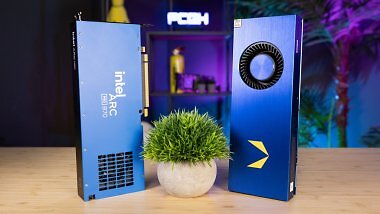
The Arc Pro B70 is manufactured by Intel itself and also offered by its board partners Asrock and Sparkle. While Intel refers to its gaming reference designs as "Limited Edition," the Arc Pro B70 goes by the simple (internal) designation "Intel Branded Card." No matter which Arc Pro B70 you buy, when it comes to cooling design, they're all professionals with a clear mission: heat has no place inside the case—especially not when up to four B70 graphics cards are supposed to work together as a "Battlematrix." To achieve this, the graphics cards rely on a cooling philosophy that died out in the gaming sector years ago: Direct Heat Exhaust (DHE).
 Source: PC Games Hardware
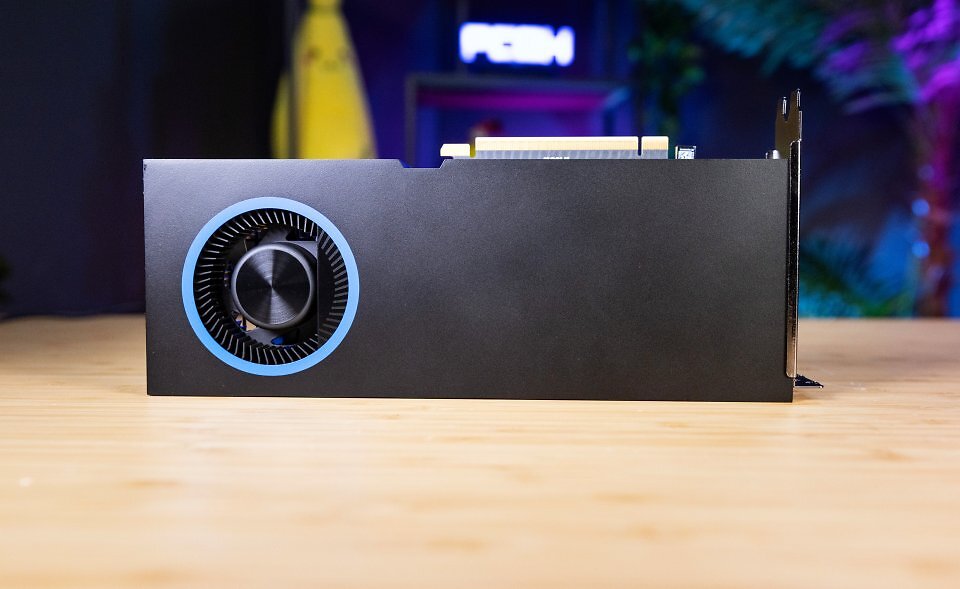
Arc Pro B70 Review: Direct Heat Exhaust, also known as "Blower," is the standard for all Pro cards.
This design, also known as a "blower," features a single radial fan at the rear instead of multiple axial fans distributed across the entire card. A DHE cooler does not distribute the heat inside the PC case but instead forces it outside. The dual-slot design is reminiscent of graphics cards from days gone by, such as the Radeon RX 5000 or Geforce GTX, though less fancy. Lighting? None—professional graphics cards do without RGB gimmicks.
Source: PC Games Hardware
Arc Pro B70 Review: Direct Heat Exhaust, also known as "Blower," is the standard for all Pro cards.
This design, also known as a "blower," features a single radial fan at the rear instead of multiple axial fans distributed across the entire card. A DHE cooler does not distribute the heat inside the PC case but instead forces it outside. The dual-slot design is reminiscent of graphics cards from days gone by, such as the Radeon RX 5000 or Geforce GTX, though less fancy. Lighting? None—professional graphics cards do without RGB gimmicks.
The downside of DHE designs is that cooling performance stands or falls with the speed of the single fan. A hurricane isn't needed to handle 230 watts; many 250-watt graphics cards, up to and including the Geforce GTX 1080 Ti and Radeon RX 5700 XT, have proven this. However, the quiet operation of modern axial fan designs is never possible with a blower. Let's see how the Intel Arc Pro B70 stacks up in comparison:
| Noise | Arc Pro B70 | Arc B580 | RTX 5070 | RTX 4070 Super | RTX 3080 | RX 7800 XT | RX 6800 XT |
|---|---|---|---|---|---|---|---|
| Model used for testing | Intel Reference | Intel Reference | Nvidia FE | Nvidia FE | Nvidia FE | AMD MBA | AMD MBA |
| Idle (UHD Desktop) | 0,2 Sone | 0,0 Sone | 0,0 Sone | 0,0 Sone | 0,0 Sone | 0,0 Sone | 0,0 Sone |
| Dual-Display (UHD + FHD) | 0,2 Sone | 0,0 Sone | 0,0 Sone | 0,0 Sone | 0,0 Sone | 0,0 Sone | 0,0 Sone |
| UHD Youtube Video | 0,3 Sone | 0,1 Sone | 0,0 Sone | 0,0 Sone | 0,0 Sone | 0,0 Sone | 0,0 Sone |
| Gaming (MAXIMUM) | 3,1 Sone | 1,5 Sone | 3,0 Sone | 2,1 Sone | 3,4 Sone | 1,9 Sone | 2,1 Sone |
| Coil Whine alone | ~0,9 Sone | ~0,4 Sone | ~0,6 Sone | ~0,6 Sone | ~0,3 Sone | ~0,4 Sone | ~0,5 Sone |
The results paint a familiar picture, reminiscent of prior DHE graphics cards. This includes the fact that the radial fan is always active (at least 800 RPM), and there is no "Zero Fan" mode during idle. Under full load, the fan speed rises to up to 2,020 RPM, resulting in a noise level of 3.1 sone. This figure also highlights the Intel Arc Pro B70's biggest issue: coil whine. Our sample chirps more than average at typical frame rates, while distinct squeaking and hissing can be heard at four-digit frame rates. We don't know if we've gotten a so-called "Monday model", but we're surprised given the professional standards.
 Source: PC Games Hardware
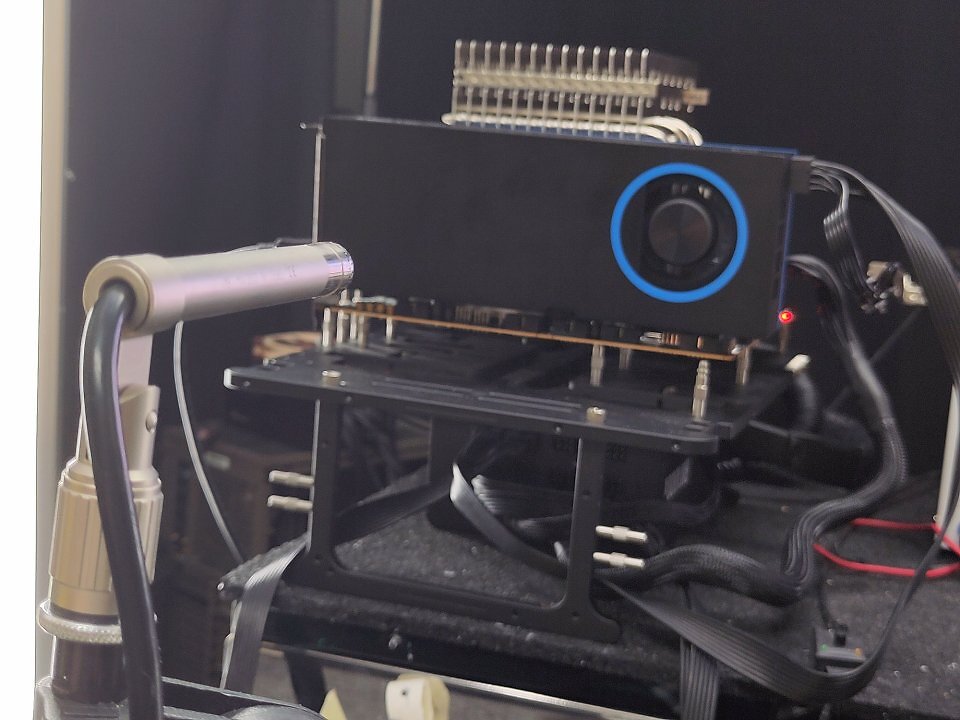
Intel Arc Pro B70: PCGH measures noise levels from a distance of 50 centimeters.
Source: PC Games Hardware
Intel Arc Pro B70: PCGH measures noise levels from a distance of 50 centimeters.
Power Consumption
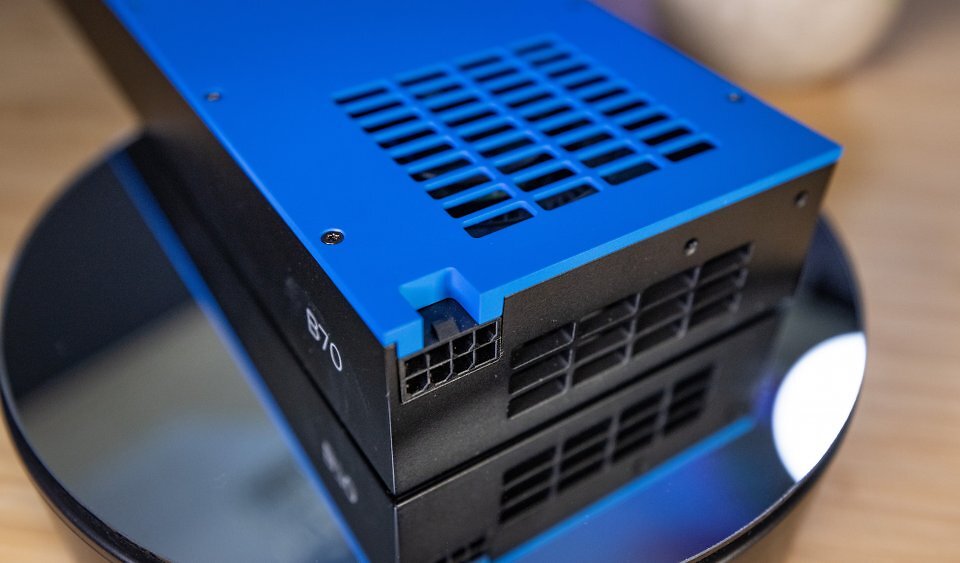
The Intel Arc Pro B70 has a total board power (TBP) of 230 watts, while some partners allow significantly higher power draw. For example, Sparkle rates its Arc Pro B70 Blower at up to 330 watts, which is sure to result in hurricane-like noise levels under full load—the Arc Pro B60 from the same manufacturer gives us a hint of what to expect. The Intel-branded card, on the other hand, feels like a "sweet spot" product, where the GPU operates at a high level of efficiency rather than forcing maximum performance at all costs. The 230-watt TBP is moderate yet noteworthy, as the graphics card requires only one 6+2-pin connector from the power supply. The specification for traditional PCI Express cables allows for a maximum of 150 watts per strand, which, combined with a maximum of 75 watts from the PCIe slot, results in 225 watts—the board power of many previous graphics cards, including the Intel Arc A770 Limited Edition. We'll soon find out just how far the tolerances are pushed.
PCGH measures the power consumption of graphics cards using the Power Capture Analysis Tool. As always, the following table shows the maximum values for all graphics cards, without the infrastructure having a limiting effect. Those with good case ventilation, who only play in Full HD, or who prefer to use frame rate limits will experience both lower power consumption and lower noise levels. Let's now take a look at the Arc Pro B70's metrics under idle conditions, light load, and various workloads:
| Power Draw | Arc Pro B70 | Arc Pro B60 | Arc B580 | RX 9060 XT 16GB | RTX 5060 Ti 16GB | RX 7600 XT |
|---|---|---|---|---|---|---|
| Model used for testing | Intel Reference | Sparkle Blower | Intel Reference | Sapphire Pulse | Zotac Twin Edge | XFX Qick |
| Idle (UHD Desktop) | 49 – 50 Watts* | 33 – 34 Watts* | 13 – 37 Watts | 6 – 7 Watts | 12 – 13 Watts | 6,5 – 19 Watts |
| Dual-Display (UHD + FHD) | 50 – 51 Watts* | 34 – 35 Watts* | 20 – 37 Watts | 7,5 – 9 Watts | 14 – 15 Watts | 24 – 32 Watts |
| Ultra HD Youtube Video | 52 – 53 Watts* | 36 – 37 Watts* | 37 – 40 Watts | 16 – 18 Watts | 15 – 16 Watts | 21 – 35 Watts |
| Gaming (MAXIMUM) | 235 Watts | 162 Watts | 197 Watts | 168 Watts | 184 Watts | 189 Watts |
| Anno 117 (Full HD, Raster) | 201 Watts | – | – | – | – | – |
| Anno 1800 (FHD, 4× MSAA) | 230 Watts | 119 Watts | 175 Watts | 167 Watts | 175 Watts | 186 Watts |
| Control (WQHD, RT) | 233 Watts | 143 Watts | 185 Watts | 167 Watts | 166 Watts | 187 Watts |
| CP2077 (Full HD, Raster) | 233 Watts | 121 Watts | 147 Watts | 167 Watts | 180 Watts | 185 Watts |
| Metro Exodus EE (WQHD, RT) | 233 Watts | 153 Watts | 196 Watts | 167 Watts | 183 Watts | 188 Watts |
| Full HD Gaming @ 60 Fps Limit | 72 Watts | 55 Watts | 62 Watts | 40 Watts | 37 Watts | 105 Watts |
| Max. Energy via PCIe (12V+3,3V) | 64 Watts | 52 Watts | – | 40 Watts | 47 Watts | – |
| Blender Benchmark (Classroom) | 231 Watts | – | – | – | – | – |
| PCGH VGA Tool (Furmark) | 234 Watts | – | – | – | – | – |
Power consumption depends on the display, resolution, and refresh rate. The range is listed as 60 to 144 hertz (without VRR). *Without ASPM explicitly enabled.
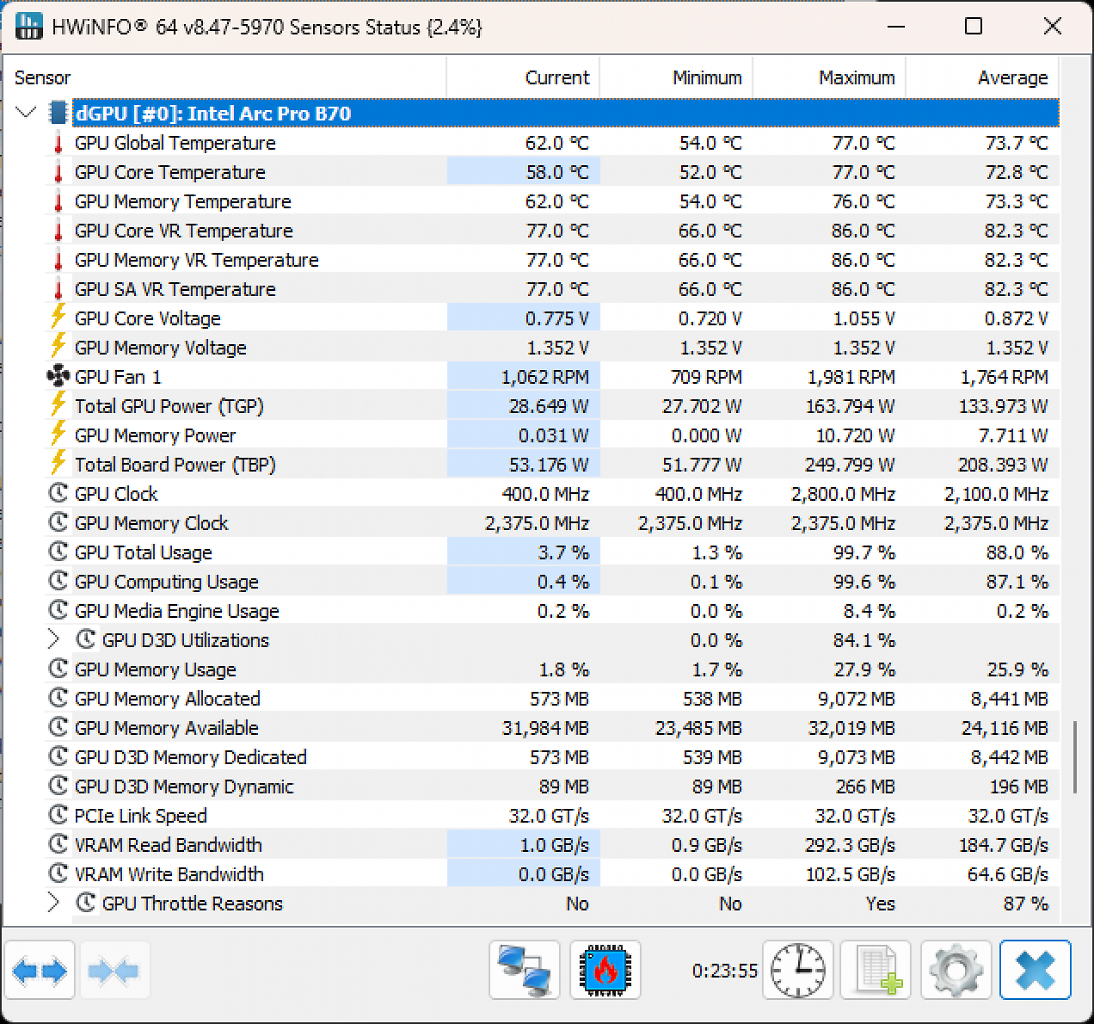
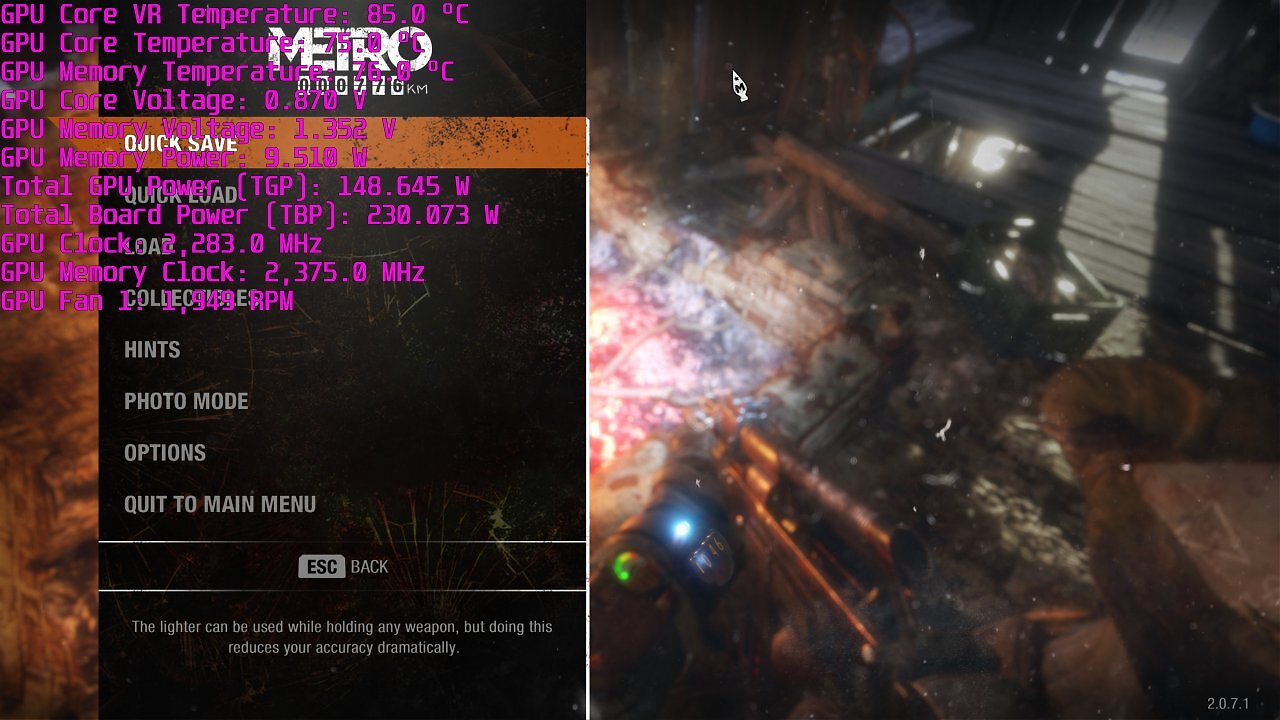
The hardware measurement matches the software reading almost perfectly and confirms our suspicion: under full load, the Intel Arc Pro B70 operates within the power cable's tolerance range. Although the telemetry is strict and reduces the GPU boost as well as the corresponding voltages from the maximum possible 2,800 MHz at 1.05 volts to significantly lower values, there are various power spikes above the limit. These are by no means dramatic, but they are clear: up to 170 watts are continuously drawn via the 8-pin cable, with occasional spikes above that. Looking at the PCIe slot, the Intel Arc Pro B70 remains well within safe limits; no more than 64 watts are drawn from the motherboard. We asked Intel for a statement regarding the power design but had not received one by the time this article was published. The fact that the card should under no circumstances draw more power is evident in the driver's tuning menu—here, the Intel-branded card does not allow any changes, only monitoring.
 Source: PC Games Hardware
Arc Pro B70 Full Review: The best graphics card Intel has to offer
Source: PC Games Hardware
Arc Pro B70 Full Review: The best graphics card Intel has to offer
Large Capacity = High Energy Demand
When comparing the Arc Pro B70 to the base models of the Radeon RX 9060 XT 16GB and Geforce RTX 5060 Ti 16GB, the Intel card consumes the most power. However, the comparison isn't entirely fair, as the Arc Pro B70 has twice as much VRAM—32 GiB of GDDR6 that needs to be powered. The total of 16 memory chips, each with a capacity of 2 GiB—eight on the front and eight on the back of the board—are manufactured by Samsung. How much power the chips require depends on the load—and it is more than one might assume. As a rule of thumb for GDDR6, two watts per chip apply. This means that for the 16 DRAM chips under load, one can assume around 32 watts and slightly more with frequent memory transfers. This amount is not insignificant and worsens the B70's performance as a gaming graphics card. An Arc B770 with "only" 16 GiB would require half that amount and could boost slightly higher with the same board power.
Active State Power Management
While power consumption during gaming is moderate, we would like to explain the poor idle results in more detail. These suffer from the same limitations as the Arc A series. In order for an Intel graphics card to enter its low-power state, Active State Power Management (ASPM) must be explicitly enabled, followed by the "Maximum Power Saving" option in the PCI Express settings under Windows. This is not necessary for Radeon and Geforce; these graphics cards enter their low-power states without ASPM.
The standard measurements (shown above) are taken without ASPM as usual; however, we took a closer look at the effects on the Arc Pro B70 and put them in the following table. Depending on the configuration, the graphics card can range from very power-efficient to power-hungry, though a clear pattern has emerged: Beyond 60 Hz, power consumption generally increases significantly, regardless of whether ASPM is enabled or not.
Energy Efficiency
Power is work per unit of time. Since we've determined both the frame rates (FPS) and power consumption (watts), we can compare them to calculate energy efficiency. To accomplish this, we've created a benchmark that compares our "Leistungsindex" with power consumption. Since both metrics are averages derived from numerous measurements, the analysis is sufficiently precise. For maximum accuracy, we performed the calculation separately for both rasterization and ray tracing. Let's see how the Intel Arc Pro B70 stacks up in comparison:
Across all rasterization benchmarks, the B70 draws around 225 watts (in Full HD, the board's power isn't maxed out at all times). This puts the card right on par with the Arc B580—a great result given its power-hungry 32 GiB of memory that is overshadowed by AMD and Nvidia. The Radeon RX 9000 and Geforce RTX 5000 series are manufactured using more advanced processes, giving these GPUs an edge in energy efficiency. Intel makes the most of TSMC's N5 process through a wisely chosen operating point but still clearly falls short. Let's take a look at how things stack up with ray tracing:
Different workload, similar result: The "Battlemage" graphics cards Arc B580 and Arc Pro B70 offer good energy efficiency, though they fall behind RDNA 4 and Blackwell. Intel's significant progress becomes clear when looking at the Arc A770 16GB: The B70 delivers 57 percent more FPS per watt than the 2022 debut model. On the next page, it's time to wrap up our review of the Arc Pro B70.