Six AM5 CPU Water Blocks Tested: The Chasing Pack
In this article
A test winner, an specialist with exotic technology and a value recommendation: our podium covers every traditional market position except one, style. Design is becoming increasingly important across the market and matters particularly to water-cooling enthusiasts. It cannot be scored, however, and therefore does not contribute to our overall rating. Two of the following blocks consequently have qualities of their own beyond the formal ranking. The final one is simply a sprightly old-timer.
Alphacool Apex 1
Fourth place goes to the "Apex 1 CPU Block". Alphacool's flagship adapts the cooling technology of the Core 1 family while aiming to add a stronger visual identity. It uses a multi-layer top that houses indirect ARGB lighting beneath an intricately milled surface, while also moving the inlet and outlet threads to the edges so that the design can extend across the full area. Screws would likewise disrupt the appearance, so Alphacool has simply moved them to the rear. In its socket-specific AM5 version, the Apex 1 uses unsprung mounting studs thin enough to pass through AMD's socket backplate and protrude from the rear of the motherboard. Nuts are then used to secure the block from behind.
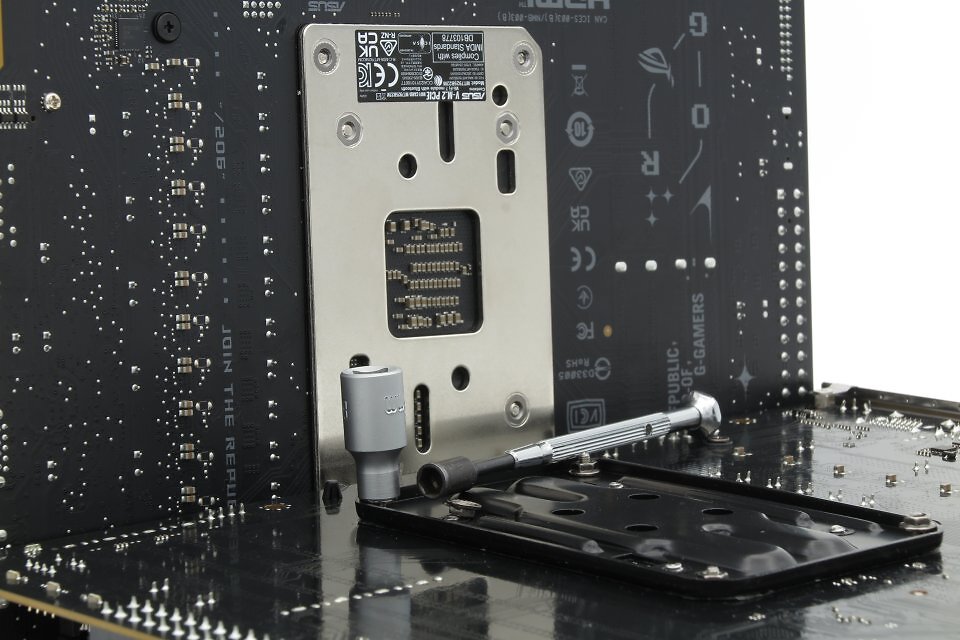
Apart from its appearance, this mounting system is something of a mixed proposition. On the one hand, it uses few parts because only the block and four successive nuts need to be handled. On the other hand, these are located on opposite sides of the motherboard, making a case with good rear access advisable — or a third hand to hold the mainboard up when installing the block outside a case. The underside of AM5 backplates is not standardised either. On versions made from thin sheet steel with a formed reinforcing edge, rather than an especially thick flat-steel plate, the clearance between the small nuts and said edge can be too narrow for standard hex sockets. In our performance tests, the convoluted interior of the Apex 1 prevents a strong flow rate, while its temperatures sit in the lower half of the field, despite another silicone insert helping the block adapt to the heatspreader. At 2 kelvin behind the Heatkiller V, the case for Alphacool's flagship therefore depends on its distinctive appearance. At least its €160 price seems fair compared with the newly launched models.
 Source: PC Games Hardware
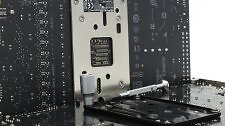
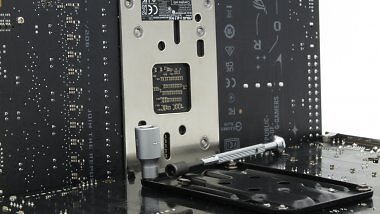
Caution, limited compatibility: fitting the Alphacool Apex 1 to a motherboard with a closely bordered backplate may require specialist tools. The socket shown bottoms out long before the nut is fully tightened. Flat backplates, as shown in the background, are unaffected.
Source: PC Games Hardware
Caution, limited compatibility: fitting the Alphacool Apex 1 to a motherboard with a closely bordered backplate may require specialist tools. The socket shown bottoms out long before the nut is fully tightened. Flat backplates, as shown in the background, are unaffected.
Thermal Grizzly Delta Mate MPII
Berlin-based Thermal Grizzly has so far made its name with cooling products, particularly those intended for extreme cooling. Founded and managed by well-known record overclocker Roman "der8auer" Hartung, its range includes delidding tools, accessories for LN2 overclocking and premium thermal compounds. For some time, it has also offered specialised water blocks for CPUs whose heatspreaders have been removed, or "delidded", with pre-prepared CPUs also available. These blocks sit directly on the CCD and IOD, or on the silicon of Intel CPUs. Unfortunately, this "Mycro Direct-Die Pro" cannot be tested comparably on a standard CPU, which is why it has not previously appeared in PCGH comparisons. This year however, Thermal Grizzly unveiled first a standard "Mycro Pro" version, followed immediately by an informal successor. Labelled "Mycro Pro II" but referred to as the "MPII", this block enters our test as part of the "Delta Mate" family. This range also includes fittings and GPU water blocks featuring a distinctive design that is, in some cases, extremely laborious to manufacture. Unfortunately, this is also reflected in the price, so we will address the biggest disadvantage immediately: at the editorial deadline, the Delta Mate MPII was listed, but not yet shipping, for €350. That sum would buy two Apex 1 blocks, three Kryos Next, or a Ryujin III together with a Heatkiller V Ultra.
 Source: PC Games Hardware
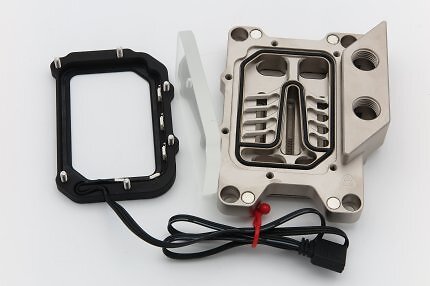
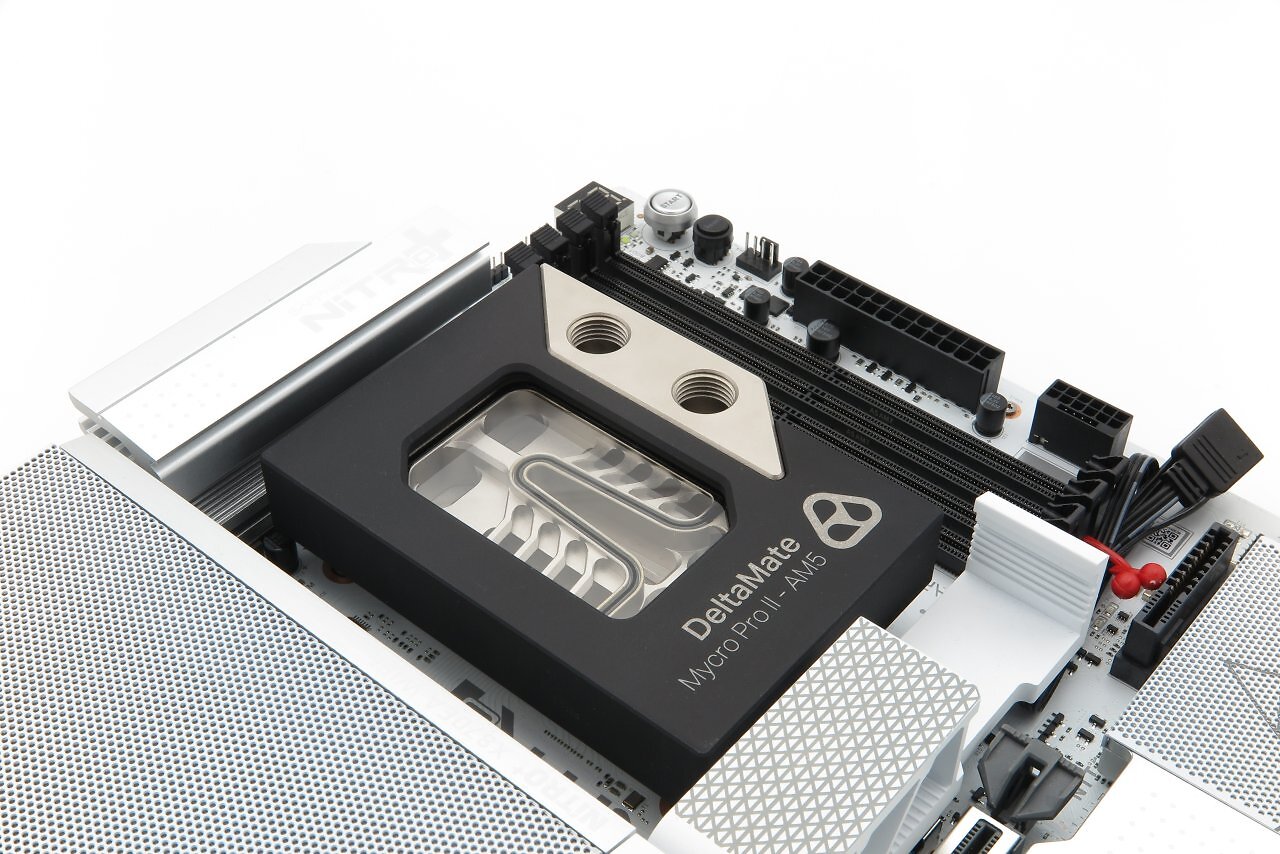
As good as it gets: the Delta Mate MPII is the world's only CPU water block with a borosilicate-glass viewing window. The flow-optimised machining beneath it is a sight to behold.
Source: PC Games Hardware
As good as it gets: the Delta Mate MPII is the world's only CPU water block with a borosilicate-glass viewing window. The flow-optimised machining beneath it is a sight to behold.
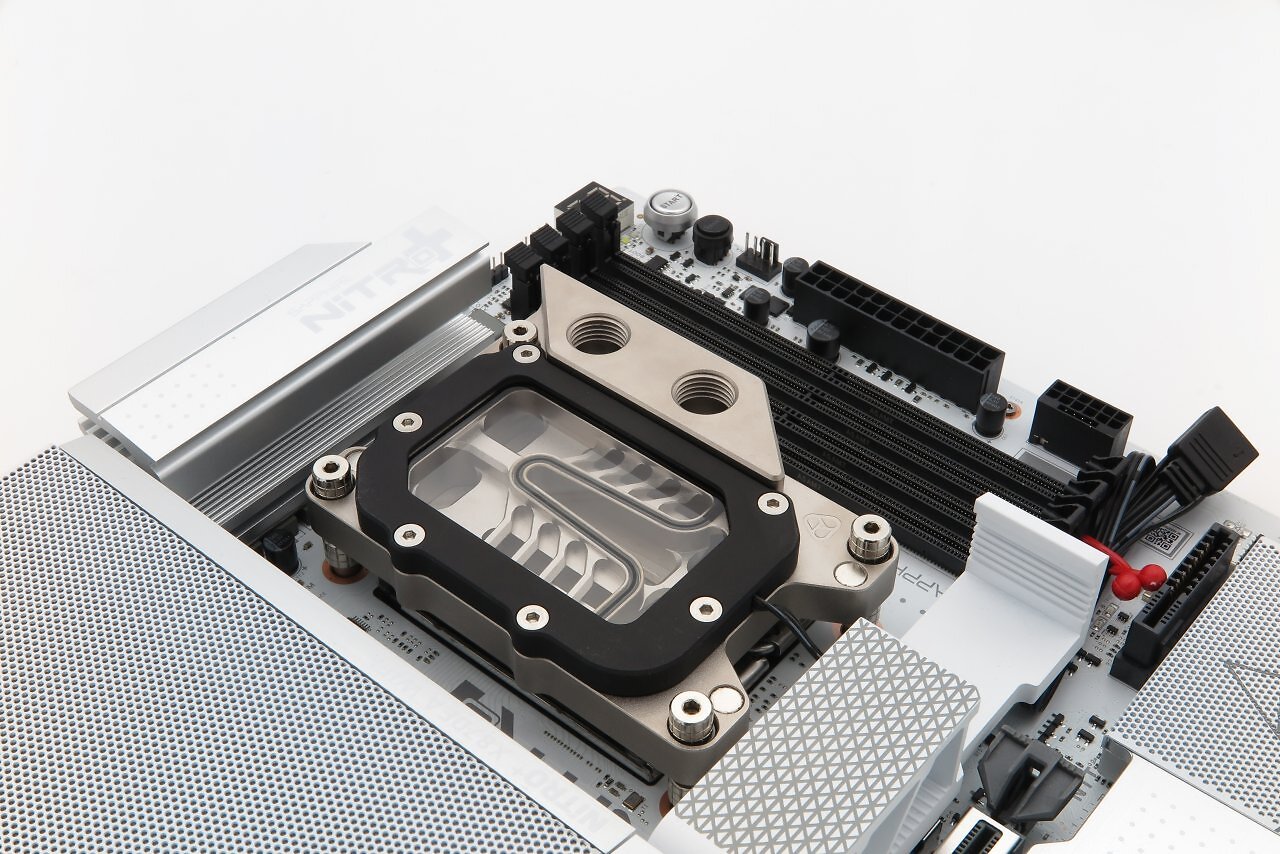
Thermal Grizzly instead supplies a block made from numerous components whose precision and attention to detail are impressive. At the top is a magnetically attached cover made from satin-finished anodised aluminium. This conceals every screw and sits flush with the fitting terminal, which is likewise satin-finished but made from nickel-plated brass. Those who prefer a more industrial appearance can simply omit the decorative cover milled from a 20 mm thick plate. This exposes the mounting screws, whose operation is reminiscent of Aquacomputer's system and which, similar to the Heatkiller V, sit in a satin-finished, nickel-plated brass intermediate plate, although without permanent attachment in this case. Within the block, this plate forms water channels and guide structures with an almost organic appearance. Anyone familiar with milling will appreciate how much additional work is involved in converging shapes, angled guide surfaces, changing radii and chamfered transitions compared with a rectangle or oval milled in a single pass.
All this effort remains visible through a borosilicate-glass top held by anodised aluminium and illuminated with ARGB lighting along its edge. This choice of material is probably partly responsible for the elaborate relocation of the fittings towards the edge, since threads cannot be cut into real glass. In return, the material is resistant to coolant additives, cleaning agents, and dyes, benefits that unfortunately cannot be attributed to the acrylic tops used by other manufacturers. The Delta Mate MPII is completed by a cold plate with "ultra-high-performance microfins (0.2 mm)".
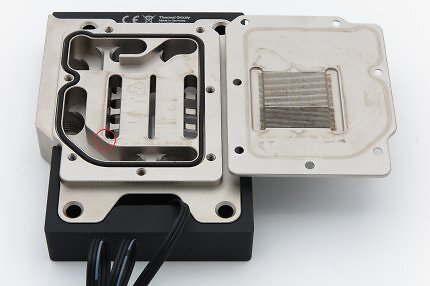
Anyone questioning that measurement after we already cited finer structures for the 11-year-old Kryos Next and less than half that thickness for the Ryujin III has identified the Delta Mate MPII's central problem. In fact, the 0.2 mm figure applies only to the area above the CCDs. Above the IOD, Thermal Grizzly uses an even more relaxed spacing of 0.4 mm, which at least distributes the water flow and cooling effect sensibly. Overall heat removal is simply poorer than on the competition, however, and the design also lacks techniques involving elastic materials or cross-cuts. Instead, the diversion from the inlet terminal to the cooling structure passes within just 2 mm of the structure's outlet openings, without Thermal Grizzly using an internal seal. The two metal surfaces are pressed firmly together, but experience with GPU water blocks shows that a flow bypass can form at points like these. Not all of the otherwise respectable 110 l/h are therefore likely to pass through the Delta Mate MPII's cooling structure. The result is a deficit of 2.6 K to the test winner, 3.5 K to Asus and still 1.9 K to the ten-year-old Kryos Next.
 Source: PC Games Hardware
The cooling structure in Thermal Grizzly's Delta Mate MPII is surprisingly small and coarse. At the marked point, the water inlet and outlet come within 2 mm of each other.
Source: PC Games Hardware
The cooling structure in Thermal Grizzly's Delta Mate MPII is surprisingly small and coarse. At the marked point, the water inlet and outlet come within 2 mm of each other.
These are not disastrous figures, of course. The Delta Mate MPII cools well enough for water cooling to remain worthwhile. We nevertheless expected more from a €350 premium product. When asked about this, Thermal Grizzly points to the direct-die version of the Mycro Pro. This, the company says, is its product for users who care about the final tenth of a kelvin — a credible claim because it bypasses Ryzen's internal heat-transfer problems — while the Delta Mate MPII focuses on design. As described, the elaborate manufacturing process and extensive use of premium materials work in its favour here. The number of buyers willing to spend this much money solely for appearance may prove small, however. We will keep an eye open, therefore, to see whether Thermal Grizzly releases an improved version in the foreseeable future. An additional seal between the intermediate plate and cold plate would at least appear easy to implement. With the cooling structure, by contrast, appearance and performance are directly opposed. The finer cold plates from Aquacomputer and Watercool repeatedly contain fins that no longer stand perfectly upright after machining. This is not a major technical problem and is already reflected in our measurements, but it would be unacceptable on a block that puts its internal construction on full display. Thermal Grizzly must find a production-ready solution.
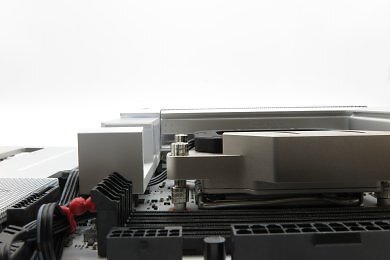
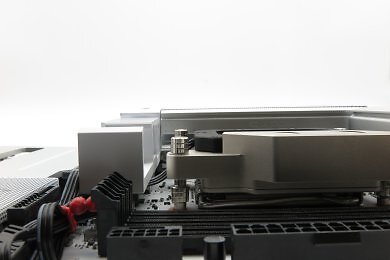
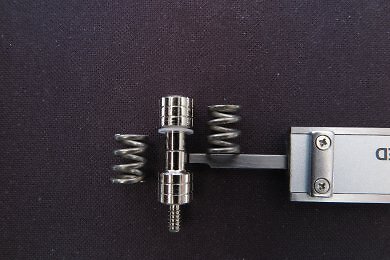
Another improvement is expected to be introduced soon. The first version of the compact manual omits both the correct position of the supplied washers between the springs and retaining nuts and the correct tightening torque for the latter. The Delta Mate MPII is the only block in the test without a hard stop in its mounting system. Although the studs appear to have been designed accordingly, they actually offer a wider adjustment range than the flexibility of the springs permits. Anyone wishing to use reasonable contact pressure — which is entirely sufficient for good cooling results, as we measure no difference — should tighten the mount only until the washer and no more than the lower third of each retaining nut disappear into the block's intermediate plate. Little about the Delta Mate MPII suggests this when it is first unpacked. A second tip is also appropriate here: the studs should first be tightened with a fine T8 Torx driver, which is not included. The UNC 6-32 thread specified by the AMD backplate for attachment to the motherboard turns more easily than the M4 thread on the block side. During removal, the studs therefore tend to rotate together with the retaining nuts rather than remaining in the motherboard.
 Source: PC Games Hardware
The Delta Mate MPII manual leaves out some important details, so we are using Thermal Grizzly's recommended maximum mounting pressure for its flagship block as an example: tighten the nuts until the first groove reaches the mounting frame.
Source: PC Games Hardware
The Delta Mate MPII manual leaves out some important details, so we are using Thermal Grizzly's recommended maximum mounting pressure for its flagship block as an example: tighten the nuts until the first groove reaches the mounting frame.
 Source: PC Games Hardware
Thermal Grizzly tested the Delta Mate MPII with the washers just disappearing into the mounting frame. We measured a 0.0 kelvin difference compared with the "first groove" mounting pressure and recommend using the gentler setting for the sake of the CPU.
Source: PC Games Hardware
Thermal Grizzly tested the Delta Mate MPII with the washers just disappearing into the mounting frame. We measured a 0.0 kelvin difference compared with the "first groove" mounting pressure and recommend using the gentler setting for the sake of the CPU.
 Source: PC Games Hardware
No hard stop: Thermal Grizzly's knurled nuts can theoretically be tightened until only 4.5 mm remain between them and the cooler mount (indicated by the upper edge of the calliper). The spring coils, however, measure 5.3 mm.
Source: PC Games Hardware
No hard stop: Thermal Grizzly's knurled nuts can theoretically be tightened until only 4.5 mm remain between them and the cooler mount (indicated by the upper edge of the calliper). The spring coils, however, measure 5.3 mm.
Watercool Heatkiller IV Pro
In principle, the Heatkiller IV has the same problem, since its mounting system was designed in 2015 for Socket 1150 systems using Watercool's own backplate. Its AM4/AM5 mounting hardware is at least easy enough to grip and tighten by hand. Beyond the wider range of supported sockets that comes with its age, however, there is little exceptional left to highlight about this established design. It still cools well enough, of course, but performs barely better than the Delta Mate MPII. Its flow rate is also quite good, though it has always been slightly lower than that of the Kryos Next. With no thermal paste included and an almost identical price, it also delivers only the second-best price-performance ratio in the test field. In brief, 11 years after its first PCGH test, the Heatkiller IV remains a solid purchase but no longer represents the best possible solution. It was genuinely time for a successor. Watercool intends to continue offering the established model because of its multi-socket compatibility and is even considering a revised AM5 mount that could improve cooling performance to the level of the Apex 1.