Six AM5 CPU Water Blocks Tested: The Top Three
In this article
The Heatkiller IV Pro also serves as a point of reference for our first highlight: The creatively named Heatkiller V will succeed it this summer, and a pilot-run sample reached us just in time for the editorial deadline of our August issue. It still lacks the final cosmetic surface treatment but matches the retail version in terms of cooling performance. Its challenger is Thermal Grizzly's Delta Mate MPII. Also made in Germany and similarly launched while our testing was under way, the "ultra-high-performance premium CPU water block" first unveiled at Computex must justify a substantial price.
Watercool Heatkiller V Ultra AMD
Among the companies still active in the consumer market, Watercool is now the second-oldest water-cooling manufacturer. Its Heatkiller series, which founder Rico Weber previously sold as a sideline, is the oldest of all. The Heatkiller 2.5, introduced in 2006, once established the basic design still dominating the entire water-cooling industry today: a central inlet, a nozzle slot beneath it, and water flowing away in both directions through a fin structure. Its 3.0 and IV successors also set standards. Now, 11.5 years after the previous update, the Heatkiller V arrives in summer 2026 and makes only cautious refinements to the successful formula. The cooling structure is slightly larger and, in the "Ultra" model tested here with its 0.15 mm cutting width, noticeably finer than that of the Heatkiller IV Pro. Above it sits an intermediate plate once again, forming the nozzle slot beneath the inlet and also serving as the mounting structure. Unlike the flat stainless-steel plate used by the Heatkiller 2.x, this time it is a large milled component containing most of the return channels, which were previously housed entirely in the top on the Heatkiller IV. The Heatkiller V top itslef will be available in acetal, solid metal, and acrylic.
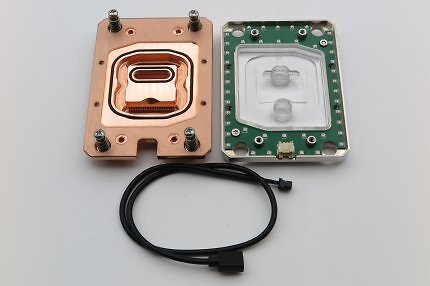
Our pilot-run test model featrues the "Acryl" version's top with an intermediate plate and cold plate made from bare copper, as will be used in the production version of the all-metal "Copper" model. The metal components of the standard production "Acrylic" version will instead be nickel-plated, allowing Watercool to use more durable and more affordable brass for the intermediate plate. Differences of this kind have no effect on performance. The same applies to the uppermost level of the block, which has not yet been mentioned. For the first time, Watercool has incorporated RGB lighting directly into the design. A large aluminium frame sits above the sealing top, with a circuit board carrying no fewer than 43 LEDs beneath it. These are bright enough to illuminate not only the acrylic tops but also to cast light from the sides of the all-metal versions through a transparent silicone layer between the frame and the intermediate plate.
 Source: PC Games Hardware
Watercool fits 43 LEDs to the Heatkiller V Ultra and stresses that these are low-power models: in initial tests with standard-output LEDs, the top reached 60 °C.
Source: PC Games Hardware
Watercool fits 43 LEDs to the Heatkiller V Ultra and stresses that these are low-power models: in initial tests with standard-output LEDs, the top reached 60 °C.
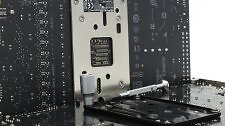
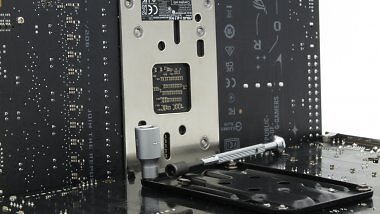
Enough about appearances, however. What matters are the practical characteristics. The Heatkiller V demonstrates another innovation during installation: the spring-loaded mounting system is permanently anchored in the intermediate plate. The entire block can therefore be positioned and tightened in one movement, eliminating the fiddling with small screws and washers required in the past. Unfortunately, the mounts can no longer be replaced flexibly. The socket-specific intermediate plate accounts for much of the block, while the attached frame is matched to its outline and screw positions. An Intel version planned for the Nova Lake launch will, at best, be able to reuse the cold plate of the AMD model. Conversely, this opens the door for socket-specific optimisation. The water inlet is no longer centred over the CPU but offset above the CCDs that require prime cooling. We already know this technique from EKWB's modular Velocity³, tested in PCGH 10/2025, but Watercool combines it with two Aquacomputer inventions. A small number of cross-cuts in the cooling structure are intended not to increase surface area but to make the cold plate more flexible, while an O-ring around the inlet slot provides the necessary flexibility in the opposing support. Unlike its predecessor, the Heatkiller V can therefore adapt slightly to the curvature of a heatspreader.
Our measurements show that Watercool's approach works, with the Heatkiller V delivering the second-best cooling performance in the test. More impressive still are the results of numerous smaller flow optimisations inside the block. Watercool also achieves the second-lowest flow resistance, resulting in the second-best flow rate with fixed pump power — and the Heatkiller V does not even need this. Although reducing the flow from 120 l/h to 60 l/h represents a severe restriction, the measured CPU temperature worsens by just 0.7 kelvin. Regardless of flow rate, this is therefore one of the strongest blocks available, while also avoiding restrictions that would hold back other components in the loop. That leaves us with the accessories, traditionally not a Watercool strength. Once again, we found ourselves limited to installation tools and a modular lighting cable, while the full version of the extensive manual must be downloaded online. The manufacturer would like this to be understood as an environmental statement, together with packaging that uses little material and is recyclable apart from a few plastic bags. At least thermal paste is included for the first time, and independent tests suggest it is a very high-quality compound.
 Source: PC Games Hardware
At the last minute, an express shipment from Watercool arrives with the final nickel-plated intermediate plate and cold plate. Anodised frames were not yet available by the editorial deadline, so we tested bare polished aluminium, which is particularly susceptible to marks.
Source: PC Games Hardware
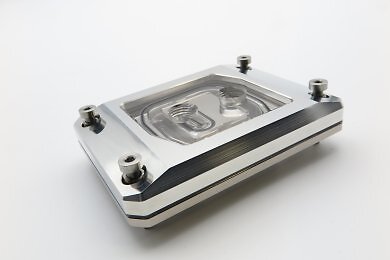
At the last minute, an express shipment from Watercool arrives with the final nickel-plated intermediate plate and cold plate. Anodised frames were not yet available by the editorial deadline, so we tested bare polished aluminium, which is particularly susceptible to marks.
 Source: PC Games Hardware
The Heatkiller V Ultra uses stainless-steel hex screws rather than the Phillips-head screws found on the pilot sample we tested, whose uncoated frame is shown here once again.
Source: PC Games Hardware
The Heatkiller V Ultra uses stainless-steel hex screws rather than the Phillips-head screws found on the pilot sample we tested, whose uncoated frame is shown here once again.
 Source: PC Games Hardware
The Heatkiller V Ultra's screws are spring-loaded and anchored in the intermediate plate.
Source: PC Games Hardware
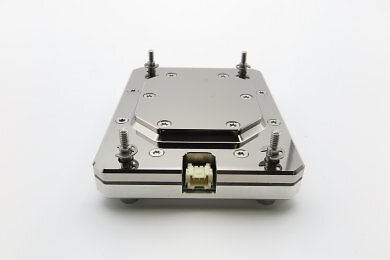
The Heatkiller V Ultra's screws are spring-loaded and anchored in the intermediate plate.
Asus Ryujin III WB
In second place, we find the runner-up from PCGH 10/2025. The Asus Ryujin entered that test as an outsider because the block is derived directly from the company's AIO range sourced from OEM manufacturer Asetek. Instead of the permanently attached tubing and radiator used by the standard Ryujin III, the "WB" offers two lateral G1/4-inch threads for modular loops. Two angled fittings and matching hard-tube connectors are included. In return, the internal pump of the AIO version is omitted, leaving a simple injection-moulded plastic top above the thin cold plate. The nominal highlights sit another level higher in the form of an integrated fan for cooling the motherboard voltage regulators and an attachment featuring a 3.5-inch LCD. This can display arbitrary (Gif) animations and status information, with the latter also available through AIDA64 Extreme for anyone wishing to avoid Asus' Armoury-Crate software.
 Source: PC Games Hardware
The Ryujin III WB can display temperature readings via AIDA64 Extreme out of the box (a one-year licence is included), but users will have to create their own designs if they want anything beyond two supplied templates.
Up to this point, the Ryujin III WB sounds like a purely cosmetic showpiece: plenty of spectacle, with little cooler underneath. Its mounting system, carried over unchanged from Asetek and correspondingly simple both to use and in construction, reinforces that impression. In reality, however, the unassuming cold plate has more to offer than it seems. More accurately, it offers "less": the fins are cut from the copper with a blade rather than milled into it, using a skived-fin process that would be unaffordable for smaller manufacturing specialists, and are less than 0.1 mm thick. The resulting heat-transfer surface in contact with the water is enormous. At the same time, a material-saving residual cold-plate thickness of just 0.5 mm creates an exceptionally short heat-conduction path through the copper. The entire structure can also flex to match the shape of the heatspreader, even more so than the Watercool and Aquacomputer designs, because the complete cooling area of the Ryujin III is sealed at the top by a flexible silicone insert.
Source: PC Games Hardware
The Ryujin III WB can display temperature readings via AIDA64 Extreme out of the box (a one-year licence is included), but users will have to create their own designs if they want anything beyond two supplied templates.
Up to this point, the Ryujin III WB sounds like a purely cosmetic showpiece: plenty of spectacle, with little cooler underneath. Its mounting system, carried over unchanged from Asetek and correspondingly simple both to use and in construction, reinforces that impression. In reality, however, the unassuming cold plate has more to offer than it seems. More accurately, it offers "less": the fins are cut from the copper with a blade rather than milled into it, using a skived-fin process that would be unaffordable for smaller manufacturing specialists, and are less than 0.1 mm thick. The resulting heat-transfer surface in contact with the water is enormous. At the same time, a material-saving residual cold-plate thickness of just 0.5 mm creates an exceptionally short heat-conduction path through the copper. The entire structure can also flex to match the shape of the heatspreader, even more so than the Watercool and Aquacomputer designs, because the complete cooling area of the Ryujin III is sealed at the top by a flexible silicone insert.
This is once again enough to deliver the best temperatures in the test by a narrow margin, even though the multi-socket block has not been specifically optimised for the asymmetrical heat output of AM5 CPUs and directs only one-third of the water across the CPU's hot CCD area. Asus, or rather Asetek, finishes last in the secondary performance assessment, again, however. The extremely dense cooling structure has very high flow resistance, depriving other water blocks in the loop of pump output. The quite small performance loss when restricting the flow to 60 l/h is therefore more of a measurement artefact than an achievement. The Ryujin III loses only 20 l/h, or 25%, between the normal and restricted measurements because its initial flow rate is that low already. Naturally, it thus suffers a smaller change than a competitor whose flow would double from 60 to 120 l/h at 55% pump output.
Aquacomputer Kryos Next
 Source: PC Games Hardware
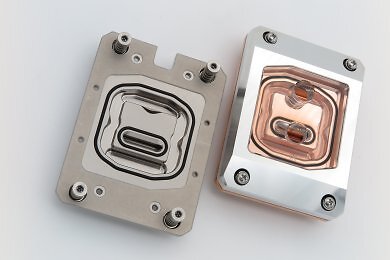
The Kryos Next has been with us for a very long time. Here is an unnickel-plated, all-copper version from the days when HEDT sockets were still a thing.
Source: PC Games Hardware
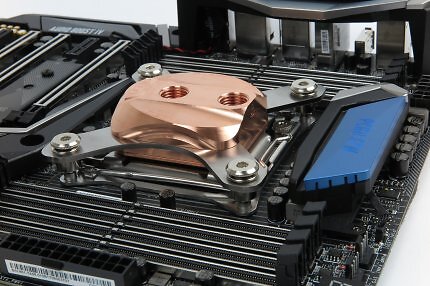
The Kryos Next has been with us for a very long time. Here is an unnickel-plated, all-copper version from the days when HEDT sockets were still a thing.
The Kryos Next can also offer 120 l/h, in fact, it sits fractionally in front of the Heatkiller V before rounding, accompanied by correspondingly slightly lower resistance. This established design has appeared in PCGH tests for almost a decade and, after numerous strong finishes, won last year's Ryzen 9 7950X comparison, as Aquacomputer was an early supplier of mounting systems optimised for the offset CCDs of Ryzen CPUs. Combined with a cooling structure that remains finely cut even by todays standards with less than 0.2 mm fin spacing, and with the flexibility trick mentioned in connection in the Heatkiller V section, but invented by Aquacomputer, this is enough for the third-best temperature on the Ryzen 9 9950X. A deficit of 0.5 K to Watercool and 1.6 K to Asus would be imperceptible without a direct comparison. The differences are significant, though, in the tightly grouped world of high-end water blocks and reflect in Aquacomputer's performance score. The Kryos also depends on its relatively strong flow rate, losing more performance than any other block at 60 l/h.
Aquacomputer does not regain ground in the features score despite its well designed mounting system, as it is the only manufacturer in the test to request the use of its own coolant. This is undoubtedly well-intentioned, but if every manufacturer took the same approach, products from different brands could be combined without voiding warranties. The range of mounting options, not included in the score, is way more positive. Although the Kryos Next must be purchased in a socket-specific version, no other block has such a wide selection of retrofit kits. Aquacomputer supports practically every platform from the past decade, including servers, and promises to continue doing so in future. A standing promise that has been honoured for a long time: even the very first CPU block made by this longest-established consumer manufacturer can still be supplied with new mounting hardware on request. The range of Kryos Next versions is even more extensive than the mounting options. No other manufacturer offers case modders a wider selection of materials, coatings and features to select from. Our all-metal test sample sits in the lower third of the range, resulting in the second-lowest price in this test — €1 more than the Heatkiller IV — and, combined with its very strong cooling performance, the best price-performance ratio.