Six AM5 CPU Water Blocks Tested: Test Loop & Methodology
In this article
A CPU water block without a water-cooling loop is merely an expensive paperweight. Alongside the Ryzen 9 9950X and the Asus X870E Hero already used in our previous test, the test system therefore includes a pump, reservoir, radiator and sensors. The combination of an Aquacomputer Aquatube and D5 Next has already proved itself as the water mover, and we once again operate it at 55% of maximum pump output. This 0.2 sone loud setting is deliberately below those preferred by performance-oriented users because a GPU water block will typically add further restriction in a gaming water-cooling system. In our test setup, by contrast, the pump's full output is available solely to the CPU block.
We choose a radiator considerably larger than necessary for a CPU-only loop, though The Ryzen 9 7950X came worryingly close to its throttling limit in the previous round-up, and the more relaxed behaviour of the 9950X was unknown before testing began, so we regulate the water temperature to a low 30 °C. Maintaining this reliably at an ambient temperature of 27 °C during midsummer requires four 20 cm fans on a Watercool Mo-Ra IV 400. Like the old-fashioned 8/11 mm tubing, this radiator has slightly above-average flow resistance, but its tube-style construction makes it particularly easy and reliable to bleed. The flexible, kink-resistant tubing format was also chosen deliberately to ensure consistent conditions for every test candidate.
Test scenarios
We load the CPU with Shader Stress, a tool originally designed to reproduce shader-compilation workloads for benchmarking. In AVX2 mode, it is about as effective at loading Zen 5 processors as current versions of Cinebench, and therefore more effective than Y-Cruncher or Prime95, while producing a more consistent workload. Our candidates must handle the resulting 200 W of heat first at a fixed pump output of 55% and again with the flow restricted to a uniform 60 l/h. In the fixed-power test, blocks with low internal resistance can benefit from higher flow rates. The fixed-flow measurement instead represents the worst-case scenario in which numerous other components in the loop make the resistance of the CPU block itself largely irrelevant.
 Source: PC Games Hardware
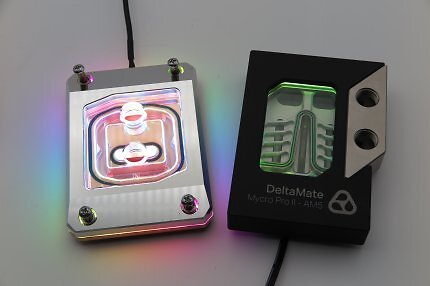
In a direct comparison, Watercool's ARGB lighting is considerably brighter, but Thermal Grizzly's LED strip is still sufficient to add accents in dark cases.
In both cases, we heat the system until temperatures stop rising over a period of 15 minutes. We then record the relevant CPU temperature, Tctl, along with the water temperature before and after the CPU block. The difference, or "delta", between the former and the average of the latter represents cooling performance and is averaged over five minutes: how cool is the CPU relative to the water flowing through the block? During the 60 l/h measurement, we also measure the water pressure before and after the block. The difference between the two — the pressure drop across the block at a constant flow rate — represents its flow resistance.
Source: PC Games Hardware
In a direct comparison, Watercool's ARGB lighting is considerably brighter, but Thermal Grizzly's LED strip is still sufficient to add accents in dark cases.
In both cases, we heat the system until temperatures stop rising over a period of 15 minutes. We then record the relevant CPU temperature, Tctl, along with the water temperature before and after the CPU block. The difference, or "delta", between the former and the average of the latter represents cooling performance and is averaged over five minutes: how cool is the CPU relative to the water flowing through the block? During the 60 l/h measurement, we also measure the water pressure before and after the block. The difference between the two — the pressure drop across the block at a constant flow rate — represents its flow resistance.
To average out variations in pressure build-up and thermal-paste application, we repeat every measurement four times. The exception is the 60 l/h temperature, which is recorded once after the final full-flow measurement. Here, we directly assess the change in cooling performance relative to the preceding measurement without removing the block or otherwise interfering with heat transfer. On the subject of thermal paste: because the included compounds vary considerably in quality, we use Arctic MX-6 throughout. It does not necessarily deliver the best possible results, but it spreads easily and reproducibly, allowing us to achieve an average difference of less than 0.5 K between the best and worst installation of each block.
Returning and new contenders
Because of the differences in the test setup, we must retest several members of the previous round-up to provide comparative figures. Aquacomputer's Kryos Next won our Ryzen 9 7950X comparison and therefore enters the contest as the favourite, despite being an 11-year-old design undergoing its fifth test. The Asus Ryujin III WB delivered the best temperatures last time and once again serves as a reference point for all-in-one liquid coolers, since it is a modular version of the cooling unit used in current Asetek AIO solutions. Alphacool's Apex 1 and Watercool's Heatkiller IV also return as frequently requested flagship models from the other two established German water-cooling manufacturers alongside Aquacomputer.