Can You Fake a CPU Review? We Built Our Own Ryzen 7 7700X3D
On this page, we examine whether our Ryzen 7 7700X3D simulation can also be used to assess efficiency.
In this article
Before discussing the results, we should note that we have revised the way CPU power measurements are evaluated. The raw data recorded by the benchmark laboratory remains the basis of the analysis. However, our interpretation now accounts more closely for platform-specific characteristics of the respective test environment.
Reported power values can vary depending on the motherboard, voltage regulation, sensor implementation, firmware and underlying platform design. In practice, these differences tend to appear as consistent overreporting or underreporting within specific load ranges rather than as random fluctuations.
To classify these effects more consistently, the raw values are normalised using evaluation logic tailored to each platform. The normalisation process does not alter or replace the underlying measurements. Instead, it standardises the interpretation in cases where reproducible offset or scaling effects occur.
The aim is to establish a robust basis for comparison between different platforms, motherboards and load states. This approach improves the consistency of CPU reviews involving different test platforms and reduces system-related distortions without fundamentally altering the raw-data nature of the measurements.By accounting for platform-specific offsets and scaling behaviour, we can provide more consistent and meaningful power figures.
On this page
Ryzen 7 "7700X3D": Efficiency
We generally praise the low power consumption of all Zen 4 processors equipped with 3D V-Cache. Their low power consumption can largely be attributed to the same design decision: To accommodate the first generation of 3D V-Cache, AMD reduced maximum boost frequencies, which also significantly improved power efficiency.
At 72 watts in games and only 85 watts in applications, our 7700X3D simulation ranks among the most economical processors in the test, alongside models such as the AMD Ryzen 5 5600 and Intel Core i5-14400F. The low heat output is an added benefit, particularly during the summer.
Fps per Watt
The performance-per-watt results highlight an important point. A CPU does not automatically become more efficient simply because it runs at a lower clock speed and consumes less power under load.
The difference between 1.438 and 1.419 is extremely small, but it is measurable. Notably, this one-percent difference was measured using the same physical processor. Once we receive a real Ryzen 7 7700X3D, we will verify the figures above and examine how closely our estimate matches the actual processor.
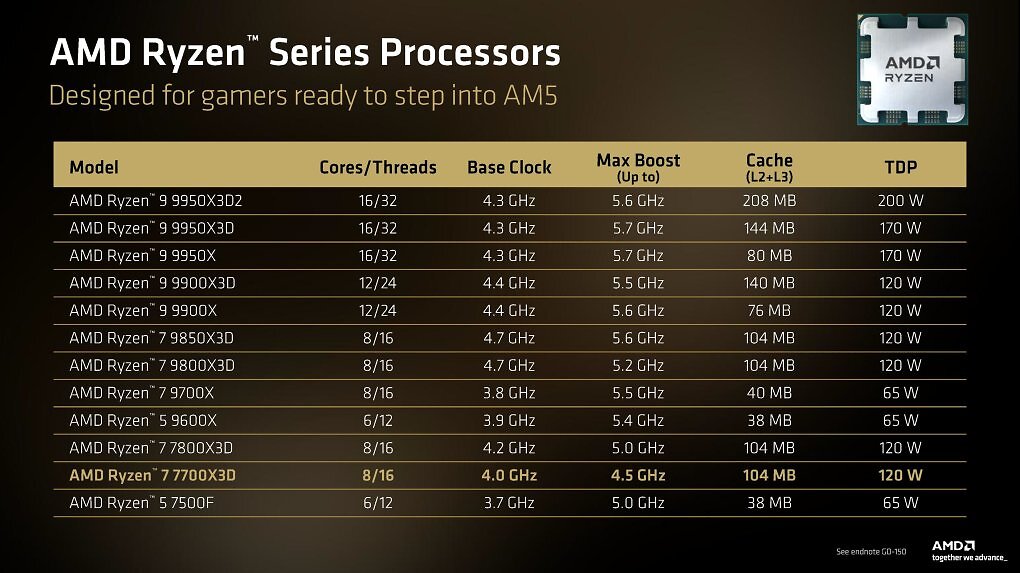 Source: AMD
AMD sieht noch Raum zwischen Ryzen 7 7800X3D und Ryzen 5 7500F, verpasst es aber dabei, Ryzen 5 7600X3D, 7500X3D, 7600 und 7600 auch aufzuführen, die sich zwischen diesen CPUs befinden.
Source: AMD
AMD sieht noch Raum zwischen Ryzen 7 7800X3D und Ryzen 5 7500F, verpasst es aber dabei, Ryzen 5 7600X3D, 7500X3D, 7600 und 7600 auch aufzuführen, die sich zwischen diesen CPUs befinden.
AMD Ryzen 7 7700X3D Simulation: Conclusion
We did it: we tested a CPU we do not actually have. Did it work? Yes and no. As the benchmarks demonstrate, configuring a Ryzen 7 7800X3D to approximate the lower-clocked model was relatively straightforward. The resulting performance figures are likely to be close to those of a genuine Ryzen 7 7700X3D. The efficiency results require considerably more caution, however, because they were not obtained from an actual Ryzen 7 7700X3D. Chip-to-chip variation could lead to noticeably different voltage and power-consumption figures in a retail sample. Even with those limitations, the simulation suggests that the Ryzen 7 7700X3D could be a compelling gaming processor that remains competitive with the other CPUs in our test.