180 Graphics Cards benchmarked: Aftermath & Conclusion
In this article
Aftermath & Conclusion
You've just seen the biggest graphics card comparison in PCGH history. When you compare the current GPU performance chart ("PCGH-Leistungsindex") with older games, the balance of power shifts, sometimes drastically. It's perfectly normal that workloads—which are entirely different from today's—appeal to different architectures. We already knew from experience what kind of preferences our four old benchmarks tend to have. Back then, the focus was on different GPU architectures, and processor limitations didn't play a role in the deliberately graphics-intensive scenes and settings.
 Source: PCGH
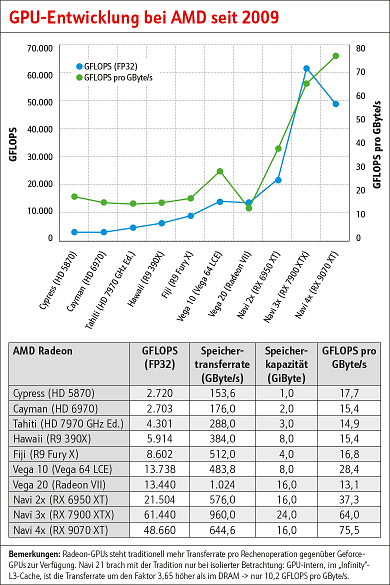
AMD GPUs 2009–2025
Source: PCGH
AMD GPUs 2009–2025
 Source: PCGH
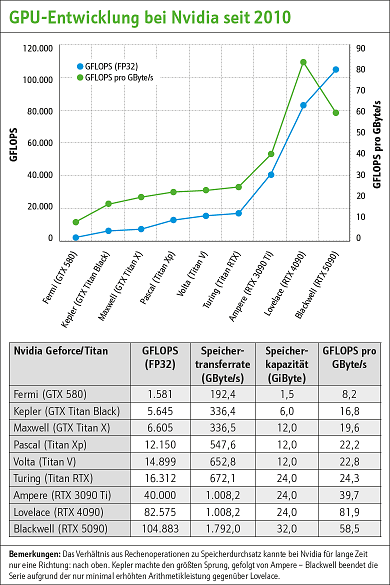
Nvidia GPUs 2010–2025
Source: PCGH
Nvidia GPUs 2010–2025
It's always interesting for a tech editor to see when a game notorious as a "GPU killer" suddenly becomes tame. The reason is clearly evident in the charts shown here: advances in computing power. The history of hardware and software is full of such examples. Every few years, a groundbreaking new engine emerges that pushes the boundaries of what's possible and brings contemporary hardware to its knees.
180 GPUs benchmarked: Impressions
Gaming veterans look back on milestones like Quake 3 Arena (1999), Max Payne (2001), Doom 3 (2004), or Crysis (2007). Graphics cards back then struggled to handle the visual splendor, and every subsequent GPU upgrade brought massive fps gains. However, as computing power increases by orders of magnitude, a point of saturation eventually sets in. It's only natural that a Geforce 8800 GTX, equipped with 346 GFLOPS, would struggle with complex DX10 shading and be easily outperformed by a Radeon HD 5870 with 2,720 GFLOPS. If you push even further, bottlenecks that were previously only hinted at come to the forefront. Crysis is mercilessly CPU-limited on modern graphics cards!
This insight can also be applied to the direction the gaming industry is taking—one that has been left out of this article so far: ray tracing and path tracing. This modern workload scales particularly well with pixels—and thus with computing power—which is why as many pixels as possible are currently being optimized away or derived using artificial intelligence. Even the most dreaded nightmares of our time will run butter-smooth on future graphics cards and hit the CPU limit—it's only a matter of time.