180 Graphics Cards benchmarked: Test #3 - Tomb Raider
In this article
Tomb Raider (2013)
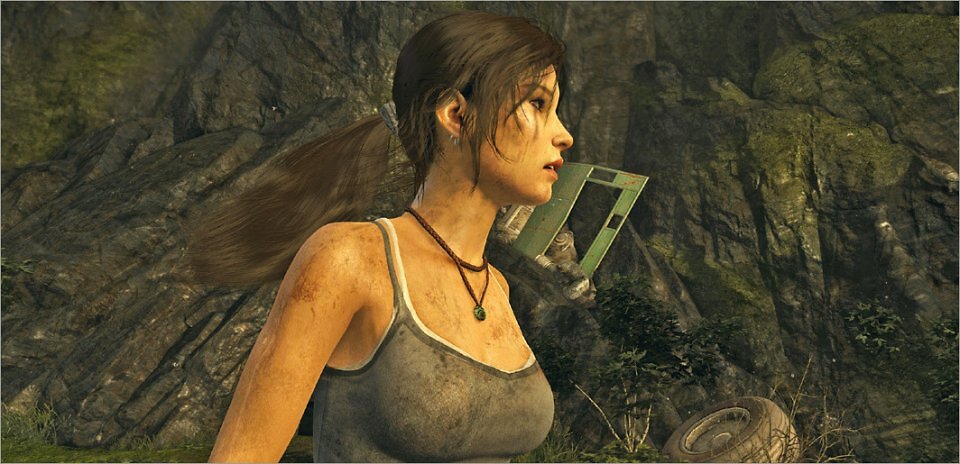
Tomb Raider? Wasn't that the 3dfx Voodoo game from 1996? Yes and no. In 2013, the series was rebooted as a trilogy and completed in 2018. The developers use DirectCompute for real-time physics simulation of Miss Croft's hairstyle powered by AMD's "TressFX": each of the countless strands of hair is treated as a chain with dozens of joints so that gravity, wind, or head movements have realistic effects on it. Of course, all of this requires processing power, and since it involves compute operations, the graphics chip is put to the test. Especially when combined with the optional supersample AA and perhaps a touch of post-sharpening, Tomb Raider (2013) still holds up well even today.
 Source: PCGH
Tomb Raider (2013)
For this comparison, we limit ourselves to FXAA and slightly reduced detail settings so that we can navigate the benchmark with reasonable accuracy even using the first-generation DX11 graphics cards. In our original test scene at the edge of a cliff at the beginning of the game, Lara must find her way along a narrow ridge before finally pulling herself up a rock face. Of course, her hair is visible the entire time, meaning TressFX is active. However, unlike in the built-in benchmark—from which the image is taken—the feature isn't highlighted quite as prominently here.
Source: PCGH
Tomb Raider (2013)
For this comparison, we limit ourselves to FXAA and slightly reduced detail settings so that we can navigate the benchmark with reasonable accuracy even using the first-generation DX11 graphics cards. In our original test scene at the edge of a cliff at the beginning of the game, Lara must find her way along a narrow ridge before finally pulling herself up a rock face. Of course, her hair is visible the entire time, meaning TressFX is active. However, unlike in the built-in benchmark—from which the image is taken—the feature isn't highlighted quite as prominently here.
Despite being roughly the same age, Tomb Raider scales better with graphics performance than Bioshock Infinite and is also significantly more demanding on older GPUs. For example, the first DirectX 11 graphics card—which is still the Radeon HD 5870—reaches just under 33 fps here, while in Bioshock "3" it easily exceeds the 40-fps mark. Interestingly, Nvidia's first DX11 model—that's right, the Geforce GTX 480—achieves the same 18 percent lead here. Meanwhile, the first Graphics Core Next, the Radeon HD 7970, doesn't perform as well here as it does in Bioshock Infinite; it achieves frame rates 94 percent higher than the venerable HD 5870.
The lack of red GPUs in the top 15 this time isn't due to a CPU bottleneck, but simply because AMD hasn't released a high-end graphics card since 2022. The Radeon RX 7900 XTX boasts significantly more raw performance than the newer RX 9070 XT, a fact that comes through here despite the architectural differences. The upcoming Radeon generation, currently rumored to have 96 compute units, will certainly be a contender in the top 5. Which graphics card do you think will be the first to break the 1,000 fps mark? A Blackwell refresh ("RTX 5090 Ti"?) will fall just short of that. The test system still has enough headroom for the first 150 TFLOPS graphics card...