180 Graphics Cards benchmarked: Test #4 - The Witcher 3
In this article
The Witcher 3
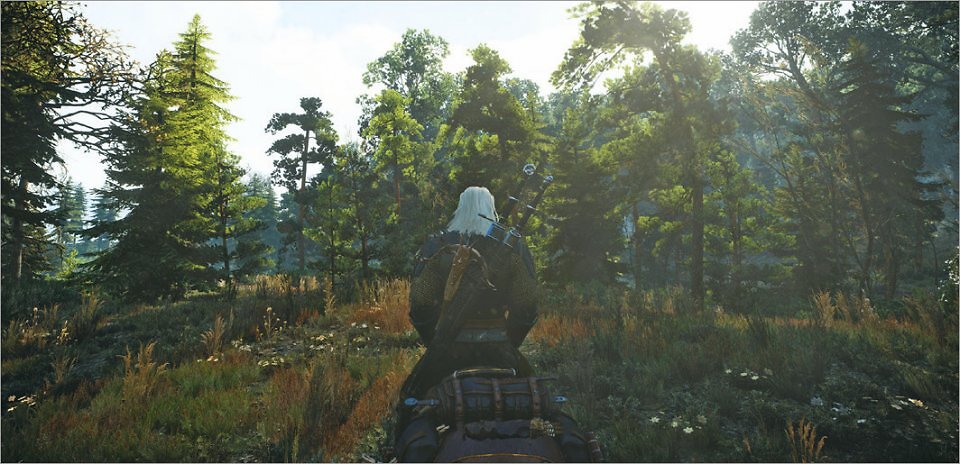
Tempus fugit, time flies: The Witcher 3 celebrated its tenth anniversary in the spring of 2025. The finale of The Witcher trilogy is considered one of the best games of our time—no wonder it has a permanent (or recurring) spot on countless gamers' hard drives. Although Geralt's advanced age is evident, the developers are masters at using color to create beautiful moments. This is especially true for the ray-tracing-enabled "next-gen" version—but in this comparison, we're naturally testing the DirectX 11 GOTY version 1.32. We've now reached the fourth and final test in this article.
 Source: PCGH
The Witcher 3
Fun fact: When comparing the 180 graphics cards, The Witcher 3 is by far the newest and most graphically demanding game. To ensure that not only TFLOPS powerhouses can produce a recognizable frame rate, but also models with just a few hundred GFLOPS, we'll stick with the "High" preset and test the game not using our worst-case scenario in Toussaint, but rather the second-most demanding location—a lush Skellige forest. The Witcher 3 rounds out the analysis with results that are once again slightly different but very interesting. The scaling with the available graphics performance doesn't come close to that of 3DMark and Tomb Raider, but Geralt's high demands result in the lowest frame rates.
Source: PCGH
The Witcher 3
Fun fact: When comparing the 180 graphics cards, The Witcher 3 is by far the newest and most graphically demanding game. To ensure that not only TFLOPS powerhouses can produce a recognizable frame rate, but also models with just a few hundred GFLOPS, we'll stick with the "High" preset and test the game not using our worst-case scenario in Toussaint, but rather the second-most demanding location—a lush Skellige forest. The Witcher 3 rounds out the analysis with results that are once again slightly different but very interesting. The scaling with the available graphics performance doesn't come close to that of 3DMark and Tomb Raider, but Geralt's high demands result in the lowest frame rates.
Let's start again in chronological order with the Radeon HD 5870. The last high-end Radeon with official ATI branding collapses under the load of The Witcher—no surprise, since The Witcher 3 was released more than five years after this graphics card. Nvidia's Geforce GTX 480 fares a little better; it achieves frame rates that are 15 percent higher but still remain below 20 fps. The legendary Radeon HD 7970 takes a giant leap forward and can now hold its own against the Geforce GTX 1050 Ti and Arc A380. Meanwhile, China's first serious graphics card, the MTT S80, fails to reach the 30 fps mark.
When The Witcher 3 was released, the Geforce GTX Titan X was at the top. After all, the 2015 enthusiast GPU is capable of 86 fps. Its 2025 equivalent, the Geforce RTX 5090, would be capable of more than 500 fps if the processor let it. Despite the mercilessly overclocked hardware, the CPU bottleneck is a common issue in this article. But this was a necessary evil. Settings that push modern GPUs to their limits would yield worthless results between zero and five fps on the "Worst 50"—whether due to a lack of raw performance, memory overflows, or even crashes. This brings us to our conclusion.