180 Graphics Cards benchmarked: History & Progress
In this article
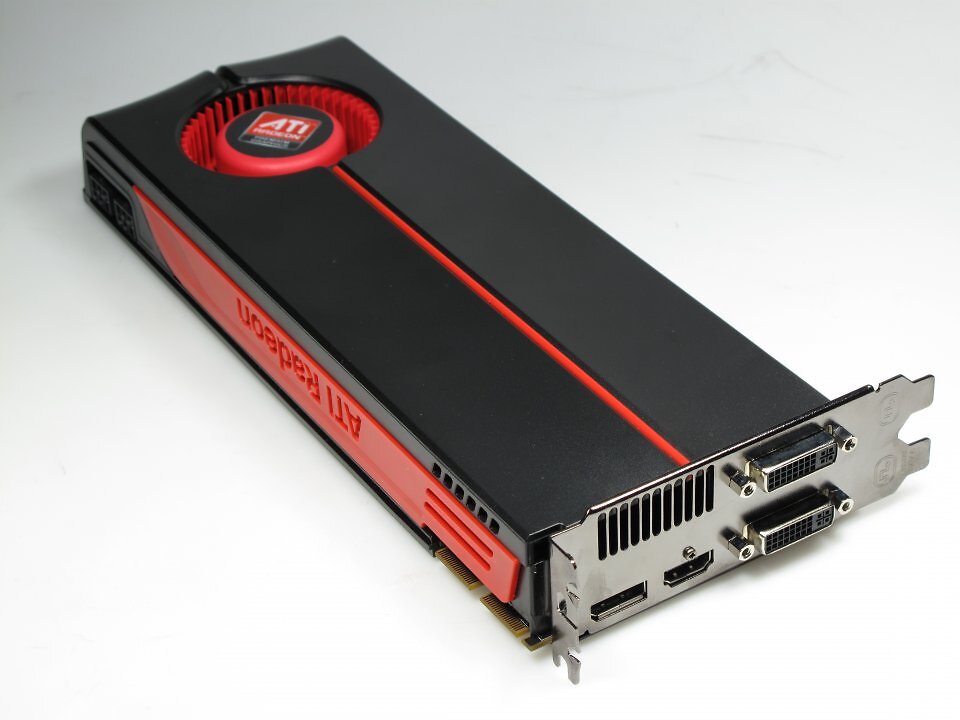
On September 23, 2009, ATI released the Radeon HD 5870, the first DirectX 11 graphics card—weeks before Microsoft released the software component with Windows 7. Cypress, as the GPU was codenamed, established technological leadership and packed 1,600 shader units into more than 2 billion transistors. In the following months, AMD rolled out its entire portfolio even before Nvidia could ship its first DirectX 11 GPU. Nvidia's Geforce GTX 480 and 470 were delayed until March 27, 2010. Although Jensen Huang's company was able to reclaim the performance throne with Fermi (GF100), it came at the cost of exorbitant power consumption and noisy cooling.
 Source: PC Games Hardware
The first DirectX 11 GPU—ATI's Cypress—was a sensation in the fall of 2009.
Source: PC Games Hardware
The first DirectX 11 GPU—ATI's Cypress—was a sensation in the fall of 2009.
A quick jump to 2006: On July 24, AMD announced the acquisition of Canadian graphics chip specialist ATI, known for its Radeon graphics cards. The HD 5000 series was the last to bear the honored ATI brand name; subsequent graphics cards were released under the AMD banner. Meanwhile, Nvidia redesigned its GF100 chip—now infamous as "Thermi"—and released it in November 2010 as the GF110; the Geforce GTX 580 and 570 were born. Together with the Geforce GTX 460, released that summer, the architecture's reputation was saved.
AMD's response followed at the end of 2010: the Radeon HD 6970/6950. The Cayman chip relied on a slicker shader design that was easier to fully utilize. This had a positive impact on benchmark results, and the standard 2 GiByte of graphics memory helped in borderline cases. However, the Geforce GTX 580 is and remains faster than the Radeon HD 6970 in most cases. This marks the end of the 40-nm era, which began in 2009.
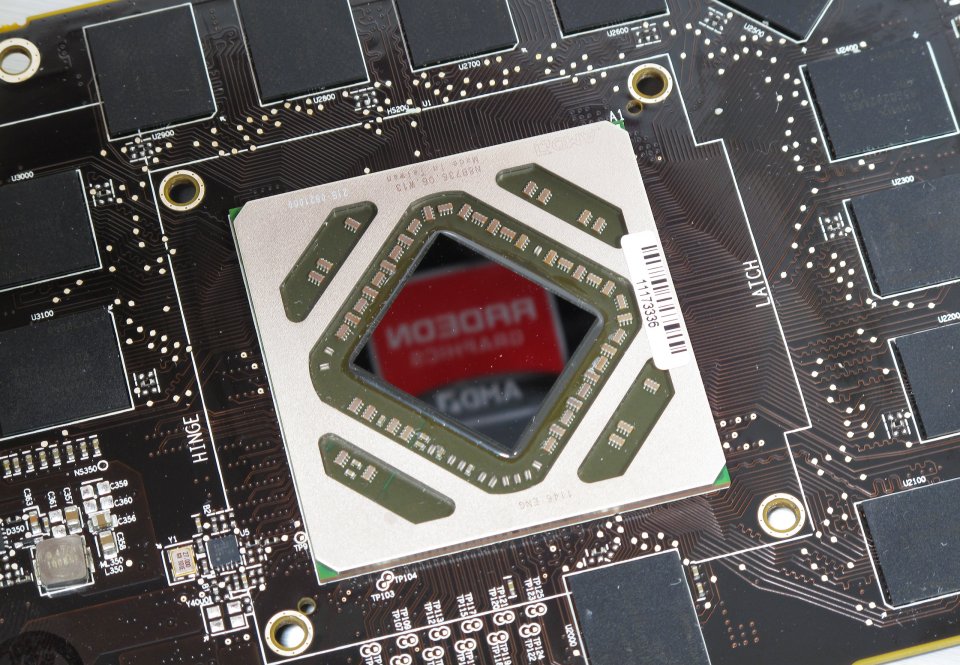
The next big announcement came at the end of 2011, when the first benchmarks for the Radeon HD 7970 (codename "Tahiti") were released. Once again, AMD was ahead of Nvidia, launching the first GPU with DirectX 11.1, PCI Express 3.0, and 28-nm manufacturing. The completely revamped "Graphics Core Next" architecture—GCN for short—relies on Compute Units (CU) as its fundamental building blocks and formed the architectural foundation for all Radeon GPUs through mid-2019 (Vega 20).
 Source: PC Games Hardware
With Tahiti—better known as the Radeon HD 7970—AMD delivered a legendary long-running product and arguably the first in the "FineWine" category.
Nvidia also redesigned its Shader Multiprocessor (SM); Kepler offered 192 FP32 ALUs per unit instead of 128. This led to significantly higher peak arithmetic performance, but other limitations effectively prevented all of that from translating to real-world performance. The Geforce GTX 680, launched on March 22, 2012, proved to be a fast, energy-efficient graphics card that was able to narrowly outperform the Radeon HD 7970, which was still slightly held back by its drivers. Nonetheless, AMD's Radeon HD 7970 has achieved legendary status today and is arguably the first product in the "FineWine" category. How come? Radeon GPUs tend to gain ground over time—in other words, to mature like a fine wine. In this case, the situation is clear: All major Tahiti models eventually left the Kepler high-end models (GTX 680/770) in the dust—thanks in part to the generous 3 GiByte of memory, which paid off in the years following 2013.
Source: PC Games Hardware
With Tahiti—better known as the Radeon HD 7970—AMD delivered a legendary long-running product and arguably the first in the "FineWine" category.
Nvidia also redesigned its Shader Multiprocessor (SM); Kepler offered 192 FP32 ALUs per unit instead of 128. This led to significantly higher peak arithmetic performance, but other limitations effectively prevented all of that from translating to real-world performance. The Geforce GTX 680, launched on March 22, 2012, proved to be a fast, energy-efficient graphics card that was able to narrowly outperform the Radeon HD 7970, which was still slightly held back by its drivers. Nonetheless, AMD's Radeon HD 7970 has achieved legendary status today and is arguably the first product in the "FineWine" category. How come? Radeon GPUs tend to gain ground over time—in other words, to mature like a fine wine. In this case, the situation is clear: All major Tahiti models eventually left the Kepler high-end models (GTX 680/770) in the dust—thanks in part to the generous 3 GiByte of memory, which paid off in the years following 2013.
Speaking of 2013: In February of that year, Nvidia showed what Kepler was truly capable of—and also tested just how deep people's pockets were. The 950-Euro flagship Geforce GTX Titan set every enthusiast's heart racing with 50 percent more computing power and three times as much memory as the GTX 680. AMD launched its counterattack in October: Thanks to a core clock of up to 1 GHz and a 512-bit memory interface, the Radeon R9 290X managed to narrowly edge out Nvidia's Titan. The GTX 780, released later, didn't stand a chance against the top-of-the-line Hawaii model despite its higher price, and it also offered only 3 GiByte of memory instead of 4. The same was true for the Geforce GTX 780 Ti, which was released in 2013 and, together with the Geforce GTX Titan Black released in February 2014, rounded out the Kepler series.
The eventful year of 2015 began with the final "Geforce GTX" Titan X. The GM200 launched in its full configuration and boasted 12 GiByte of VRAM. It took nearly six and a half years (!) for Nvidia to integrate this memory capacity into a high-end Geforce card. As with Kepler, a scaled-down variant followed: the Geforce GTX 980 Ti with "only" 6 GiByte. Together with the Geforce GTX 980 and 970 models released in the fall of 2014, Nvidia had a compelling lineup.
AMD's approach was quite different. Their only real innovation looked highly promising on paper but proved disappointing in practice. As the first consumer product, the Fiji chip relied on High Bandwidth Memory (HBM). The four 1 GiByte memory stacks were each connected via a 1,024-bit bus and together achieved an enormous transfer rate of 512 GByte/s. Since the GM200 was a tough competitor even in its stripped-down form, AMD pushed the top-of-the-line Radeon R9 Fury X to its absolute limit and had to resort to liquid cooling to do so. In 2015's big showdown, the Fury X narrowly lost to the GTX 980 Ti—except for a few notable victories. The Radeon R9 390 and 390X, released the same year, also achieved such results, thanks to memory running at 6 GT/s and being twice as large. This combination gave the models a long gaming lifespan that would likely still be going strong today if driver support hadn't long since come to an end.
Among other things, 2016 was marked by the transition to the popular Pascal generation and AMD's Polaris. The Radeon RX 480 fell short of the high expectations that had been fueled by marketing. However, it offered performance and efficiency on par with the nearly two-year-old Geforce GTX 980 and GTX 970 at an affordable price.
Nvidia's Pascal architecture, the last that was uncompromisingly optimized for rasterization performance, made a bigger impact and launched in the summer of 2016 as the Titan X (since then without the "Geforce GTX" brand). With the GP102, Nvidia specifically addressed Maxwell's weaknesses and put together a package featuring numerous processing units and high clock speeds nearing 2 GHz. All of this also applied to the Geforce GTX 1080 Ti, a only slightly scaled-back version released in March 2017. Both models are still quite usable in 2026—without ray tracing, of course. We probably don't need to say much more about the GTX 1080 and GTX 1070 either, although their age has left a more noticeable mark here.
AMD's response in the summer of 2017 met a similar fate. The Radeon RX Vega 56 and 64 models successfully competed with Nvidia but consistently consumed more power. Once again, AMD delivered an interesting technology accelerated by High Bandwidth Memory, but most of the GPU's special features never really took off. Although the Vega siblings perform slightly better in newer games than they did at launch, this improvement isn't decisive.
In the summer of 2019, AMD retired the eight-and-a-half-year-old GCN architecture: RDNA (1) offered a completely revamped shader core built on modern 7-nm process technology. The Radeon RX 5700 and 5700 XT graphics cards based on this architecture came close to matching Nvidia's high-end Turing models, prompting the Geforce makers to respond with "Super" versions of the RTX 2070 and 2060. RDNA was an important milestone because, while Nvidia has long been known for consistent performance, Radeon cards finally achieved this level of performance with RDNA.
Even earlier, in late summer 2018, Nvidia ushered in the era of ray tracing with the Turing architecture. This wasn't a solo effort; the market leader was simply the first manufacturer to implement the industry-wide decision regarding DirectX Ray Tracing (DXR) in hardware. Many gamers were claiming that the die area could have been used for additional traditional processing units à la Pascal—these voices have since fallen silent. Even DLSS, which was rightly met with skepticism at first, has matured into an indispensable tool. Ever since our Turing retest in 2024, it has been clear that we are dealing with what is arguably the most visionary GPU architecture of all time. Nvidia's influence has certainly played a major role in ensuring that these bold ideas have indeed achieved market penetration over the years.
With the Ampere architecture, Nvidia not only doubled ray tracing performance in the fall of 2020 but also the FP32 throughput essential for "normal" games. Unsurprisingly, Nvidia successfully outperformed itself—albeit with record-breaking power consumption. One of the reasons for the high power was likely the looming competition that entered the scene at the end of 2020. AMD's RDNA 2 architecture, better known as the Radeon RX 6000 series, didn't offer increased performance per compute unit, but it delivered significantly higher clock speeds—thanks to superior TSMC manufacturing—as well as an impressive trick: thanks to the "Infinity Cache"—an exceptionally large Level 3 cache—AMD achieved unprecedented performance even with just 300 watts of board power.
Early 2022 brought refreshes of the existing architectures—the calm before the storm. What came next has rightfully earned its place in the history books. In the fiery second half of 2022, not only did AMD's RDNA 3 and Nvidia's Lovelace generations debut, but Intel also made its comeback in the graphics card market after decades of dormancy—so far without a disruptive impact, but with quite a few notable successes. The star of 2022 and beyond, however, was the Geforce RTX 4090. While its hefty price tag was a bit of a blow, the lasting joy of owning what remains the second-fastest graphics card to date has made buyers feel fine about it.
The architectures that have dominated the market since 2025—AMD RDNA 4 and Nvidia RTX Blackwell—seem like a breeze compared to Ada, and even more so compared to Ampere and RDNA 2. While the recent architectures are certainly the most advanced ever made, they don't break new ground. While AMD has made significant strides in ray tracing, Blackwell disappoints with the smallest generational leap to date—the newly invented Multi Frame Generation has to save the day.