Bartlett Lake Core Scaling: Where 12 Cores Promise More Performance
Currently, the only place you can find 12 CPU cores that can be loaded without latency is in the embedded market. We're testing the Core 9 273PQE in various games to see how well they actually scale with more cores.
Special Add as a preferred source on Google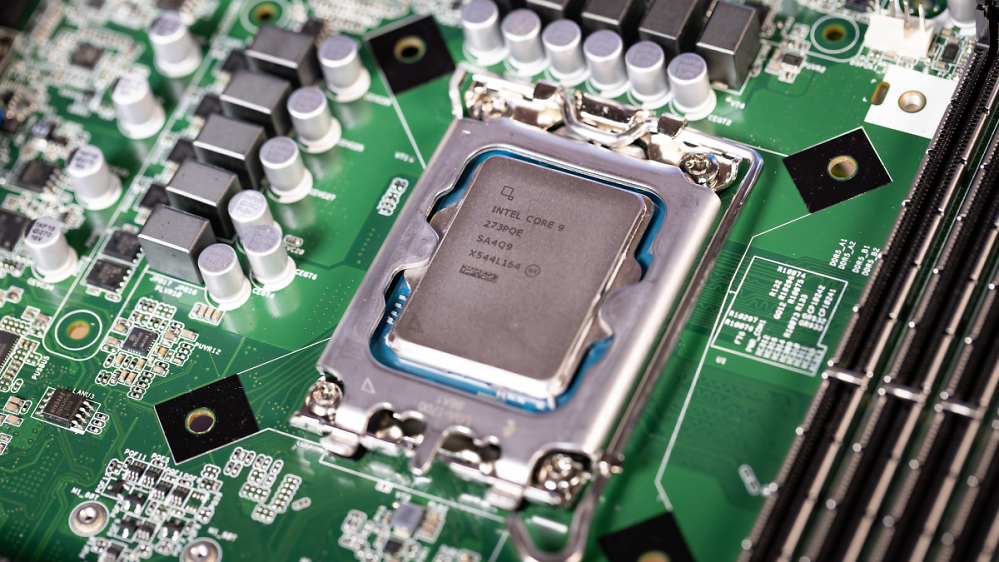
Zen 6 and Nova Lake may be just around the corner, but until then, there's one question to address in the desktop space: How well do games scale with more than eight cores? Yes, they already exist—the 12-, 16-, or even 24-core processors—no question, but these are either hybrid CPUs with a maximum of eight P-cores or, in the case of AMD Ryzen, a design with multiple CCDs (2 × 8 cores are not the same as 1 × 16 cores). However, there is a monolithic 12-core processor: the Intel Core 9 273PQE. In our Bartlett Lake review, we already noted that performance is surprisingly high depending on the game. As an extended special feature to the regular review, we're now interested in how high the core scaling actually is in the tested games when more than eight cores can be utilized monolithically. To that end, we've selected a few specific tests, which we'll now present to you.
Bartlett Lake: 12-core scaling
About the testing methodology: We use "msconfig" to configure the number of threads. By default, 24 threads are active on the 273PQE. If we reduce this value to 20, 10 cores remain active. At 16, there are 8 cores, and at 12, there are 6 cores. A reboot is required between each change. The benchmarks are structured as follows: The top 12 cores are always listed, and the order is fixed. For the most detailed information, please expand the values in the mobile view.
![[PLUS] CPU-Kaufberatung: Diese drei Modelle lohnen sich jetzt besonders](/screenshots/1020x/2026/04/Sockel-AM5-CPU-AMD-Ryzen-5-7500X3D-LGA-1851-Prozessor-Intel-Core-Ultra-7-270K-Plus-guenstig-kaufen-Angebot-pcgh_artwork1.jpg)
[PLUS] CPU-Kaufberatung: Diese drei Modelle lohnen sich jetzt besonders
PCGH Plus: Welche CPU lohnt sich jetzt für einen Gaming-PC? Wir haben 10 Spiele mit jeweils 20 Prozessoren getestet und zeigen Ihnen unsere Top-3-Empfehlung für preisbewusste Nutzer.
mehr ...
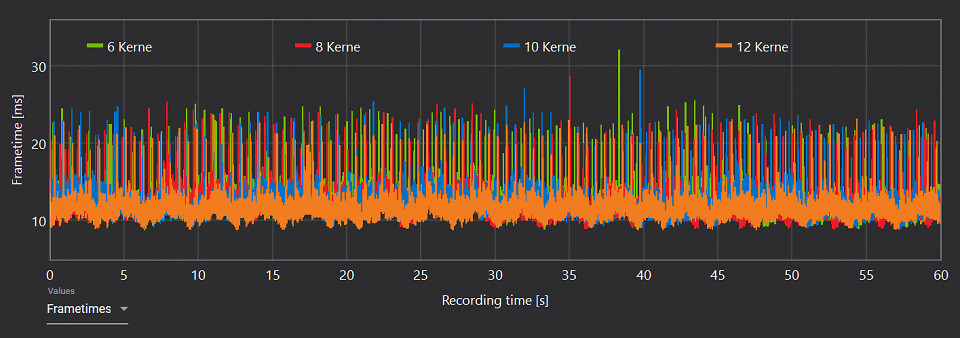
For our analysis, we're looking at a total of seven games. This yields 21 individual results, which quickly paint a clear picture. The 12-core configuration achieves the most top rankings with eight, even though this CPU is most likely to have to reduce its clock speed due to power limits. Both the 8-core and 10-core configurations each achieve seven top rankings. The 6-core configuration, on the other hand, fails to secure a single overall victory. However, a closer look at the individual metrics reveals interesting differences. In terms of average FPS, 8 and 12 cores are tied with three wins each, while 10 cores reach the top position twice. The 1st percentile, on the other hand, is dominated by the 10-core configuration, which wins four out of seven rankings. This seems to be the sweet spot for this CPU. The 12-core configuration wins here twice, and the 8-core configuration once. In the particularly telling 0.2% percentile, 8-core and 12-core configurations share the lead with three top scores each, while the 10-core configuration takes the lead once. We observe similar patterns with other multi-core CPUs.
 Source: PCGH
Frametime progression from Anno 117: Pax Romana: The unrest persists across all configurations.
The picture becomes even more interesting when we look at direct comparisons. The 6-core configuration generally has a tough time against the "competition." It loses all 21 individual benchmarks against 8-core systems. 10-core systems prevail over 6-core systems in 18 out of 21 cases; the 6-core system comes out ahead twice, and the comparison ends in a tie once. Against 12 cores, the 6-core variant also wins only twice, while the larger configuration wins 19 comparisons. Between 8, 10, and 12 cores, however, the results are surprisingly close. Against 8 cores, the 10-core configuration scores eleven wins, while 8 cores come out ahead nine times. One comparison ends in a tie. The 12-core variant beats 8 cores in 13 cases and loses eight times. In a direct matchup between 10 and 12 cores, the larger configuration prevails eleven times, while 10 cores achieve nine wins. Here, too, there is a tie.
Source: PCGH
Frametime progression from Anno 117: Pax Romana: The unrest persists across all configurations.
The picture becomes even more interesting when we look at direct comparisons. The 6-core configuration generally has a tough time against the "competition." It loses all 21 individual benchmarks against 8-core systems. 10-core systems prevail over 6-core systems in 18 out of 21 cases; the 6-core system comes out ahead twice, and the comparison ends in a tie once. Against 12 cores, the 6-core variant also wins only twice, while the larger configuration wins 19 comparisons. Between 8, 10, and 12 cores, however, the results are surprisingly close. Against 8 cores, the 10-core configuration scores eleven wins, while 8 cores come out ahead nine times. One comparison ends in a tie. The 12-core variant beats 8 cores in 13 cases and loses eight times. In a direct matchup between 10 and 12 cores, the larger configuration prevails eleven times, while 10 cores achieve nine wins. Here, too, there is a tie.
 Source: PCGH
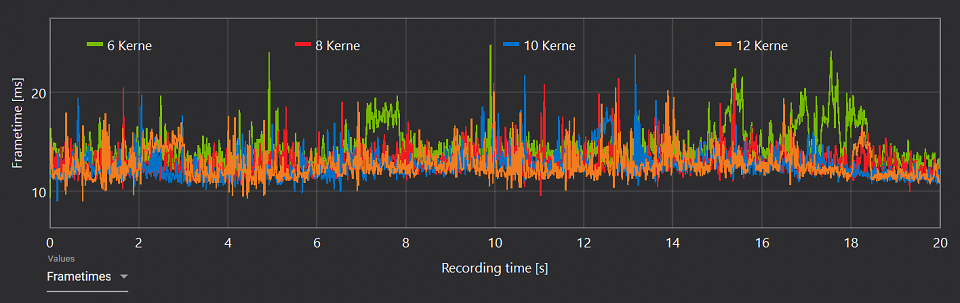
Frametime graph from the Gothic 1 Remake: 10 and 12 cores smooth out significant outliers.
The jump from six to eight cores is clearly measurable, at around six to seven percent depending on the metric. Beyond that, however, the scaling flattens out significantly. While twelve cores achieve the highest scores and show slight advantages, particularly at the 0.2% percentile, ten cores perform well at the 1% percentile. However, in terms of average FPS, 8, 10, and 12 cores are practically neck and neck. The data suggests that eight cores already utilize the majority of available performance in current everyday gaming, while ten and twelve cores can offer even smaller advantages primarily in specific titles and in terms of frame times.
Source: PCGH
Frametime graph from the Gothic 1 Remake: 10 and 12 cores smooth out significant outliers.
The jump from six to eight cores is clearly measurable, at around six to seven percent depending on the metric. Beyond that, however, the scaling flattens out significantly. While twelve cores achieve the highest scores and show slight advantages, particularly at the 0.2% percentile, ten cores perform well at the 1% percentile. However, in terms of average FPS, 8, 10, and 12 cores are practically neck and neck. The data suggests that eight cores already utilize the majority of available performance in current everyday gaming, while ten and twelve cores can offer even smaller advantages primarily in specific titles and in terms of frame times.
Are 12 cores worth it?
It's not entirely fair to draw a conclusion about whether more than 8 cores are generally useful for everyday gaming based on a single CPU that's also constrained by its power limit. But for now, we don't have any other option for desktops. Strictly speaking, the Bartlett Lake CPU isn't a desktop CPU either. Nevertheless, it offers a glimpse into future processor generations, which will hopefully offer more than eight cores "in a row." However, based on the results, our forecast is rather sobering: While more than 8 cores are measurably faster, no one would shell out extra money for the more expensive CPU just for that few percent gain. The blame lies partly with the CPU, due to Intel's limitations, but mainly with the games: developers need to incorporate multi-core optimization into the engine.
Everyone always talks about upscaling, but they tend to forget about the increased CPU load. For example, if you're running at UHD resolution with DLSS performance, the system is internally rendering at Full HD resolution. But for the graphics card to deliver more frames, the CPU has to keep up. This is exactly where better core scaling comes in. It delivers more FPS and a smoother frame time curve. So it would be great if developers could focus on this.