Steam Machine: Benchmarks, FSR and UHD limits
Steam Machine review: FHD and WQHD are a better fit for Valve's system, while UHD requires upscaling and reduced presets.
Inhaltsverzeichnis
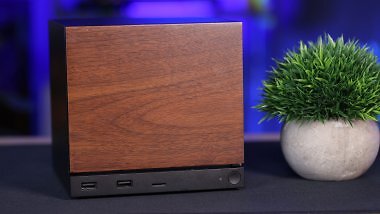
Even though the Steam Machine is equipped much like a PC, Valve apparently does not intend it to replace a conventional gaming PC. At least, that is what the hardware configuration suggests. The combination of a 6-core CPU, 16 GiB of memory and Radeon graphics with 8 GiB of VRAM can at best be described as a compact mid-range system, and even that comes with some caveats. More on that later. In an interview with PCGH, Valve also pointed out that the Steam Machine is aimed more at 1,920 × 1,080 or 2,560 × 1,440 pixels as the render resolution, which can then be upscaled to higher output resolutions. The target, according to Valve, is 60 fps at realistic presets.
Benchmarks: FHD and WQHD are a better fit than UHD
So that is what we tested. We looked at upsampling and tested several games at different resolutions and FSR settings. The results initially confirm Valve's own assessment: the Steam Machine is not a system that can generally handle modern games at native UHD resolution. Unsurprisingly, its more sensible operating range is FHD and WQHD, supplemented by upscaling.
This becomes quite clear in Cyberpunk 2077. With FSR 3.0 in Performance mode, the Steam Machine reaches 76 fps at FHD and 68 fps at WQHD. At UHD, however, only 40 fps remain. Even with aggressive upscaling, Valve's stated 60 fps target is therefore not met at 4K. In Quality mode, the frame rate drops even further, to 30 fps at UHD. That should hardly come as a surprise, however, as 8 GiB of VRAM is no longer a generous reserve in modern games. Especially at higher resolutions, with large texture packs and modern rendering paths, the memory limit quickly becomes a restricting factor.
Anno 117 is less forgiving and shows even more clearly where Valve's target profile reaches its limits. In the Ultra preset with FSR 3.0 Performance mode, the game remains far from 60 fps at UHD. FHD is still reasonably plausible, depending on expectations, while WQHD already becomes tighter and UHD falls outside the range Valve itself described as realistic. In other words, the Steam Machine requires adjusted presets, a reduced render resolution and upscaling. That is apparently what the system is designed for, rather than high native UHD workloads.
Eindrücke zur Steam Machine
Counter-Strike 2 shows the other side of the picture. In the "Very High" preset with FSR 3.0 Performance mode, the shooter runs considerably faster and still reaches high triple-digit frame rates even at UHD. That is not irrelevant for the target audience, as many Steam libraries do not consist solely of current AAA games with large texture packs, ray tracing and heavy GPU loads. Esports titles, older games and technically less demanding productions are likely to suit the Steam Machine much better. At the same time, Counter-Strike 2 should not be used as a benchmark for today's most demanding graphical showcases.
Hohe Presets: 8 GiByte VRAM werden schnell zur Grenze
[RECTANGLE_AD ]Hogwarts Legacy is a much more critical case. In the Ultra preset, even FSR cannot save the Steam Machine. At UHD, the frame rate reaches only 16.9 fps even with Ultra Performance, while native rendering produces just 2.0 fps. Even FHD does not reach a clean 60 fps class in the Ultra preset. The result is similar to Cyberpunk 2077: 8 GiB of VRAM is not a minor detail, but a real limitation. Anyone choosing very high presets quickly moves beyond what the Steam Machine can reasonably deliver.
Anyone planning to use the Steam Machine with particularly recent titles can also look at the Gothic Remake, which we have already tested. In the Medium preset with AMD FSR 3.1.4, upscaling provides a noticeable benefit, but the system still does not reach 60 fps at UHD. Only in the Low preset, and with very aggressive upscaling, does the Steam Machine reach 65 fps at UHD. We therefore skipped tests with higher presets. The result illustrates the limit quite well: UHD is not ruled out entirely, but it comes with clear restrictions.
Baldur's Gate 3 is more forgiving, but ultimately confirms the same pattern. In the Ultra preset, FHD stays close to the range Valve describes for the device, while WQHD remains plausible with adjusted expectations. UHD is possible, but not as a 60 fps target. The game is therefore not a problem case in the same way as Hogwarts Legacy in the Ultra preset, but it also shows that the Steam Machine does not have large reserves.
The situation looks somewhat better in Forza Horizon 6. In the Medium preset without FSR, the game performs quite well on the Steam Machine, provided very high settings are not forced. The Steam Machine reaches 76 fps at FHD and 63 fps at WQHD. In this configuration, Forza therefore fits Valve's stated target profile quite closely. At UHD, however, the frame rate drops to 42 fps. Here, too, the same applies: 4K output is possible, but it is not automatically a 60 fps scenario.
Once the settings are pushed higher, the picture changes significantly. In the Extreme preset without FSR, only 8 fps remain at UHD. With FSR in the Ultra preset, the situation improves, but even Ultra Performance reaches only 23 fps at UHD. That is no longer playable. Not even if 30 fps is considered acceptable because that is what some players are used to from consoles. What does this mean for prospective buyers? The Steam Machine requires realistic settings.
The additional GPU comparisons from our most recent Linux benchmark test help put this into context. Valve's system competes there against familiar desktop graphics cards such as the Radeon RX 5700 XT, Radeon RX 6700 XT, Geforce RTX 2080 Ti and Arc B580. The Steam Machine positions itself more as a compact, clearly limited mid-range solution. In some scenarios, it comes closer to older desktop GPUs. Once resolution, memory demand and rendering load increase, however, it falls clearly behind.
The limit becomes even clearer with ray tracing. Cyberpunk 2077 with RT visibly pushes the Steam Machine to its limit. Ray tracing is therefore not a genuinely realistic target for Valve's device, but at most an option for heavily reduced settings and low render resolutions. Another limit appears here as well.
In summary, FSR is not merely an optional extra for the Steam Machine. Without it, Valve's small black cube does not get particularly far. If a game offers good upscaling, the 60 fps target can be achievable at realistic presets. If a game lacks usable upscaling, the graphics memory fills up or the preset is set too high, the system quickly falls back on its limited raw performance. Alternatively, users have to settle for Full HD or, at most, WQHD.
There is one bright spot, however: in its interview with PCGH, Valve already confirmed that FSR 4 is coming. Exactly when remains unclear, but it could give the Steam Machine another boost. Valve also continued to supply the Steam Machine with updates throughout the review process. It is conceivable that the situation will develop in a similar way to the Steam Deck. Valve's handheld received several performance updates in the period after its release.
Steam Deck: More performance, but not six times the frame rate
Since we are already on the subject of the Steam Deck, Valve has also promised more than six times the performance for the Steam Machine compared with the handheld. In this case, PC Games ran its internal benchmarks in Cyberpunk 2077 and Forza Horizon 6. The aim was not to push the Steam Machine as far as possible. Instead, the benchmarks were run using the Steam Deck presets in order to assess the gap between the handheld and the living-room PC more cleanly.
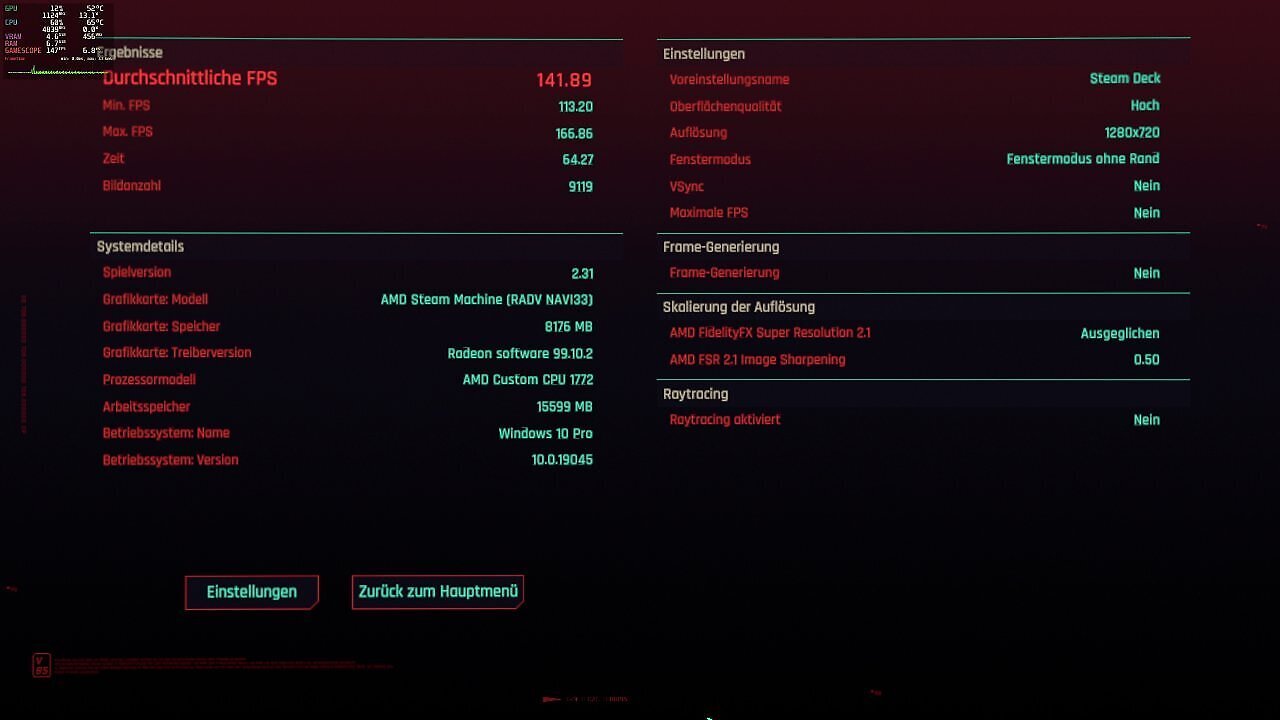
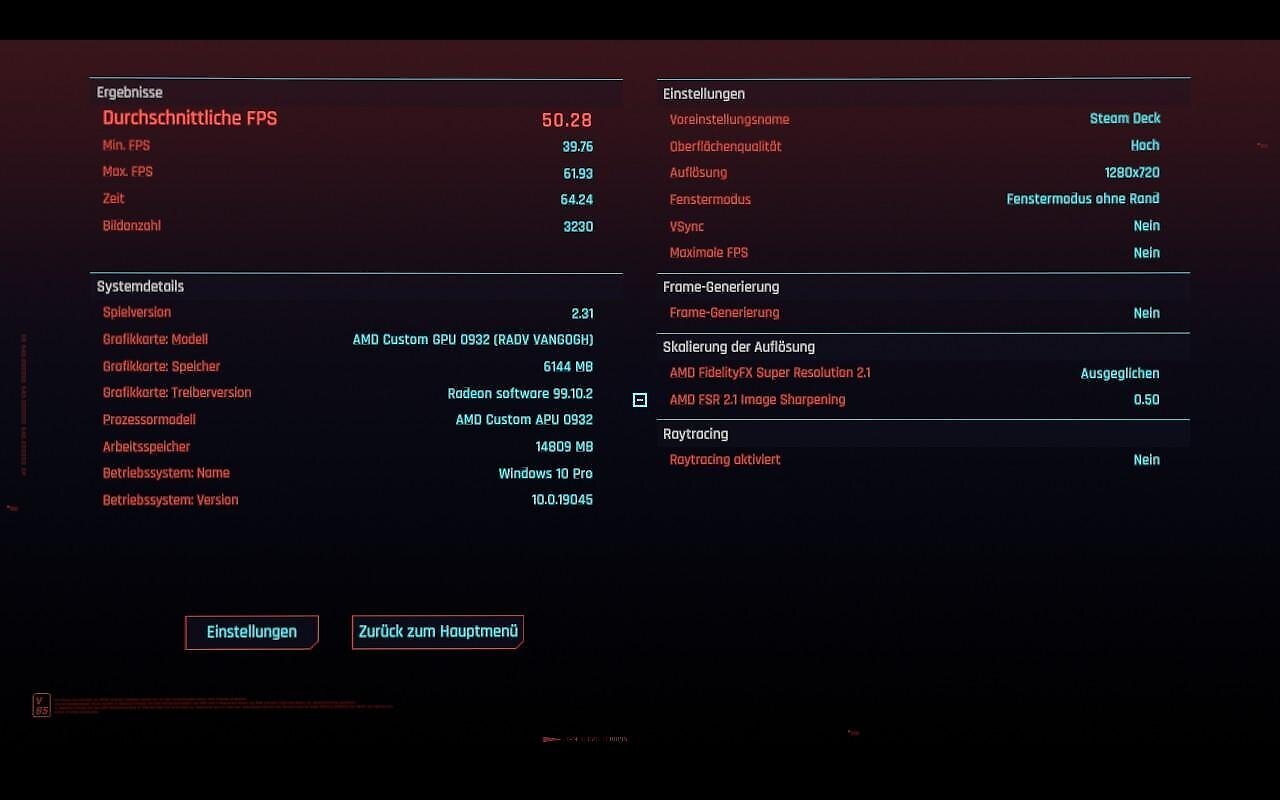
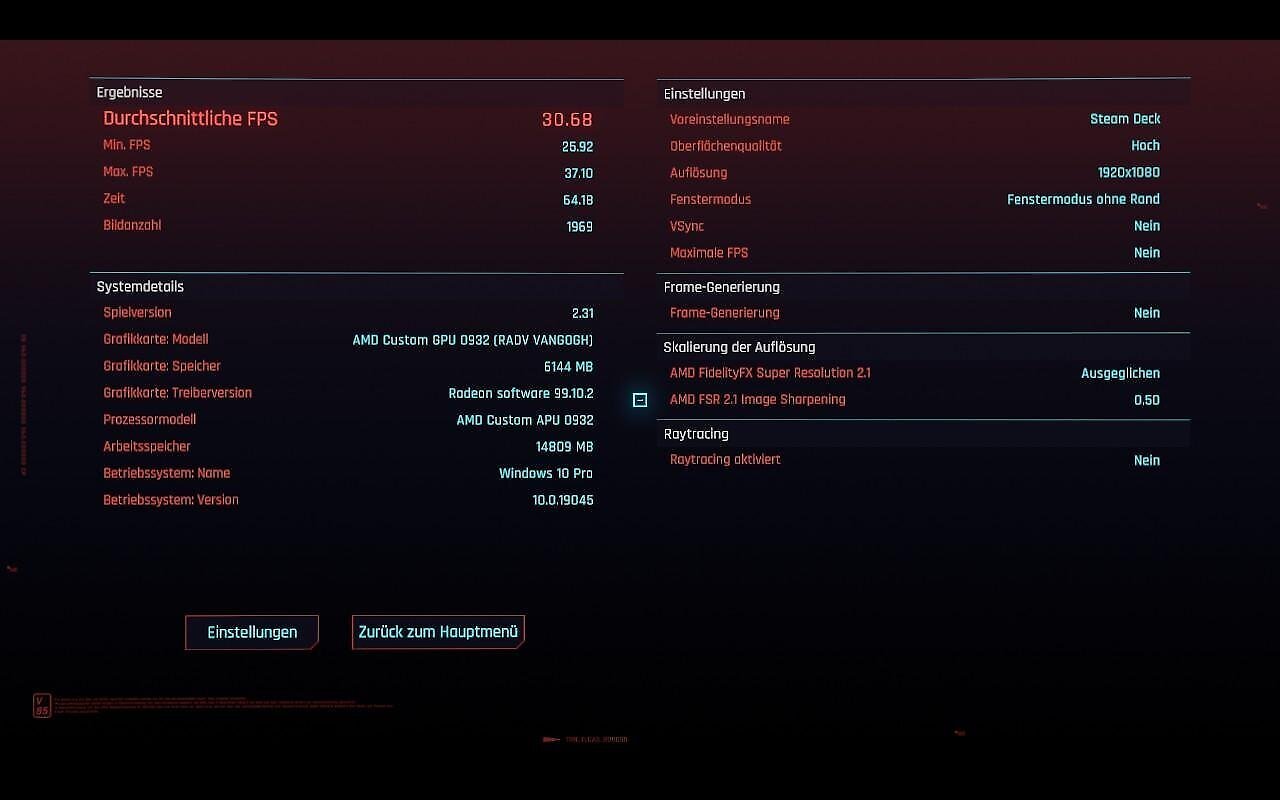
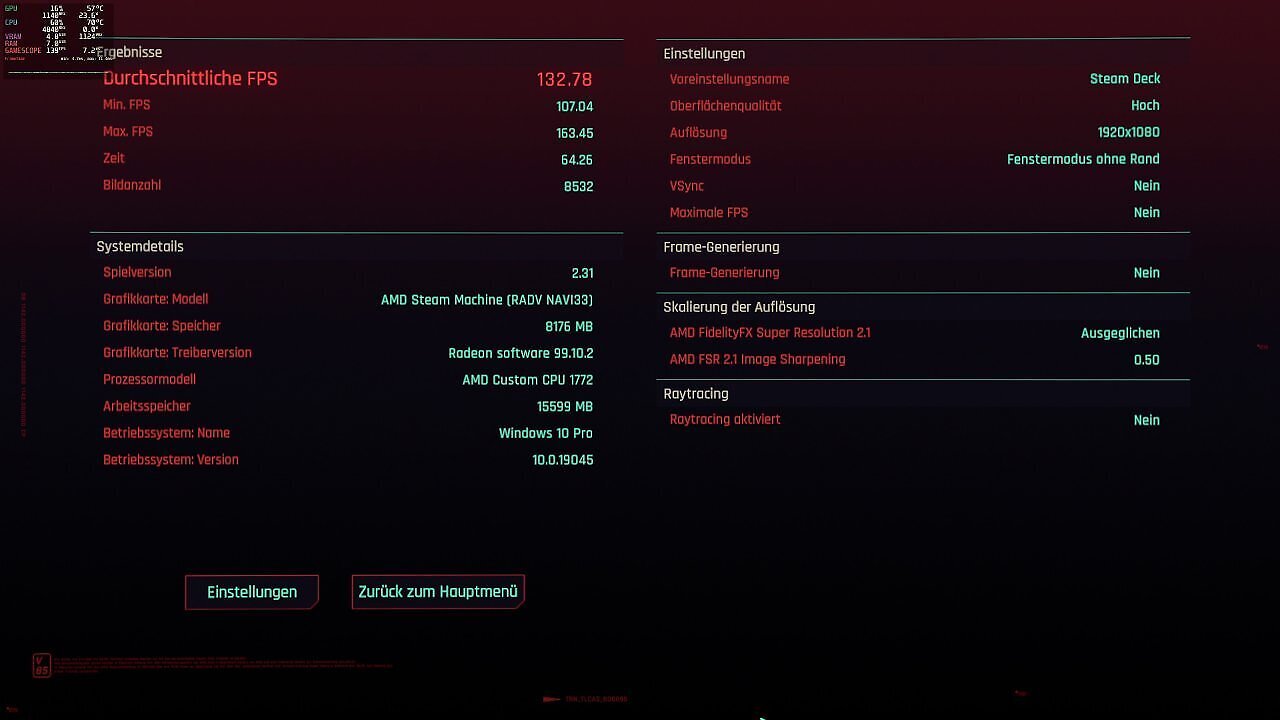
In Cyberpunk 2077, the Steam Machine's lead is clear, but it remains below a factor of 6. At 1,280 × 720 pixels, the Steam Deck reaches around 50 fps, while the Steam Machine reaches around 142 fps. At 1,920 × 1,080 pixels, the gap widens further: the Steam Deck manages around 31 fps, while the Steam Machine reaches just under 133 fps. In practice, that is a major leap, turning a result just above the 30 fps mark into something clearly smoother. Even here, however, the frame rate is not six times higher.
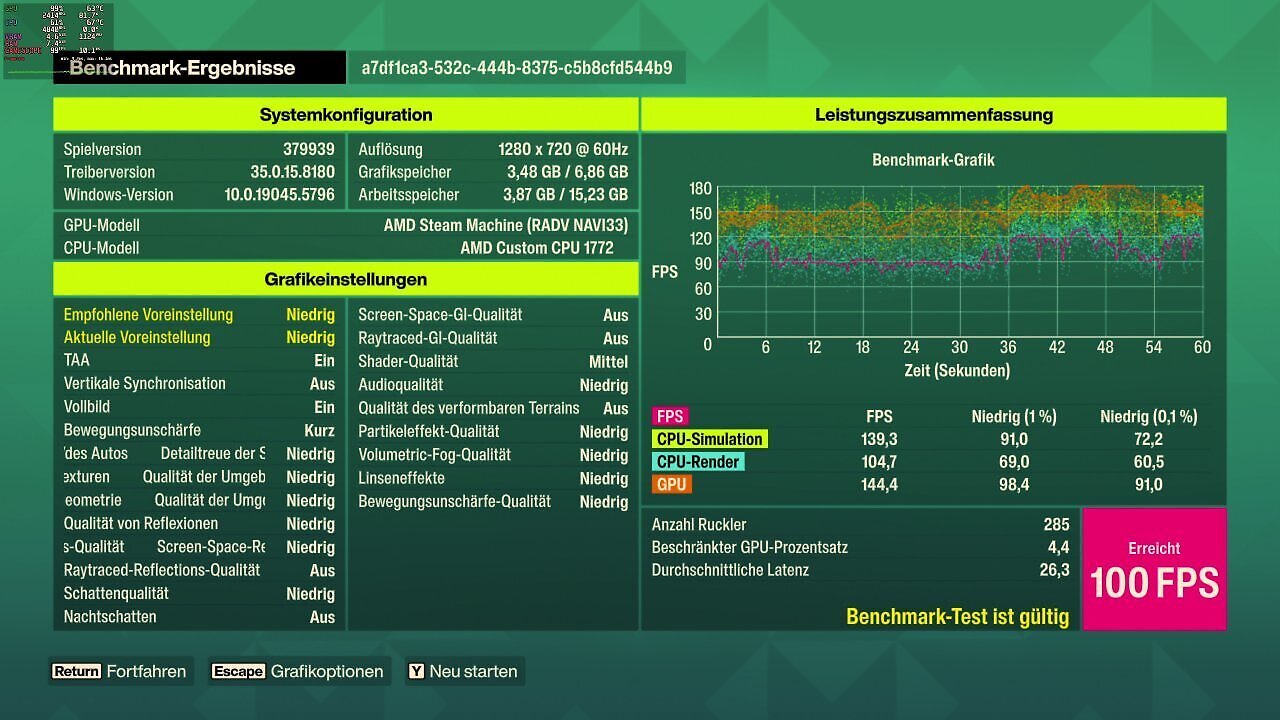
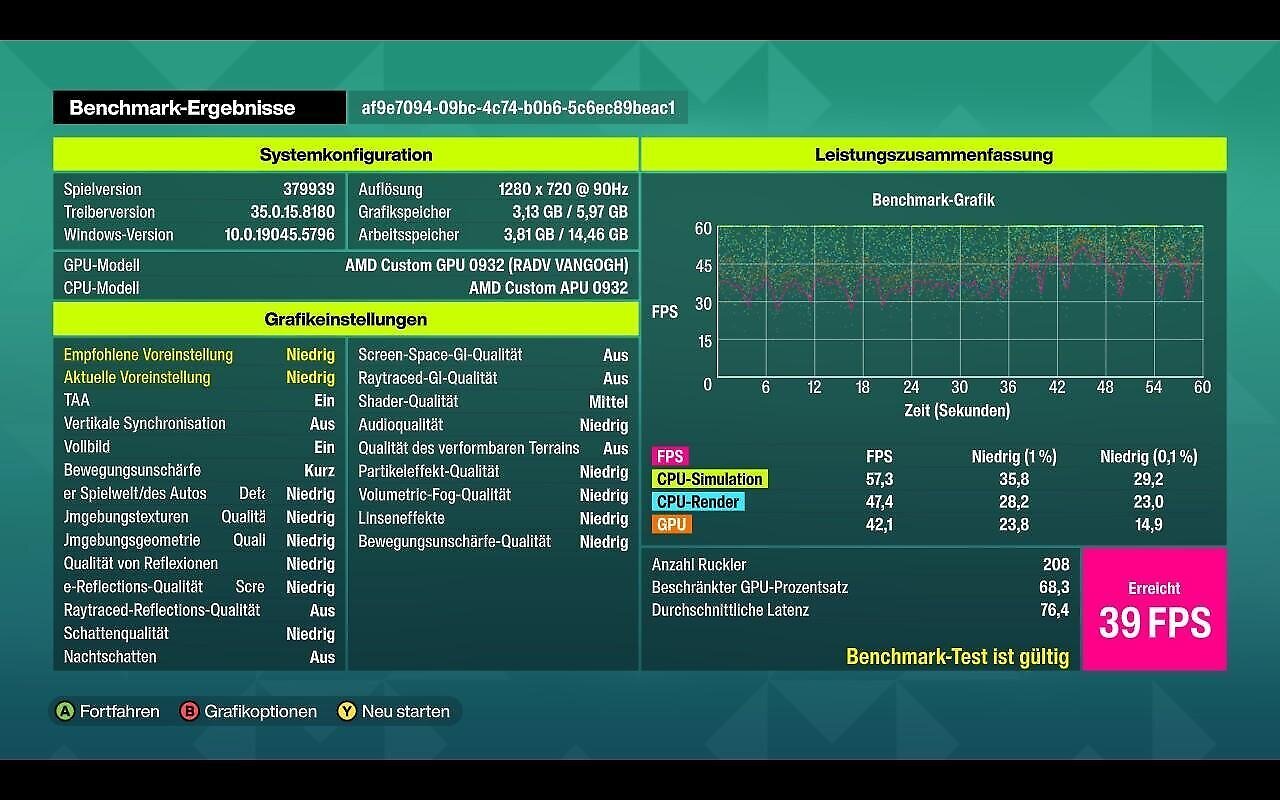
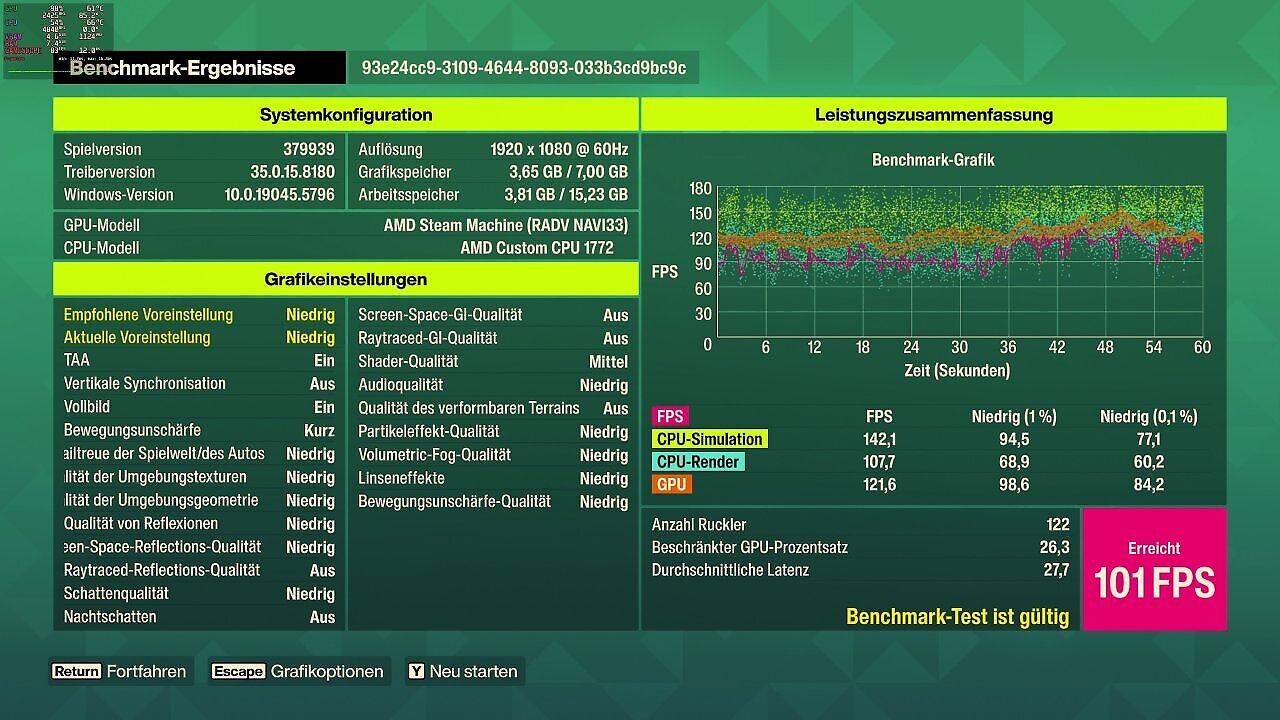
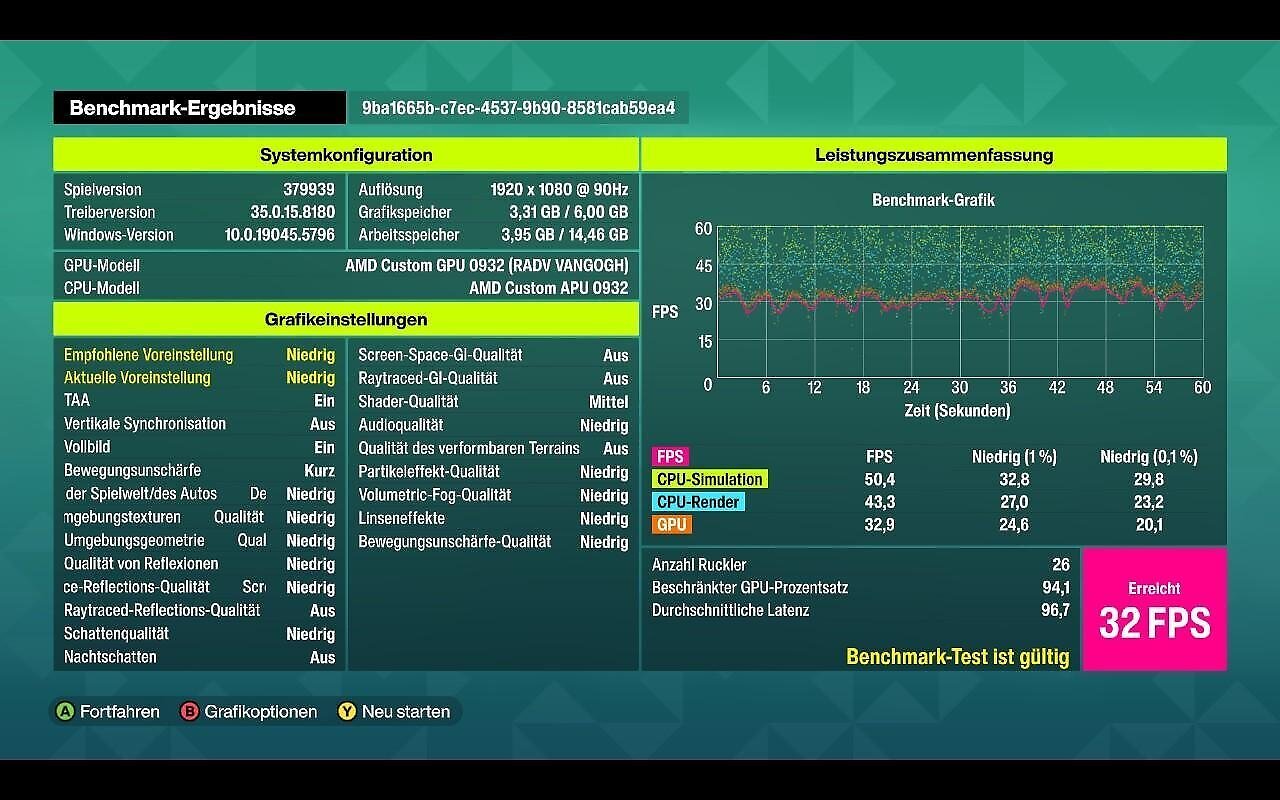
Forza Horizon 6 shows a similar picture. With the Steam Deck settings, the frame rate rises from around 39 fps to roughly 100 fps at 1,280 × 720 pixels. At 1,920 × 1,080 pixels, the Steam Deck and Steam Machine land at around 32 and 101 fps, respectively. That is also a clear gap, but it is closer to a doubling or tripling than to a sixfold increase in gaming performance.