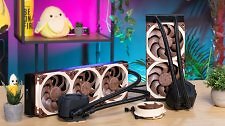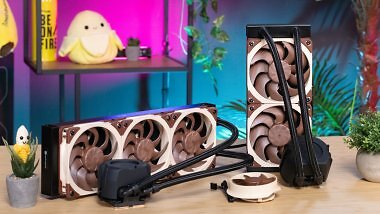
Noctua NL-LC1: We put the first 240mm and 360mm liquid cooling systems to the test.
In the following, we will test the Noctua NL-LC1 for its cooling performance and take a closer look at the pump.
In this article
Cooling capacity
A few things stand out in the noise-normalized results. Fan speeds are very consistent, and specific PWM settings are easy to reproduce. While that is not conclusive on its own, it is a good sign: the fans run at relatively high speeds for the measured noise level. For example, the dual-fan NL-LC1-24 already reaches 1,000 RPM at just 0.2 sone. The performance results confirm this first impression. The fan geometry clearly contributes to the NL-LC1's excellent cooling performance, and that applies to both models. The 360mm version delivers the best cooling performance we have measured so far across almost all noise levels. The smaller 240mm model is nearly as impressive, taking second place in the overall ranking. In the 240mm segment, the NL-LC1-24 is unmatched. It even outperforms almost the entire field of 360mm AIOs. Only Deepcool's LE360 V2 prevents Noctua from taking the top two spots.
Asetek, aluminum, and plastic—are these standard materials?
At first glance, the NL-LC1 could be mistaken for a fairly standard AIO. After all, it is based on a familiar Asetek platform. The radiator is made of conventional aluminum, the pump housing uses plastic, and the hose fittings are fixed. In other words, this is a sealed unit and not user-serviceable. Noctua has refined an existing platform rather than reinventing the AIO. A large part of the performance clearly comes from the excellent fans, but the changes to the pump and water block also prove to be important. The integrated switch lets you choose between quiet, balanced, and manual modes, so the cooler can be tuned to suit your needs. The default Silent mode is particularly impressive. Combined with the heavily optimized pump cover, it reduces pump noise to just 0.1 sone. That is a welcome improvement in a category where pump noise is often one of the main weaknesses.
Pump and heat dissipation
At full speed, the pump is noticeably louder, but there is rarely a good reason to leave Silent mode. We tested both models using the factory default Silent setting, and performance was already excellent. To see whether higher pump speeds make a meaningful difference, we ran an additional stress test. Using an overclocked Core i9-12900K, we pushed the AIO close to its limits. By increasing both clock speed and voltage, the CPU could theoretically draw well over 350 watts. For this test, we set the 360mm model's fans to the speed measured at 0.2 sone and then measured maximum cooling performance based on CPU power throttling: once with the pump in Silent mode and once with the pump running at full speed. In Silent mode, the cooler was able to dissipate an impressive 320 watts of heat at an ambient temperature of around 22-23 °C. With the pump running at full speed, cooling capacity increased by 10 watts to 330 watts. That is a measurable improvement, but not a large one. At lower heat loads, the difference would likely be even smaller. For that reason, it is not worth giving up the pump's extremely quiet 0.1-sone operation in Silent mode.
Maximum power consumption
At 320 watts and just 0.2 sone, the 360mm version is already highly impressive. We also wanted to see what it could do without noise limits, so we set both the pump and fans to maximum speed. The result: our Core i9-12900K did not hit its temperature limit until 350 watts, where it eventually stabilized. That is an excellent result and one that is rarely achievable under normal conditions. For users who want maximum thermal headroom, including overclockers, the NL-LC1 is an extremely strong option.
Ventilation
When the PC starts up, or whenever power is supplied to the AIO pump, the pump first runs at medium speed, then briefly ramps up to full speed, and finally settles at the selected preset. This short startup routine is surprisingly well thought out. At first, the coolant begins circulating gradually. If the pump were to run at full speed immediately, air could be drawn into the pump before the coolant is fully moving. After a few seconds, the pump ramps up to maximum speed to help purge trapped air from the loop and move it into the radiator and expansion chamber. Only then does the pump return to normal operation. Is this just a gimmick? In our two test samples, the feature worked very well and kept the pump free of air every time. It is a small touch, but it makes a real difference.
Price and Competition
At €250 for the 360mm model and €220 for the 240mm model, the NL-LC1 is firmly in premium-price territory. That makes it a poor fit for budget-conscious PC builds. There are simply better value options, such as Deepcool's LE360 V2, which also delivers excellent performance for around €60, or Arctic's Liquid Freezer III series, one of our go-to recommendations for affordable high-performance cooling. Another group unlikely to be interested is RGB-focused builders. The brown-and-beige color scheme gives the cooler a distinctive Noctua look, but there are no alternative colors, lighting options, or other visual customization features. Whether Noctua will release an all-black chromax version remains to be seen.
The NL-LC1 is aimed primarily at performance enthusiasts who want top-tier cooling without the complexity of a custom water-cooling loop. Both versions currently lead the field in cooling performance and, despite being based on a familiar Asetek platform, include several clever optimizations that make a noticeable difference. The whole product feels carefully engineered. We found no teething issues or obvious weaknesses. In our testing, the NL-LC1 is the best AIO we have reviewed so far.