Steam Machine review: Valve's underwhelming living-room PC has a serious price problem
The Steam Machine is meant to bring SteamOS into the living room. In testing, however, Valve's cube-shaped PC proves to be considerably faster than the Steam Deck, but it also has its flaws, especially when it comes to price.
Test Add as a preferred source on Google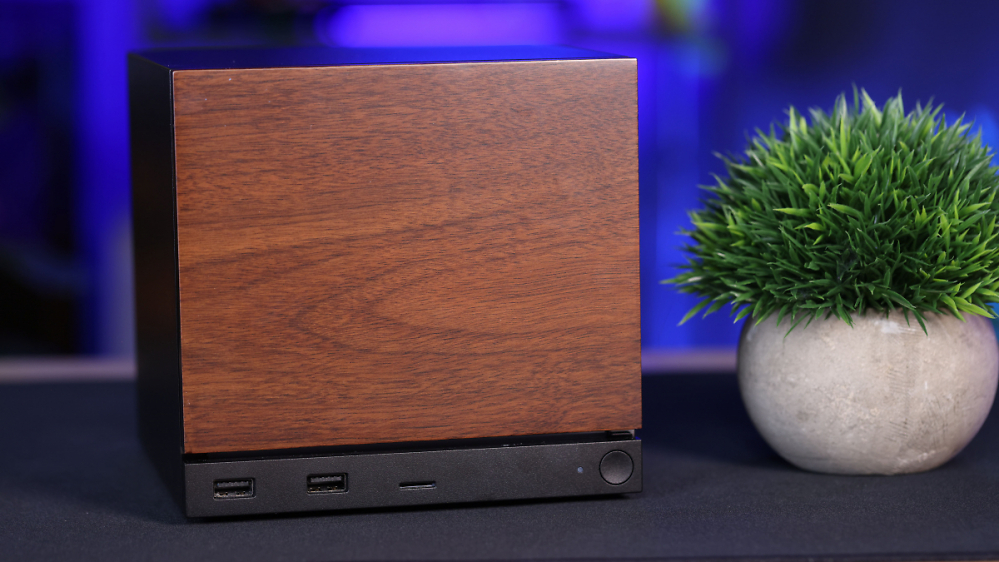
Inhaltsverzeichnis
Hardware is expensive, and it could become even more expensive if Valve is to be believed. Even so, the company is bringing the Steam Machine to market. That means Valve's new living-room PC is launching in a difficult environment: consoles are firmly established, compact gaming PCs are available across a wide range of price and performance tiers, and the PC market remains under pressure from high component prices. That makes the key question all the more important: who is the Steam Machine actually for? For console players, the Steam Machine may require some explanation, because it does not offer the closed-off simplicity of a PlayStation or Xbox. For traditional PC players, the question is different: why choose a prebuilt SteamOS system instead of building a PC themselves or buying a Windows machine? And for Steam Deck owners, the Steam Machine mainly offers a stationary version of an idea they already know. Perhaps, however, a closer look at the device can shed more light on who Valve is actually trying to reach.
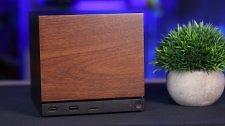
With the new Steam Machine, Valve is betting on its own compact system, measuring 16.5 × 15.5 × 15.3 cm. The small black cube is designed to bring SteamOS, the Steam library and a more console-like user experience closer together. That is also how Valve is positioning the device: the Steam Machine is not meant to be a freely configurable mini PC, but a ready-made living-room system that feels simpler than a conventional gaming PC while remaining more open than a console.
Hardware: Compact cube with PC roots
The system is equipped with a custom AMD CPU featuring 6 cores and 12 threads, 16 MiB of L3 cache and a maximum clock speed of 4.86 GHz. It is paired with 16 GiB of DDR5 memory. The discrete Radeon graphics unit has 8 GiB of GDDR6 video memory and is identified under SteamOS as "AMD Radeon Graphics" based on Navi 33. As a result, the Steam Machine uses the RDNA 3 architecture introduced in 2022, also known as "GFX11". The GPU is most closely comparable to a slightly cut-down Radeon RX 7600. While the retail graphics card uses a fully enabled configuration with 32 compute units and 2,048 FP32 units, the Steam Machine has only 28 CUs active, corresponding to 1,792 ALUs. The power budget drops from 165 watts for the Radeon RX 7600 to 110 watts for the Steam Machine's GPU.
 Source: PC Games Hardware
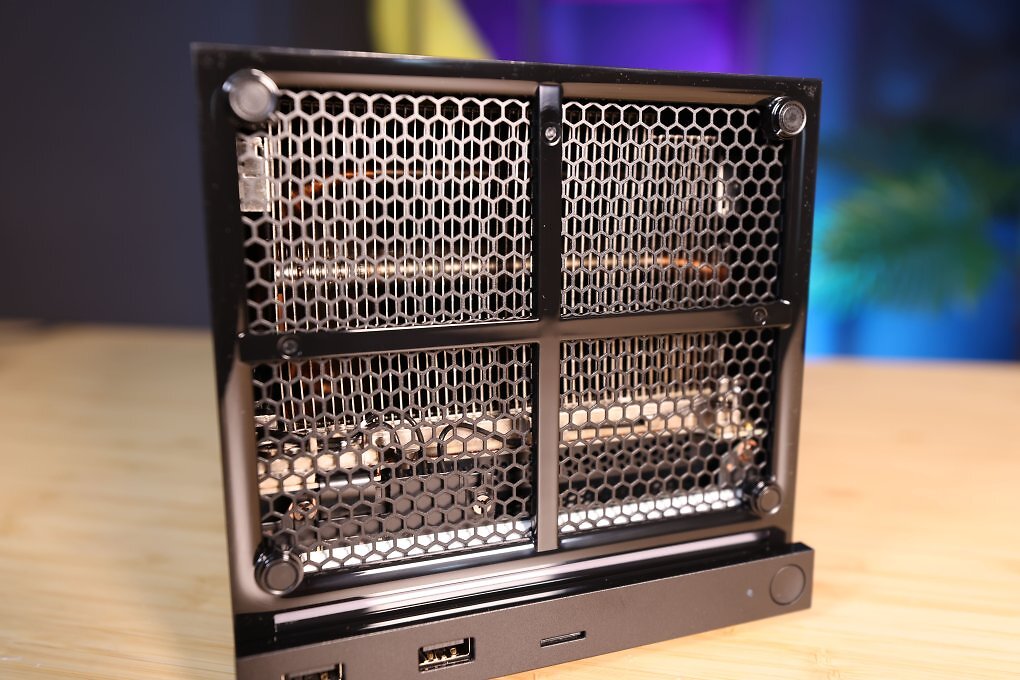
Cooling is one area where the Steam Machine delivers: even under full load, it is barely audible.
Source: PC Games Hardware
Cooling is one area where the Steam Machine delivers: even under full load, it is barely audible.
For mass storage, SteamOS reports an NVMe drive with roughly 1.9 TB in our test system. The controller is listed as a Kingston device. In addition, the system has a zram swap of around 7.6 GiB. The test system runs SteamOS 3.8.9 in its x86-64 version. In desktop mode, the Steam Machine therefore still presents itself as a Linux PC with a KDE interface. Alternatively, as on the Steam Deck, the system can be used through a gaming interface designed more closely around controller input.
For the PCGH test, this point matters because Valve acknowledged in an interview that Gaming Mode and Desktop Mode do not always behave exactly the same. Major deviations should not be expected, but differences can arise, for example, from windowed or fullscreen behavior. Our tests were carried out in Desktop Mode. The results therefore do not automatically cover every possible edge case in Gaming Mode.
 Source: PC Games Hardware
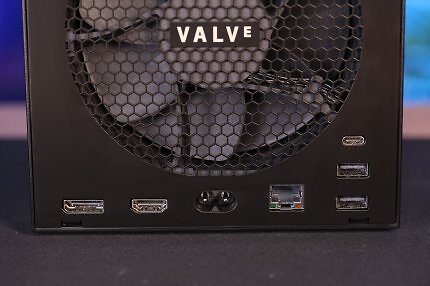
The Steam Machine offers plenty of ports.
Source: PC Games Hardware
The Steam Machine offers plenty of ports.
In terms of connectivity, Valve covers the key requirements for a living-room PC. Display output is handled by one HDMI 2.0 port and one DisplayPort 1.4 port. According to the specifications published so far, HDMI 2.0 supports up to 4K at 120 Hz, while DisplayPort 1.4 supports up to 4K at 240 Hz or 8K at 60 Hz. For peripherals, there are four USB-A ports in total and one USB-C port. The USB-A ports are split between two USB-A 3.2 Gen 1 ports on the front and two USB-A 2.0 ports on the rear. According to the specification, the rear USB-C port runs at USB 3.2 Gen 2 speeds, meaning up to 10 Gbit/s. Network connectivity is provided by Gigabit Ethernet, Wi-Fi 6E and Bluetooth 5.3. A 2.4 GHz wireless adapter for the new Steam Controller is also integrated. Although the form factor is more reminiscent of consoles such as the Xbox Series X or two GameCubes stacked on top of each other, it is clear that the Steam Machine's hardware is close enough to a PC to set it apart from most consoles. At the same time, however, it is not as freely configurable as a custom-built system.