Zu hohe Speicherspannung gefährlich für Core i7?
Mit dem integriertem Speichercontroller der Nehalem-CPUs scheint die Wahl des Arbeitsspeichers und des Mainboards für ein Core i7-System eine entscheidendere Rolle zu spielen als bisher angenommen.
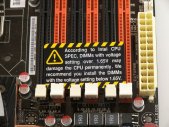
 Warnhinweis auf dem Asus P6T Deluxe OC Palm Edition (Bild: PCGH)
In letzter Zeit kamen Gerüchte auf, dass bei der Kombination aus Core i7-Prozessor und X58-Mainboard bei einer Speicherspannung von mehr als 1,65 Volt die akute Gefahr besteht, den Hauptprozessor dauerhaft zu beschädigen. Diese Einschätzung haben vor allem Bilder der X58-Platine Asus P6T Deluxe genährt, das mit einem entsprechenden Hinweiszettel an Tester verschickt wurde. Nach Angaben des Inquirers hat Asus allerdings auch mit 1,7 Volt erfolgreiche Tests absolvieren können.
Warnhinweis auf dem Asus P6T Deluxe OC Palm Edition (Bild: PCGH)
In letzter Zeit kamen Gerüchte auf, dass bei der Kombination aus Core i7-Prozessor und X58-Mainboard bei einer Speicherspannung von mehr als 1,65 Volt die akute Gefahr besteht, den Hauptprozessor dauerhaft zu beschädigen. Diese Einschätzung haben vor allem Bilder der X58-Platine Asus P6T Deluxe genährt, das mit einem entsprechenden Hinweiszettel an Tester verschickt wurde. Nach Angaben des Inquirers hat Asus allerdings auch mit 1,7 Volt erfolgreiche Tests absolvieren können.
Die JEDEC-Spezifikation sieht für DDR3-Module zwar nur 1,5 Volt vor, zahlreiche Übertakter-Module wurden von den Herstellern allerdings zum Teil mit mehr als zwei Volt spezifiziert. Steffen Eisenstein, Vizepräsident des Speicherherstellers Mushkin, sprach davon, speziell angepasste Triple Channel-Module im Laufe des nächsten Monats vorzustellen.
Neuere Informationen besagen, dass das Mainboard eine wesentlich wichtigere Rolle einnimmt, als bisher angenommen. So spricht Fudzilla von einer möglichen Speicherspannung von bis zu 2,3 Volt. Diese Spannung ist wiederum für DDR3-Module auf Dauer nicht zu empfehlen. Entscheidend ist hierbei die Frage, ob ein X58-Mainboard auch entgegen der Intel-Vorgabe eine so hohe Spannung zur Verfügung stellen wird. Es ist davon auszugehen, dass zumindest für High-End-Anwender und Übertakter derartige Core-i7-Boards im Handel auftauchen werden.








Core i7 has no Voltage limitations
Despite everything we've heard so far, it seems like Intel hasn't implemented a Voltage limitation on the Core i7 processors, nor on the memory and the two aren't linked to each other. We've heard reports of some boards reaching 2.2 or even as much as 2.4V on the memory, so those of you out there with high-performance DDR3 memory have nothing to worry about.
Furthermore, it seems like the 1.65V limitations for the Core i7 CPUs is a safety precaution, as the CPUs are unlikely to die straight away if you go beyond this, but it will shorten the life span of the processors. Intel doesn't really seem to know at what Voltage the life span will be severely shortened and the 1.65V limit is a blanket safe zone so that people don't end up frying their processors.
Turbo Boost will not modify the CPU Voltage and it even sounded like there's no need to tweak the CPU Voltage for the average overclocker and that this is something that would only be needed to be done by extreme overclockers and the Intel people we spoke to sounded very pleased with the overclocking results of the Core i7 processors.
It's still about a month to go before anyone will be able to get their hands on the new CPUs and actually start frying them, but we have a feeling that most people won't be having any issues, especially as there's no correlation between the CPU and memory Voltage with should please a lot of people that have been thinking about upgrading to the new platform.
Ist futsch, da Betrieb außerhalb der Spezifikation.
Mich würde dann mal die Garantie der CPU interessieren wenn man den Speicher OCed?!
mfg ceph
Mein DDR3 Ram ist herstellermäßig mit 1,5-1,8V spezifiziert, abhängig vom FSB. 1,5V bei 1066er -, 1,7 bei 1333er - und 1,8V bei 1600er Betrieb.
Ram wäre also auf 'ner X58 Platine bereits grenzwertig.
Die Speicherspannung liegt auch an der CPU an...