Assassin's Creed Black Flag Resynced: Linux vs. Windows, Four GPUs Tested
We took a closer look at the pirate-themed Assassin's Creed on our Linux computer. Four GPUs from Nvidia and AMD demonstrate just how good the game's performance is.
Special Add as a preferred source on Google 53,99 €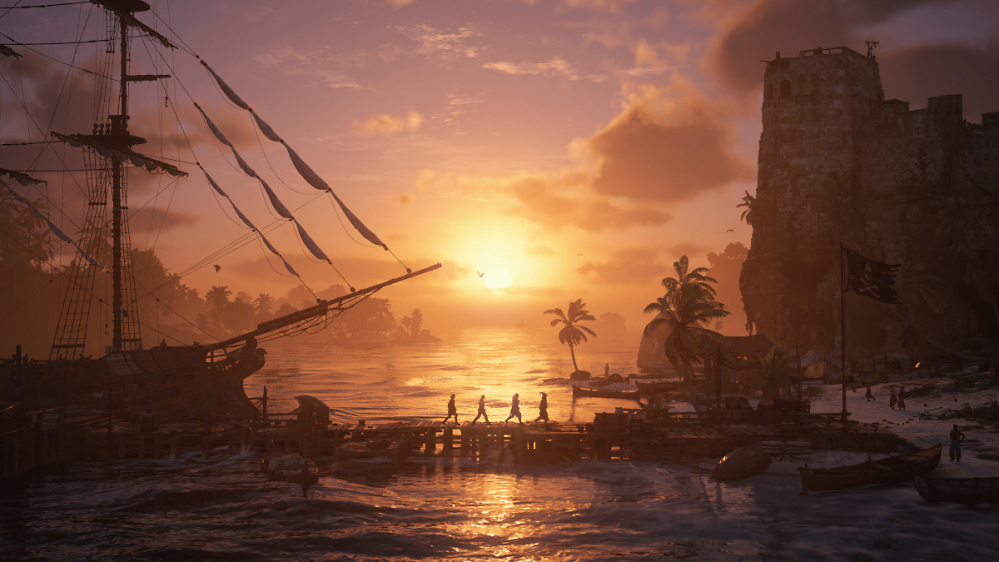
Inhaltsverzeichnis
The beloved Assassin's Creed 4: Black Flag is coming to PCs as a visually upgraded version. Beautiful beaches, palm trees, and water. We tested the game extensively with four AMD and Nvidia graphics cards. But of course, we also installed the game directly on our Linux computer and took a close look at its performance there. Does it run smoothly? Does AMD once again perform well under Linux? And what's the result of the Nvidia's historically more difficult Linux driver situation? We found out.
Painful installation, interesting start
We try to launch games through Steam whenever possible. Thanks to the automatic Proton integration, this is much easier than launching them outside the ecosystem. In the case of the new AC, however, we only had access to the Ubisoft Connect version, which required a few extra steps. Steam offers the option to add a third-party game, which ultimately allows you to use the selected application via the integrated Proton. In the case of Ubisoft Connect, you first need to integrate and run the installer, and then launch Connect itself. Integrating it into Steam has proven to be a simple method for us, but you can also use other dedicated launchers for this kind of setup.
The game launches without any major issues. The launcher sometimes has some initial glitches, which can be resolved by switching to a different Proton version and then restarting the game. On AMD hardware, the game runs smoothly. On Nvidia hardware, however, we encountered some odd and occasionally severe issues. Upon first launch, both Nvidia cards showed frequent graphical glitches. Fortunately, a restart was enough to resolve the issue.
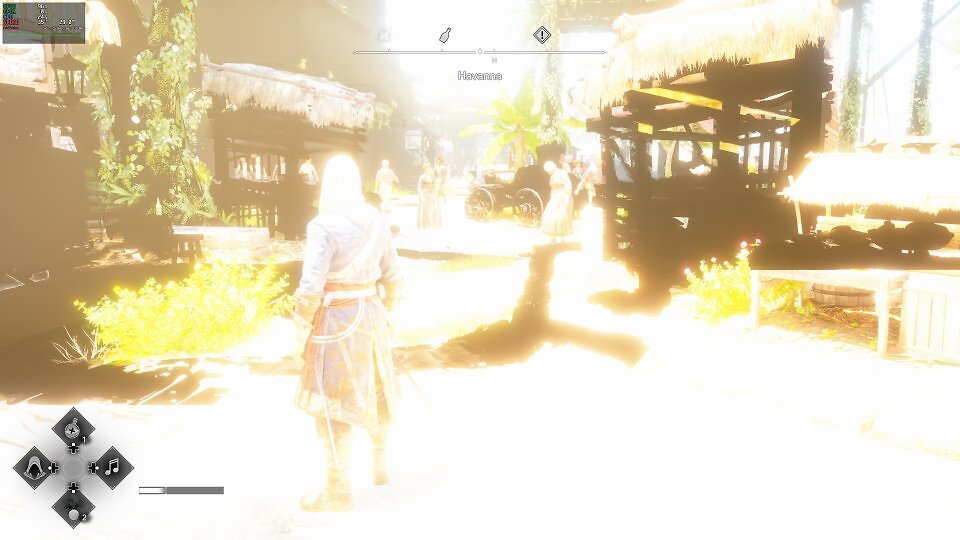 Source: PC Games Hardware
Don't panic: Graphics glitches seem to be a common occurrence when launching the game for the first time on Nvidia GPUs. If you restart the game, everything will be back to normal.
Source: PC Games Hardware
Don't panic: Graphics glitches seem to be a common occurrence when launching the game for the first time on Nvidia GPUs. If you restart the game, everything will be back to normal.
Test Methodology
As with our other Linux benchmarks, we're using our standard system here, consisting of an AMD Ryzen 7 9800X3D, 48 GiB of RAM running at 6,000 MT/s, and CachyOS as the operating system. The Windows comparison benchmarks were run on a different computer and, despite minor hardware differences, are still broadly comparable. Only the CPU bottleneck on NVIDIA's 5090 shows a slightly different picture, but this is due less to hardware differences than to the extremely problematic behavior of Linux. More on that later.
In the Linux vs. Windows benchmark, we use a different scene than in the comprehensive Windows GPU comparison. On both systems, we use a 20-second run through Havana's harbor promenade. We test using two different settings. In the pure rasterization benchmark, we use the "Extreme High" preset without ray tracing and with native TAA. The ray tracing benchmark adds the "Advanced" RT preset. We test at three resolutions, using two Nvidia GPUs and two AMD GPUs each. In doing so, we cover two generations or architectures each.
Rasterization
When it comes to rasterization, the results are fairly clear: AMD nearly matches its Windows performance on Linux with the older 7000 architecture—but it doesn't quite match it. The newer 9070 XT isn't quite as well optimized and, with a slight drop in FPS, achieves a slightly worse Linux-to-Windows ratio—which is actually to be expected. What's unusual, however, is that despite competition from the 5090, the RX 7900 XTX takes first place under Linux at WQHD and Full HD. And that's due to Nvidia's performance, which is far from impressive here.
The 5090's top ranking in UHD already gives a clear indication of why this is the case. The RTX 5090 quickly hits the CPU limit. Despite the very powerful 9800X3D, performance tops out at around 83 FPS. However, the fact that this isn't actually the CPU limit—but rather a flaw on Nvidia's part—is evident from AMD's competition, which doesn't even come close to reaching the CPU limit even at over 96 FPS. It simply appears to be a matter of driver overhead.
Ray tracing
Some interesting things stand out in the ray tracing scenario. Once again, Nvidia is struggling with the same issues on Linux as it does with rasterization. Whether it's the 5090 or the 4080, the GPUs aren't being utilized effectively. In the case of the 5090, scaling from WQHD to Full HD almost disappears in this scenario. In both cases, performance tops out at around 71 FPS—the CPU limit seems to be fully in effect. Under Windows, 110 FPS are possible here despite a weaker CPU, before the system becomes slightly CPU-limited. Once again, the question arises: what's going on with the Nvidia driver?
AMD's results are mixed as well. Under Windows, even AMD's 7900 XTX—which is somewhat limited in ray tracing—performs quite well, while the newer RX 9070 XT can even outperform Nvidia's RTX 4080. Under Linux, however, things get a bit stranger. While the AMD cards still perform well—unlike Nvidia's—they lose a few FPS compared to their Windows performance. Most notably, the P1 values drop significantly, and small stutters can be observed in the graphs, which drag down the average frame rate.
Conclusion: What's going on here?
Assassin's Creed Black Flag Resynced can be made to run on both AMD and Nvidia for now. However, there are significant differences in performance. As expected, AMD delivers strong performance in rasterization, but it hasn't quite reached the ideal scenario of a performance boost on Linux. Ray tracing, on the other hand, still presents issues with micro-stuttering. Nvidia, meanwhile, is not only dealing with minor issues but is also wasting a massive amount of performance due to unnecessary CPU limitations and utilization problems. Driver improvements are clearly needed. The pirate adventure is best enjoyed on Linux with AMD RX 7000 hardware without ray tracing.