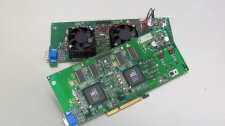
3dfx History and Voodoo 5: Retro special with brand-new benchmarks and insights
The history of 3dfx is unprecedented: Only four years passed between absolute market dominance from 1996 to 1998 and insolvency at the end of 2000. PC Games Hardware invites you to take a journey back in time - with brand-new insights, comprehensive benchmarks and more than one surprise. Curious?
Special Add as a preferred source on Google
On this page
- 1 Millennium problems
- 2 Plan vs. reality - 0:1
- 3 Hardware T&L: Hen or egg?
- 4 Voodoo meets 2017: From the idea to reality
- 5 Voodoo meets 2017: The infrastructure
- 6 Tests from 1999 to 2005
- 7 Benchmarks: Settings ...
- 8 ... and results
- 9 Benchmark analysis
- 10 3dfx History: Conclusion
- 11 Interview: Oscar Barea alias "osckhar"
While there is no doubt that 3dfx was a pioneer of nice and fluid 3D worlds on the PC, people are still arguing about which factors actually caused the rapid fall of the company, or how this could have been prevented. Don't worry, this isn't another of the well-known "Everything was better in the past" articles that sing about the gold rush times of the 3D accelerators - well, most of this article. This retro special is designed to broaden your horizon with information that never existed in this form before. Look forward to very special, completely new benchmarks and analysis which we have created with the help of extensive research and together with the remaining 3dfx community. But first of all, however, a review is needed that explains the context and lets young readers find their way into the topic.
Disclaimer on the translation: Since English isn't our native tongue, please look generously over "bumpy" sentences. Most of the text was translated from German to English with the help of www.DeepL.com/Translator. You can find the original article here.
Millennium problems
Things didn't go as planned. In November 1999, 3dfx presented the VSA-100 processor including the products Voodoo 4 4500, Voodoo 5 5000/5500 and Voodoo 5 6000 at Comdex in Las Vegas - an exposition comparable to today's CES - with a delay of several months. Everything looked good, but in fact it was just a nice marketing facade. 3dfx did not have any working silicon at that time, nor did it have any idea what would go wrong with the Voodoo Scalable Architecture (VSA, also known as "Napalm"). The plan at that time was to publish the first three products intended for the mass market in the first quarter of 2000 and to complete them two months later with the quad-chip battleship Voodoo 5 6000.
History teaches us that this didn't work out. The Voodoo 5 5500 was launched in spring of 2000 without the V4 and then was recalled because of late discovered problems. Finally, in June the time had come - many months after the initial planning. The epic delay caused the Voodoo 5 5500 to encounter a completely different market than expected, with other competitors. In 1999, the 3dfx card would have had to fight the first Geforce (256) - a battle that Nvidia would have come out with many injuries. In the middle of 2000, however, Nvidia had already released Geforce 2 GTS with almost doubled performance, accompanied with the price/performance champion Geforce 2 MX and the upcoming Geforce 2 Ultra.
But there still was the Voodoo 5 6000, which had the potential to pick up the performance crown in mid-2000. We're talking about a $600 graphics card, while the GF2 Ultra started from $500. As times change. Nvidia's current top dog Titan V costs $2,999, while the Geforce GTX 1080 is priced at $699. In the end, the V5 6000's ambitious four-chip design was doomed to failure, it was never released to the public. The tests later carried out on the prototypes - including our own - proved that the Voodoo 5 6000 was the most powerful graphics card for 32-bit color depth, high resolutions and anti-aliasing until 2001, but relies on a strong CPU.
 Source: PC Games Hardware
3dfx Voodoo 5 6000: She wouldn't have saved 3dfx. But she would've produced long benchmark bars until Rampage was finally ready.
Source: PC Games Hardware
3dfx Voodoo 5 6000: She wouldn't have saved 3dfx. But she would've produced long benchmark bars until Rampage was finally ready.
Plan vs. reality - 0:1
 Source: PC Games Hardware
The Napalm Data Book shows that 3dfx originally calculated with 200 MHz, which equals 200 Megapixel/s.
The Voodoo 5 5000, designed as a nice upgrade for PCI computers, also never left the prototype status. Meanwhile, the Voodoo 4 4500 with just a single VSA-100 could only compete with the Geforce 2 MX in games with Glide API.
Source: PC Games Hardware
The Napalm Data Book shows that 3dfx originally calculated with 200 MHz, which equals 200 Megapixel/s.
The Voodoo 5 5000, designed as a nice upgrade for PCI computers, also never left the prototype status. Meanwhile, the Voodoo 4 4500 with just a single VSA-100 could only compete with the Geforce 2 MX in games with Glide API.
Further research reveals what must have gone wrong with Napalm alias VSA-100. At the end of 1999, 3dfx stated that the V4 4500 - like the Voodoo 3 - would be able to work with passive cooling. Tests with Voodoo 3 coolers have shown that the VSA-100 becomes much hotter than its predecessor and that passive cooling is therefore impossible. A deep dive in the Napalm Data Book reveals what 3dfx originally had in mind: 200 MHz clock frequency at 2.5 volts core voltage. They got desastrous ~167 MHz at 2.9 volts in the end.
Hardware T&L: Hen or egg?
The hype topic of that time - Hardware T&L - further exacerbated 3dfx's situation. Introduced in 1999 with the first Geforce and expanded by Atis Radeon in 2000, the lack of a dedicated geometry unit did not cast a good light on the VSA series - this also would have been different in 1999. No one really knew the consequences and development of T&L games at that time, so there was a lot of speculation floating around. With this article, we are able to enrich the discussion about T&L with numerous facts.
For the younger readers: The abbreviation T&L stands for Transformation, Clipping and Lighting and describes dedicated arithmetic units within the graphics chip. The task is as simple as that: The game's polygons have to be moved in screenspace, their visibility has to be checked and they have to be illuminated in the end. This was a very FPU-heavy task of the main processor (floating-point calculations) in earlier games. But unlike CPU T&L, GPU T&L in Direct 3D only works after explicit implementation by game developers. In 2000, it gradually found its way in games. T&L-less graphics cards - like all Voodoos and Kyros - are heavily dependent on the processor before they can start rasterizing, and are therefore frequently found in the CPU limit. This disadvantage ceases with increased resolution, since GPU fill rate and memory capacity become more important then. 3dfx' successor generation Rampage alias Specter was supposed to introduce HTnL in 2001.
Voodoo meets 2017: From the idea to reality
We could write various books about 3dfx's history, but now it's time to face the present - at least in part. We have done our utmost to create brand-new benchmarks of classic graphics cards that show their full potential. You probably wonder why the hell these German freaks are testing graphics cards that have been released 17 years ago. "Because we can" is one possible answer. But there is more, a kind of curiosity. As mentioned above, the transition from classic CPU polygon computation to GPU transformation slowly began in 2000. While at that time it was only possible to speculate, we finally have the answer to the question: Can this disadvantage be compensated with the help of a very strong CPU?
But HTnL is only one discipline the classic graphics cards have to face. Hi-res gaming and the very demanding 32-bit color depth are important tests, too. Doing all this, special attention is given to a Voodoo 5 5500 AGP with doubled RAM capacity and high clock potential. 3dfx fans have found ways to refurbish the venerable hardware. Our card can work with up to 210 MHz - 26 percent more than standard cards. Remember: 200 MHz were targeted by 3dfx. This experiment shows the scaling behavior of the 3dfx-SLI architecture with increasing clock rate and provides nice and new results. But would it also have changed history?
 Source: PC Games Hardware
Voodoo 5 @ 128 MiB: front. The PCB lacks traces for the higher capacity SDR-SDRAM, so they have been put on using wires.
No commercially available VSA-100 graphics card has a clock frequency of 200 MHz, the stable range is between 175 and 185 MHz. In order to set ourselves apart from the standard clocks, which is 166.67 MHz for both core and memory, we used a modified Voodoo 5 5500 AGP. The mod was done by a loyal 3dfx fan and collector: Oscar Barea, better known as "osckhar". He is not only collecting all possible 3dfx prototypes and presenting them on his website, he is also improving them. Interested readers can find the interview with Oscar Barea and some pictures of his lab at the end of this article.
Source: PC Games Hardware
Voodoo 5 @ 128 MiB: front. The PCB lacks traces for the higher capacity SDR-SDRAM, so they have been put on using wires.
No commercially available VSA-100 graphics card has a clock frequency of 200 MHz, the stable range is between 175 and 185 MHz. In order to set ourselves apart from the standard clocks, which is 166.67 MHz for both core and memory, we used a modified Voodoo 5 5500 AGP. The mod was done by a loyal 3dfx fan and collector: Oscar Barea, better known as "osckhar". He is not only collecting all possible 3dfx prototypes and presenting them on his website, he is also improving them. Interested readers can find the interview with Oscar Barea and some pictures of his lab at the end of this article.
The mod was done with an ordinary Voodoo 5 5500 AGP. First, the two standard VSA-100 chips and 8 × 8 MiByte SDR-SDRAM were removed using a reflow machine and then later replaced with more powerful parts. The VSA-100's Revision 320 is also used on the Voodoo 5 6000 and allows higher frequencies than its predecessors. The new RAM consists of 8 × 16 (128 MiB), which means 64 MiB per chip - that's all the VSA-100 can address. Since the board lacks traces for operating 16-MiB chips, they were manually installed using wires. Last but not least, a resistor in the power supply ensures that the cores operate at 3.1 volts (standard: 2.9). In order to cool all this fancy stuff, we also replaced the weak standard coolers with two Titan CUV2AB.
Talking about 64 MiByte per chip, 3dfx actually had plans: the Voodoo 4 4800 and Voodoo 5 5800. This is why we named our overclocked mod card "V5 5900". It is unclear when these models were planned or which timeframe they should have been released. More exciting and largely under the radar of the public has remained that 3dfx has also worked on "Daytona" until they were laid off. Daytona's a shrink of the VSA-100 from 250 to 180 nm fabrication and with support for DDR-RAM. According to collectors, the rare prototypes of the Voodoo 4-2 4200 run extremely cool even without any heatsink. We assume that Daytona should have fed 3dfx' lowcost/OEM graphics channels in 2001 to complete the high-performance Specter portfolio - possibly also with 64 MiByte per chip.
Voodoo meets 2017: The infrastructure
Designed specifically for band-new retro benchmarks, our testing rig shows the performance of 2000's graphics cards without CPU limitation, as it achieves approximately three times the performance of contemporary high-end CPUs (like the Athlon Thunderbird 1 GHz). With this force in the back, previously unnoticed bottle necks become more recognizable. You will be amazed by some of the the results, promised!
 Source: PC Games Hardware
Our retro testing rig. The midi case is nearly 20 years old - this is how PC's looked at that time!
It's not easy to build the ultimate Voodoo PC. Fortunately, there is no "right" or "wrong". While many 3dfx fans like the idea of using venerable but special CPU's such as the Pentium 3 Tualatin, others strive for maximum performance. The main problem is the limited AGP capability of 3dfx chips: Except for the V4 4500 and rare V5 cards with AGP4× notch, Voodoo AGP cards require 3.3 volts. This means that AGP-3.0 chipsets such as the Nvidia nForce 2/3 or VIA KT600 can not be used at all. Difficulties get worse if a V5 6000 prototype should be used. This graphics card is a real diva and only works in a fraction of the potentially capable boards, sometimes there is even a risk of defects. But the 3dfx community has created compatibility lists that we have used. The Asrock M266A Rev. 3.0 combines all our desires: It is suitable for the CT-479 adapter to operate the powerful Pentium M "Dothan" (2M L2 cache). We use the model 765 because it has the highest multiplier of all Pentium M processors. Our final setting consists of 130 MHz FSB clock with a multiplier of 20, which results in 2.6 GHz. A Pentium 3 Tualatin would have to run at more than 3.5 GHz for comparable performance. The nice thing is that AGP 4× capable graphics cards can use the full feature set during benchmarking.
Source: PC Games Hardware
Our retro testing rig. The midi case is nearly 20 years old - this is how PC's looked at that time!
It's not easy to build the ultimate Voodoo PC. Fortunately, there is no "right" or "wrong". While many 3dfx fans like the idea of using venerable but special CPU's such as the Pentium 3 Tualatin, others strive for maximum performance. The main problem is the limited AGP capability of 3dfx chips: Except for the V4 4500 and rare V5 cards with AGP4× notch, Voodoo AGP cards require 3.3 volts. This means that AGP-3.0 chipsets such as the Nvidia nForce 2/3 or VIA KT600 can not be used at all. Difficulties get worse if a V5 6000 prototype should be used. This graphics card is a real diva and only works in a fraction of the potentially capable boards, sometimes there is even a risk of defects. But the 3dfx community has created compatibility lists that we have used. The Asrock M266A Rev. 3.0 combines all our desires: It is suitable for the CT-479 adapter to operate the powerful Pentium M "Dothan" (2M L2 cache). We use the model 765 because it has the highest multiplier of all Pentium M processors. Our final setting consists of 130 MHz FSB clock with a multiplier of 20, which results in 2.6 GHz. A Pentium 3 Tualatin would have to run at more than 3.5 GHz for comparable performance. The nice thing is that AGP 4× capable graphics cards can use the full feature set during benchmarking.
Originally we also wanted to deliver benchmark results of our Voodoo 5 6000 Rev. A-3700 with this article, but unfortunately the Napalm flagship turned out to be partly incompatible with the motherboard - no matter which application, the card locks up after a couple of time. Changing the drivers and AGP settings did not solve the problem. We will continue to work on possible solutions, but until then the V5 6000 is out of bounds.
Tests from 1999 to 2005
When it comes to benchmarks, we mix the then popular timedemos with modern measurements via Fraps - including frametimes that nobody had ever done in 2000. Timedemos are, as popular as they were at that time, only replays of the game and therefore not 100 % practical - but they are the only way to compare low-level interfaces such as 3dfx Glide with Direct3D and OpenGL. Most benchmarks are based on scenes from both contemporary and more recent games that have been evaluated by us specifically for this test. We have provided the titles with their release year and sorted them chronologically for the sake of clarity. All games from 2001 onwards appeared after the tested graphics cards, as well as the operating system Windows XP and the drivers used - we use the latest versions published by AMD and Nvidia. Looking at 3dfx, the situation is different: The company closed its doors nine months before the release of Windows XP and has therefore never released suitable drivers. The fact that XP is the best choice for playing newer games on a Voodoo is due solely to fans - first and foremost to the British "SFFT", who worked on the driver of the same name until the end of 2011. His working basis is the source code of 3dfx's Windows 2000 driver, which has reached the Internet many years ago.
As far as the tested GPU's are concerned, we are presenting the Who-is-who of the year 2000. Unlike today, 17 years ago we were not talking about "Radeon vs. Geforce", but "Voodoo vs. Geforce". Ati, now the graphics division of AMD, wasn't recognized as a real alternative at that time, despite the advanced Radeon. This should change with 3dfx's demise. The legendary R300, which was realeased 15 years ago, ultimately set Ati's title as "the new 3dfx". We pay tribute to this development and have also benchmarked the first Radeon with DDR memory.
| Model | Voodoo 5 6000 | „Voodoo 5 5900“ | Voodoo 5 5500 | Voodoo 4 4500 | Geforce 2 Ultra | Geforce 2 GTS | Geforce 2 MX | Radeon 32 MB DDR |
|---|---|---|---|---|---|---|---|---|
| Vendor | 3dfx | 3dfx | 3dfx | 3dfx | Nvidia | Nvidia | Nvidia | ATI |
| Fabrication in nm (foundry) | 250 (TSMC) | 250 (TSMC) | 250 (TSMC) | 250 (TSMC) | 180 (TSMC) | 180 (TSMC) | 180 (TSMC) | 180 (TSMC) |
| GPU('s) | 4 × VSA-100 | 2 × VSA-100 | 2 × VSA-100 | 1 × VSA-100 | NV15(BR) | NV15 | NV11 | R100 („Rage 6“) |
| Core clock (MHz) | 183 | 210 | 167 | 167 | 250 | 200 | 175 | 164 |
| RAM clock (MHz) | 183 | 210 | 167 | 167 | 460 (effective) | 333 (effective) | 166 | 328 (effective) |
| Fillrate (Mtexel/s) | 1.464 | 840 | 666 | 333 | 2.000 | 1.600 | 700 | 984 |
| RAM interface (Bit) | 4 × 128 | 2 × 128 | 2 × 128 | 128 | 128 | 128 | 128 | 128 |
| RAM bandwidth (MB/s) | 11.712 | 6.720 | 5.333 | 2.667 | 7.360 | 5.328 | 2.656 | 5.248 |
| RAM capacity/-type | 4 × 32 (128) MiB SDR-SDRAM | 2 × 64 (128) MiB SDR-SDRAM | 2 × 32 (64) MiB SDR-SDRAM | 32 MiByte SDR-SDRAM | 64 MiByte DDR-SDRAM | 32 MiByte DDR-SDRAM | 32 MiByte SDR-SDRAM | 32 MiByte DDR-SGRAM |
| AGP capability | AGP 2× (PCI66 = AGP 1× internally) | AGP 2× (PCI66 = AGP 1× internally) | AGP 2× (PCI66 = AGP 1× internally) | AGP 4× | AGP 4× | AGP 4× | AGP 4× | AGP 4× |
| Hardware T&L | No | No | No | No | Yes | Yes | Yes | Yes |
| Special features | Never released, up to 8× SGSSAA | PCGH simulation, not an official 3dfx product | Up to 4×SGSSAA | 2× SGSSAA | Up to 4× OGSSAA and 2:1 AF | Up to 4× OGSSAA and 2:1 AF | Up to 4× OGSSAA and 2:1 AF | „Hyper-Z“ (bandwidth optimization) |
Notes: 3dfx's initial plans for the VSA-100 (Codename "Napalm") were 200 MHz at 2.5 volts - 166,67 MHz at 2.9 volts is what they got in the end. Now we have 210 MHz at 3.1 volts.
Benchmarks: Settings ...
In 2000, pixels looked different. While today we are raving about Ultra-HD and HDR most of the players looked at a CRT screen and played with 16 bit color depth. 32 bit was, despite the hype started by Nvidia in 1998, a very expensive fun: The frame rate in the same resolution broke down by 30 to 50 percent - and if not, a CPU limit prevailed. In most games, the optical gain was disproportionate, especially for Voodoo users, who were less affected by rounding error artifacts than others thanks to the 22-bit filter.
It can be said that 1.600 × 1.200 with 32 bit color depth was the Ultra HD at the turn of the millennium. Only the fastest graphics cards achieved playable frame rates. We garnish this top-of-the-range pixel class with resolutions of 1.024 × 768 and - for high-fps gamers - 640 × 480 with a color depth that makes sense depending on the game. In a few cases we had to deviate slightly from these standards due to unselectable resolutions or active frame limits. This also applies to the clock rate of the modified V5 5500: Depending on the game, 205 or 210 MHz can be used.
... and results
Note that you can choose three resolutions from the drop-down menu on the left side of the benchmarks for each of the games. Only in the case of Flatout, which is very demanding for the venerable cards, we have refrained from more demanding settings (only two resolutions). First of all, we hope you enjoy browsing through the results since dynamic benchmarks for retro cards have never been available before. The analysis will follow.
 Source: PC Games Hardware
Frametimes in Max Payne 2 and UT2004 (taken from the German printed magazine PCGH 03/2017)
Source: PC Games Hardware
Frametimes in Max Payne 2 and UT2004 (taken from the German printed magazine PCGH 03/2017)
Benchmark analysis
The wide range of games and the dramatically changed requirements over the years have produced exciting results. To get a better understanding of the numbers, you should know some detail about VSA-100 boards. A Voodoo 5 5500 offers exactly twice the raw power of a V4 4500 and should therefore always be twice as fast. If this is not the case, the framerate depends on other limits. However, the V5 6000 provides 2.2 times as much power as the V5 5500 and therefore also declassifies our 210 MHz version.
Let's start with the 3dfx playground (years 1999 and 2000). The overclocked Voodoo 5 AGP shows some excellent scaling from 1.024 × 768, in some cases it is even (reproducible) 27 percent faster than the reference card. The old games don't show any advantage with 64 MiByte per GPU, but the Geforce 2 GTS is no longer a problem with this clock rate. Looking at the Voodoo 4 4500 AGP, this card could also use 200+ MHz in order to compete with the Geforce 2 MX outside of Glide-powered games. Speaking of which, games based on the Unreal engine show impressively what close-to-the-metal-programming already brought at that time. Vulkan and DirectX 12 walk on this path.
 Source: PC Games Hardware
Giants (shot from the benchmark sequence): One of the best-looking games in 2001. We're using a savegame and Fraps to get the results.
Sacrifice, the first serious showcase for HTnL, draws a completely different picture. In 640 × 480 all Voodoos get the same results, which looks like a CPU bottleneck at first. Further PCGH benchmarks have shown that this is in fact an AGP limit. The reason for this is the SLI circuitry of the Voodoo 5 cards: To get two or four VSA-100 processors work together, they must communicate with each other. The data path between them uses the PCI66 protocol, which corresponds to AGP1×. This means that although a Voodoo 5 AGP works with AGP2× towards the motherboard, only half the transfer rate is available internally. The powerful CPU in our testing rig can prepare the polygon data fast enough, but it remains stuck "in front" of the (Voodoo) graphics card. GPUs with Hardware T&L avoid this bottleneck, as they do all the work within the GPU and keep it in their vertex cache.
Source: PC Games Hardware
Giants (shot from the benchmark sequence): One of the best-looking games in 2001. We're using a savegame and Fraps to get the results.
Sacrifice, the first serious showcase for HTnL, draws a completely different picture. In 640 × 480 all Voodoos get the same results, which looks like a CPU bottleneck at first. Further PCGH benchmarks have shown that this is in fact an AGP limit. The reason for this is the SLI circuitry of the Voodoo 5 cards: To get two or four VSA-100 processors work together, they must communicate with each other. The data path between them uses the PCI66 protocol, which corresponds to AGP1×. This means that although a Voodoo 5 AGP works with AGP2× towards the motherboard, only half the transfer rate is available internally. The powerful CPU in our testing rig can prepare the polygon data fast enough, but it remains stuck "in front" of the (Voodoo) graphics card. GPUs with Hardware T&L avoid this bottleneck, as they do all the work within the GPU and keep it in their vertex cache.
Giants, which is still a beautiful game, requires both polygon power and memory transfer rate for the 32-bit color depth used in our testing. The latter is the great weakness of the Geforce 2 series, so that the overclocked Voodoo 5 (relatively) performs better with increasing resolution. The same goes for Max Payne 2, where the Voodoo 5 boards are unexpectedly fast. In 1.600 × 1.200, the tweaked Voodoo 5 AGP can almost compete with the expensive Geforce 2 Ultra. And what's even more surprising, the memory upgrade helps to keep the frame rate high. Another surprise opens up in UT2004: Although all Voodoo's min-fps are fully AGP-limited (yes, again), the performance looks good. We suspect that the engine is causing a lot of data traffic, so that the Geforce 2 chips starve to death at their memory bandwidth.
Dungeon Siege 2, the latest game in the test, tops everything else: The Voodoo 4 4500 is faster than any Voodoo 5! This is due to its ability to handle real AGP4×. The game is so tuned for HTnL that neither the Geforce 2 GTS nor the Radeon DDR are in reach for the Voodoos - it's playable anyway.
Stagnant driver development
What we don't know is how the stalled Voodoo driver development affects the performance of the newer games. Although SFFT and other fans have implemented improvements in the drivers, this does not replace many years of a driver team's work. Just before the end, 3dfx has integrated some interesting experiments in their latest beta drivers. There is an option called "Geometry Assist", which pretends the existence of Hardware T&L to applications. The then popular 3DMark versions 2000 and 2001 run much better with this option turned on. Possibly, 3dfx would have found a way to extend this trick to some games. In the unfinished version, however, the feature is unstable.
In addition, with "Hidden Surface Removal" (HSR) another experimental switch was introduced in the last 3dfx drivers, which tries to imitate a modern feature in software (only for Glide and OpenGL): In modern GPU's, a depth check clarifies which polygons in the final image are covered by others (overdraw), and discards them prematurely. Of course, this function can't do the trick like a tile-based deferred renderer, like the Kyro, but it points into this direction. The idea of avoiding work, which in the end will be discarded anyway, should come later in 3dfx hardware, using the acquired Gigapixel technology. The software HSR in 3dfx's drivers was configurable from "conservative" to "aggressive" and looked promising in contemporary tests - at least the lower settings. The high levels regularly surpassed the target, so that parts of the scene were missing and the frame rate became choppy. However, the low settings could actually increase the frame rate without visible problems. Unfortunately, we will never know what HSR and Geometry Assist would have looked like in a mature form.
AGP versus PCI
The pronounced AGP limit of Voodoo boards was by no means foreseeable in 2000, although contemporary tests criticized 3dfx's incomplete AGP implementation. In retrospect, it is interesting to note that benchmarks at that time showed only minimal differences between AGP and otherwise identical PCI graphics cards such as the V3 3000 or V5 5500. This was due on the one hand to the less demanding games (less data and especially polygons), but on the other hand to the predominant processor limits. The bottleneck PCI was masked - time to look at the results without other limits.
| Mode | Frequency | Bandwidth |
|---|---|---|
| PCI | 33 MHz | 133 MByte/s |
| AGP 1× | 66 MHz | 266 MByte/s |
| AGP 2× | 66 MHz | 533 MByte/s |
| AGP 4× | 66 MHz | 1.066 MByte/s |
| AGP 8× | 66 MHz | 2.133 MByte/s |
Notes: The VSA-100's on all Voodoo 5 cards communicate with AGP1× speed internally - a tight bottleneck.
Our powerful - you could also say "imba" - infrastructure generates so much pressure from below that there are no other limits than the graphics card or its interface. While the differences between Voodoo 5 AGP and Voodoo 5 PCI are small in 1999's games (Descent 3 & Expendable), the much more polygon-heavy titles of the year 2000 are already starting to fall apart. In Alice, the V5 5500 AGP is up to 25 percent faster than the PCI version. Increasing resolution naturally shrinks the distance, but in this case the AGP card is still nine percent faster even in 1.600 × 1.200. In FAKK2, which also uses the Quake 3 engine but lacks the detail textures, the difference amounts to a maximum of 22 percent, while in NFS Porsche the difference is five percent. Last, but not least, please excuse the "Famous Wiking game" instead of the real name - German authorities put the bloody Unreal engine game on their blacklist to protect the youth. Speaking of funny things: The Voodoo 3 3500 is actually faster than the Voodoo 5 PCI (and every Geforce 2)! And the Voodoo 5 AGP is 30 percent faster than the PCI version.
But the year 2000 was only foreplay. The problems which cause a V5 5500 AGP to fall behind a V4 4500 AGP4× are nothing if compared with the V5 PCI. In Sacrifice, a V5 AGP renders up to 54 percent more fps than its PCI sister. The difference is about 36 percent in Max Payne, 41 percent in Dungeon Siege 2, about 52 percent in UT2004 and even 57 percent in Flatout. These values confirm and extend older tests, like here at Voodooalert.de: AGP vs. PCI: Voodoo4 4500 and PCI-Overclocking - Voodoo5. Those who can should therefore make use of overclocking of the AGP/PCI. Depending on the mainboard and hardware configuration, gigantic profits can be made here. Attention, AGP overclocking is strongly discouraged when using a Voodoo 5 6000!
3dfx History: Conclusion
We've come to the end of the time travel, countless benchmarks and many surprises behind us. But what can we learn from all this? For one thing, life isn't running according to plans. Let's assume that 3dfx's Napalm graphics cards (Voodoo 4/5) would have been released six months earlier with higher clocks and together with the V5 6000. Certainly the story would have been a bit different, because Nvidia's superiority would have been limited to a handful of T&L games. 3dfx could have maintained its supremacy over Glide and scored with useful features such as Sparse Grid SSAA and the 22-bit post filter. These functions also existed in reality, but with less performance and therefore not useful for everyone.
2001 would have been much more exciting with 3dfx still in business. After all we know about Rampage, the top model Specter 3000 would have become as strong as the Geforce 4 Ti - and this GPU was released in 2002, so Nvidia's delayed Geforce 3 would have been an easy target for 3dfx. However, it is also relatively certain that 3dfx would have had no chance against Atis R300, which was released later in autumn 2002. Meanwhile, it is unclear what the quality of Rampage's SLI scaling would have been like, because in times of hardware transformation new challenges came up on hardware and software. The days of the proprietary Glide API were also numbered - Direct3D had established itself due to its versatility. At this point, reality is catching up with us again. In an interesting interview in 2013, the former 3dfx management admitted self-critically that one should have surrendered sooner or later to the ambitious Nvidia - it was sooner, as we all know.
Everything else is history. We hope you had as much fun with the journey through time as we had when we put it together. In the gallery we have accommodated numerous additional pictures with further information for interested readers. Your feedback is highly welcome! Last but not least, we would like to thank the 3dfx fans all over the world - without your enthusiasm this article would not have been possible or even useful.
Bildergalerie
Interview: Oscar Barea alias "osckhar"
 Source: www.3dfx.es
Oscar Barea with his Rampage (Specter 1000)
For this article we were supported by a dedicated 3dfx fan and modder. He answered our questions in the interview below. Pictures from osckhar's laboratory can be found in the picture gallery
Source: www.3dfx.es
Oscar Barea with his Rampage (Specter 1000)
For this article we were supported by a dedicated 3dfx fan and modder. He answered our questions in the interview below. Pictures from osckhar's laboratory can be found in the picture gallery
➤ Hello! Good to have you here. Please introduce yourself to our readers.
Oscar: My name is Oscar aka osckhar inside the 3Dfx world. I am from Spain. My big passion for 3Dfx led me to initially collect all kinds of 3Dfx cards. Later I decided to leave the commercial cards and focus exclusively on prototypes with the only idea of creating my own online museum based on lab cards. You can find it on www.3Dfx.es.
➤ When did your passion for 3dfx start?
Oscar: My passion for 3Dfx began in 1999 while watching an advertising spot of the Voodoo3. When I saw the green box I felt in love and bought my first Voodoo3 3000 AGP - I still have it! When 3Dfx closed doors in early 2001 and the Voodoo5-6000 prototypes appeared on the scene, my obsession became to being owner of one of them. This is where I started collecting. I can say with pride that my prototype collection is one of the greatest worldwide.
➤ In the 3dfx community, you are not only known as collector, but also as avid modder. How come? Which mods can you do and do you have a special place/lab/gear to do them?
Oscar: In my free time I started to work in a small company that was dedicated to reflows, reballing of consoles, repairs of laptops et cetera. Once there, I got experience and knowledge that little by little was applied to the 3Dfx cards. My initial idea was to get enough knowledge for fixing my own prototypes, especially Voodoo5 6000's, since I did not want to depend from other people. What started as a game over the years makes you one of the world's leading mods and repairers of all types of 3Dfx cards (Voodoo5 6000, Daytonas, Rampage). An example, for Rampage reworks check this site. Speaking of mods within the 3Dfx world, the pioneer is a user named komponent. He showed us the way. We can say that he was my inspiration.
I have a lab equipped with BGA rework machines, reballing (welding by IR or Hot Air) welders of all kinds, specialized in micro welding SMD components. Having this, I offer any kind of 3Dfx modification on eBay, like memory upgrades for V4 & V5 AGP/PCI from 64 to 128 MB (TSOP SDRAM from 6 ns to 5/4/3.5 ns), jumpers to set capacities of 16/32/64/128 MB on fly or voltage mods up to 3,2 volts. I also offer an AGP riser built by me that converts AGP1× to AGP 4x (3.3V to 1.5V) so that AGP 2.0 cards like to Voodoo5 AGP work on AGP4× motherboards [editor's note: still with 1× speed, of course]. I also offer to replace VSA-100 chips on standard V4/5 cards with the 3rd revision which is used on the V5-6000. According to Hank Semenec [editor's note: ex-engineer at 3Dfx and father of the V5 6000's PCI rework], this revision is able to operate at speeds higher than 200 MHz.
I also offer repairs of any V5-6000, having had different customers from Germany, Romania, France and Spain. If I don't manage to get the card repaired, you get the money back. I also offer an AGP2PCI adapter and other material.
➤ Great! What are you currently working on?
Oscar: I am currently working on a PCIe2AGP adapter for 3Dfx cards that will see the light of day soon. This adapter will allow us to use a Voodoo AGP card on a current-generation motherboard through the PCI Express interface. One of the most exciting mods is a request of an Italian guy who contacted my services: the modification of a V5-6000 from 128 (4× 32) to 256 MB (4× 64). The mod has already been tested and works, I only need to polish some details. It will be the first V5-6000 with 256 MB!
➤ Rampage is a huge topic. A real myth that can be uncovered. Can you tell us a bit more about the progress and people involved?
Oscar: Yes, the word Rampage became an obsession for me. For many years I focused all my time and effort on contacting ex-3Dfx engineers in search of the legendary Rampage and after many sleepless nights I can proudly say that I currently own 2 fully functional copies of the Specter 1000 [editor's note: 1× Rampage GPU, no SAGE geometry engine]. Although there are so few owners of the Specter 1000, no one had the idea of building a team - each owner with their material and contacts has worked independently. That turned out to be a big mistake. Nevertheless, great progress has been made since the modification of the RAM from 16 to 32/64 MB and the modification of the GPU/RAM speed and timings. Now we can say that there is a driver totally stable and compatible with many famous games of the 3Dfx time. Unfortunately, the project is on hold because without the necessary documentation of Rampage's registers for the driver modification we can't continue. Everything humanly possible has been done.
➤ Anything else that you want to tell us?
Oscar: There is a lot of history behind all these years in search of prototypes. If people are interested I can contribute with photos, anecdotes and material yet unseen.
➤ Thank you very much, Oscar!
 Source: www.3dfx.es
osckhar's lab #1
Source: www.3dfx.es
osckhar's lab #1